OCR · GCSE · History
Course version: J410 · Version from Mar 2026
The People and the State (J410/05) - Growing resistance and repression…
Full specification wording
South Africa 1960–1994: The People and the State (J410/05) - Growing resistance and repression c.1970s: The further development of resistance: the Black Consciousness Movement, SASO, women’s groups, trade unions including the Durban workers’ strike 1973 and young people, including the Soweto students’ uprising 1976; the ANC in exile; the international Anti-Apartheid Movement; the impact of resistance on the Apartheid regime; the response of the regime to resistance.
This topic traces how resistance to apartheid widened in the 1970s.
Checked against the OCR J410 specification (opens in a new tab) on .
- 3 key terms
Study notes
From the checked teaching notes for this specification point.
The idea
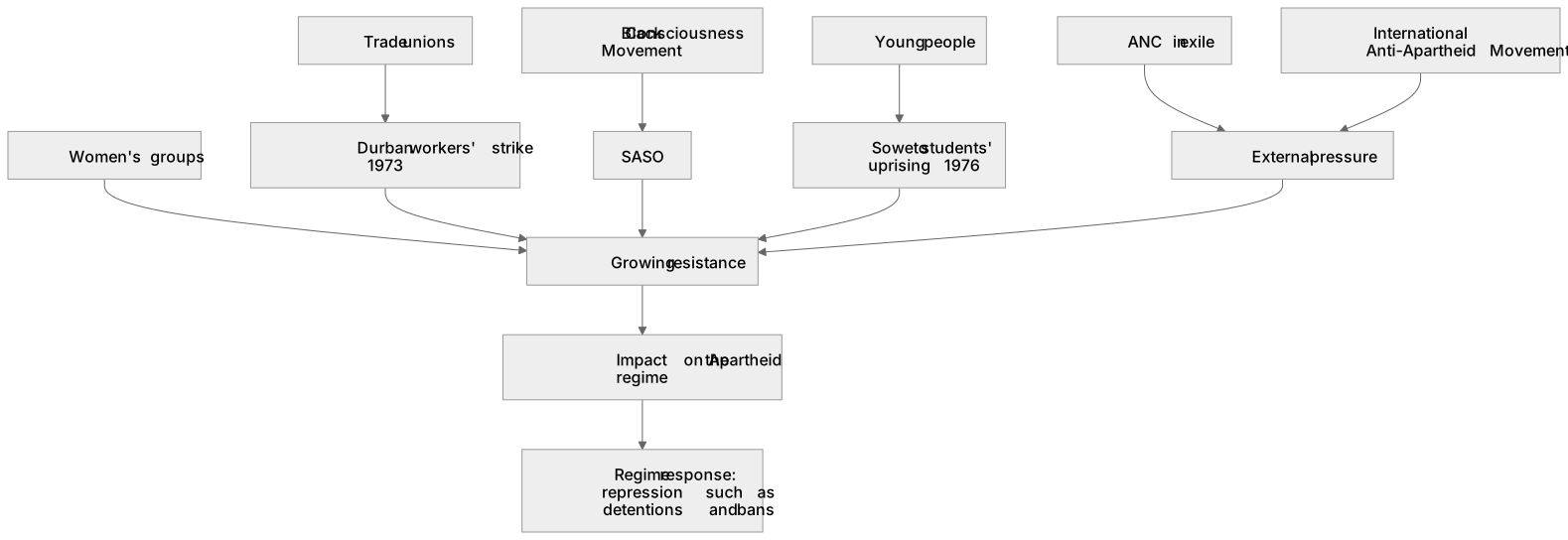
This topic traces how resistance to apartheid widened in the 1970s. The Black Consciousness Movement, led by Steve Biko, urged Black South Africans to reclaim psychological and political confidence, and SASO organised Black students on university campuses. Women's groups, such as the Black Women's Federation, mobilised around community and welfare issues. Trade unions grew into a powerful force, shown by the Durban workers' strike of 1973, when thousands of African workers struck over pay and conditions. Young people became central, above all in the Soweto students' uprising of 1976 against the use of Afrikaans in schools. Meanwhile the ANC operated in exile, and the international Anti-Apartheid Movement campaigned abroad for boycotts and sanctions. Together these pressures affected the apartheid regime, which responded with repression such as detentions and bans.
What earns the marks
- Identifies the Black Consciousness Movement and SASO as forms of Black-led resistance in the 1970s.
- Explains that the Durban workers' strike of 1973 showed the growing strength of trade unions.
- Describes the Soweto students' uprising of 1976 as resistance by young people against Afrikaans in schools.
- Links the ANC in exile and the international Anti-Apartheid Movement to external pressure on the regime.
- Explains how resistance affected the apartheid regime and how the regime responded with repression.
Common mistakes and how to put them right
Confuses the Black Consciousness Movement with the ANC.
Put it right: Keep them as distinct organisations with different methods.
Places the Soweto uprising in the wrong year.
Put it right: State 1976 accurately.
Treats the Durban workers' strike as a student protest.
Put it right: Describe it as a strike by African workers over pay and conditions.
Exam tips
- Read the question stem carefully to spot which form of resistance or which response is being asked about.
- Eliminate options that give the wrong date or the wrong organisation before choosing.
- Check that the chosen option links resistance to its impact or to the regime's response, not just a name.
Try the lesson
The start of the South Africa 1960–1994: The People and the State (J410/05) - Growing resistance and repression c.1970s: The further development of resistance: the Black Consciousness Movement, SASO, women’s groups, trade unions including the Durban workers’ strike 1973 and young people, including the Soweto students’ uprising 1976; the ANC in exile; the international Anti-Apartheid Movement; the impact of resistance on the Apartheid regime; the response of the regime to resistance. lesson, made from checked teaching notes for this specification point.
Have a go first
After it was banned inside South Africa, from where did the African National Congress continue to organise resistance in the 1970s?
Listen
This topic traces how resistance to apartheid widened in the 1970s. The Black Consciousness Movement, led by Steve Biko, urged Black South Africans to reclaim psychological and political confidence, and SASO organised Black students on university campuses. Women's groups, such as the Black Women's Federation, mobilised around community and welfare issues. Trade unions grew into a powerful force, shown by the Durban workers' strike of 1973, when thousands of African workers struck over pay and conditions. Young people became central, above all in the Soweto students' uprising of 1976 against the use of Afrikaans in schools. Meanwhile the ANC operated in exile, and the international Anti-Apartheid Movement campaigned abroad for boycotts and sanctions. Together these pressures affected the apartheid regime, which responded with repression such as detentions and bans. A strong answer earns marks for these points. Identifies the Black Consciousness Movement and SASO as forms of Black-led resistance in the 1970s. Explains that the Durban workers' strike of 1973 showed the growing strength of trade unions. Describes the Soweto students' uprising of 1976 as resistance by young people against Afrikaans in schools. Links the ANC in exile and the international Anti-Apartheid Movement to external pressure on the regime. Exam tip: Read the question stem carefully to spot which form of resistance or which response is being asked about.
See it
Key words
Say what each word means before you turn the card.
Black Consciousness and SASO
Try answering aloud or in your head before turning the card.
Trade unions and the Durban strike 1973
Try answering aloud or in your head before turning the card.
Youth resistance and the Soweto uprising 1976
Try answering aloud or in your head before turning the card.
See every definition
- Black Consciousness and SASO
- A movement led by Steve Biko that urged Black South Africans to reclaim psychological and political confidence, while SASO organised Black students on university campuses.
- Trade unions and the Durban strike 1973
- Trade unions grew into a powerful force, shown when thousands of African workers struck over pay and conditions.
- Youth resistance and the Soweto uprising 1976
- Young people became central, above all in the students' uprising against the use of Afrikaans in schools.
Label the diagram
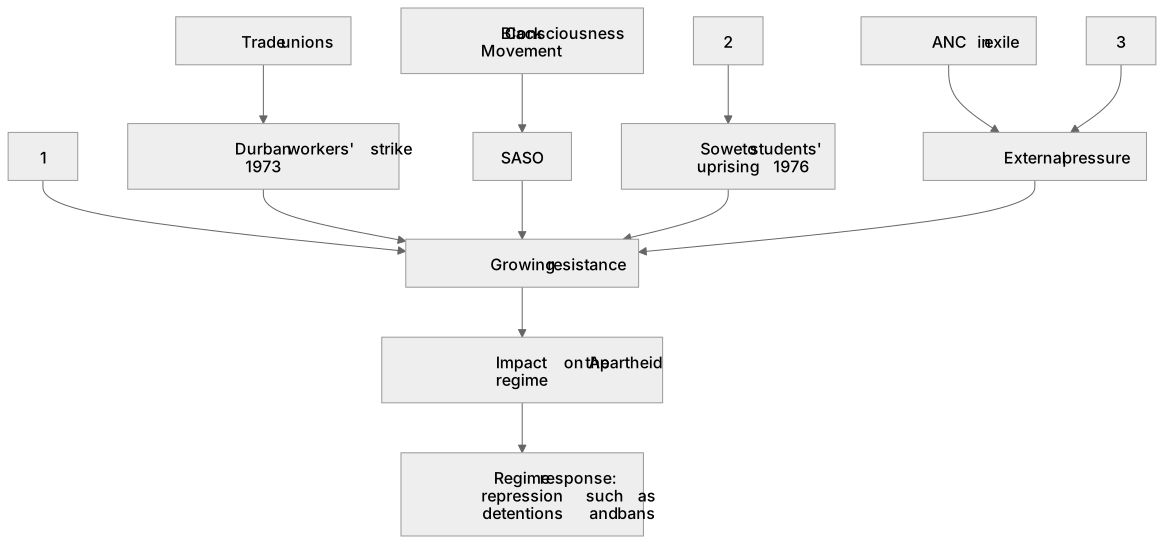
Some boxes have lost their names. Pick the right name for each number.
1Box 1
2Box 2
3Box 3
There is more to this lesson
The full lesson goes on to check your understanding and help you earn the marks. Create a free account to carry on, with your progress saved.
A week of Premium from your first lesson · Then the free plan continues · No card, no charge
Test your understanding of South Africa 1960–1994: The People and the State (J410/05) - Growing resistance and repression c.1970s: The further development of resistance: the Black Consciousness Movement, SASO, women’s groups, trade unions including the Durban workers’ strike 1973 and young people, including the Soweto students’ uprising 1976; the ANC in exile; the international Anti-Apartheid Movement; the impact of resistance on the Apartheid regime; the response of the regime to resistance.
Active recall beats re-reading. Take an instant quiz now to test what you’ve learned and lock it into long-term memory.
A week of Premium from your first lesson · Then the free plan continues · No card, no charge