OCR · GCSE · History
Course version: J410 · Version from Mar 2026
The People and the State (J410/05) - Opposition to the Apartheid regime…
Full specification wording
South Africa 1960–1994: The People and the State (J410/05) - Opposition to the Apartheid regime c.1960s: The consolidation of Apartheid – Separate Development and the establishment of the Bantustans; nature and extent of support for Apartheid; methods used by government to maintain the Apartheid regime; the Sharpeville Massacre and its impact; reasons for, methods of and impact of different types of resistance to the Apartheid regime, including the ANC, continuing impact of the Freedom Charter and Umkhonto we Sizwe and Poqo; the Rivonia Trial 1964 and its consequences.
This topic examines how Apartheid was consolidated and resisted in the 1960s.
Checked against the OCR J410 specification (opens in a new tab) on .
- 4 key terms
Study notes
From the checked teaching notes for this specification point.
The idea
This topic examines how Apartheid was consolidated and resisted in the 1960s. Learn how Separate Development was organised and how the Bantustans were established as nominally self-governing homelands. Weigh the nature and extent of support for Apartheid among different groups. Study the methods government used to maintain the regime, such as legislation and policing. Examine the Sharpeville Massacre and its impact on opposition and international opinion. Compare reasons for, methods of and impact of different types of resistance, including the ANC, the continuing impact of the Freedom Charter, and the armed wings Umkhonto we Sizwe and Poqo. Finally, cover the Rivonia Trial of 1964 and its consequences for the leadership of resistance.
What earns the marks
- Explains the consolidation of Apartheid through Separate Development and the establishment of the Bantustans.
- Assesses the nature and extent of support for Apartheid among different groups.
- Describes the methods government used to maintain the Apartheid regime.
- Explains the Sharpeville Massacre and its impact on opposition and wider opinion.
- Compares reasons for, methods of and impact of resistance by the ANC, Umkhonto we Sizwe and Poqo.
- Explains the continuing impact of the Freedom Charter on resistance.
- Describes the Rivonia Trial of 1964 and its consequences for the resistance leadership.
Common mistakes and how to put them right
Treats the Bantustans as genuinely independent states.
Put it right: Describe them as part of Separate Development designed to deny shared citizenship.
Confuses Umkhonto we Sizwe with Poqo.
Put it right: Keep the ANC's armed wing distinct from the PAC-aligned movement.
Dates the Rivonia Trial outside 1964.
Put it right: Anchor it firmly in that year and its consequences.
Ignores the Freedom Charter's continuing impact.
Put it right: Link it to later resistance aims.
Exam tips
- Match each option to a named element such as Bantustans, Sharpeville or Rivonia before choosing.
- Eliminate options that misattribute armed wings to the wrong organisation.
- Check that an option covers the whole clause, for example both methods and impact of resistance.
- Use the date 1964 to test options about the Rivonia Trial and its consequences.
Try the lesson
The start of the South Africa 1960–1994: The People and the State (J410/05) - Opposition to the Apartheid regime c.1960s: The consolidation of Apartheid – Separate Development and the establishment of the Bantustans; nature and extent of support for Apartheid; methods used by government to maintain the Apartheid regime; the Sharpeville Massacre and its impact; reasons for, methods of and impact of different types of resistance to the Apartheid regime, including the ANC, continuing impact of the Freedom Charter and Umkhonto we Sizwe and Poqo; the Rivonia Trial 1964 and its consequences. lesson, made from checked teaching notes for this specification point.
Have a go first
Under the policy of Separate Development, what were the Bantustans intended to be?
Listen
This topic examines how Apartheid was consolidated and resisted in the 1960s. Learn how Separate Development was organised and how the Bantustans were established as nominally self-governing homelands. Weigh the nature and extent of support for Apartheid among different groups. Study the methods government used to maintain the regime, such as legislation and policing. Examine the Sharpeville Massacre and its impact on opposition and international opinion. Compare reasons for, methods of and impact of different types of resistance, including the ANC, the continuing impact of the Freedom Charter, and the armed wings Umkhonto we Sizwe and Poqo. Finally, cover the Rivonia Trial of 1964 and its consequences for the leadership of resistance. A strong answer earns marks for these points. Explains the consolidation of Apartheid through Separate Development and the establishment of the Bantustans. Assesses the nature and extent of support for Apartheid among different groups. Describes the methods government used to maintain the Apartheid regime. Explains the Sharpeville Massacre and its impact on opposition and wider opinion. Exam tip: Match each option to a named element such as Bantustans, Sharpeville or Rivonia before choosing.
See it
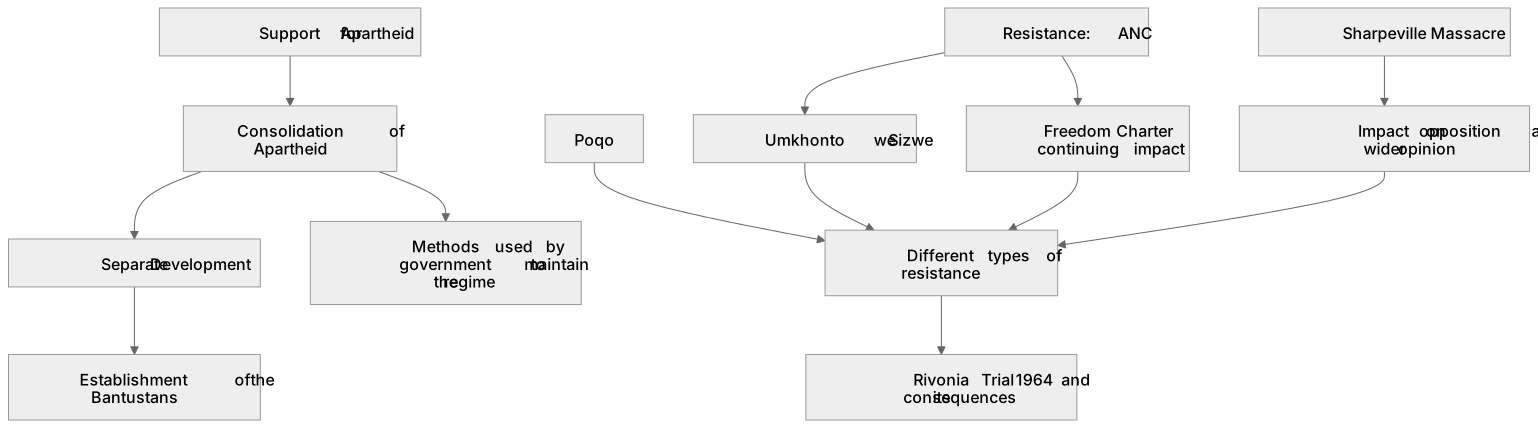
Key words
Say what each word means before you turn the card.
Consolidation of Apartheid
Try answering aloud or in your head before turning the card.
Separate Development and Bantustans
Try answering aloud or in your head before turning the card.
Sharpeville Massacre and its impact
Try answering aloud or in your head before turning the card.
Rivonia Trial and its consequences
Try answering aloud or in your head before turning the card.
See every definition
- Consolidation of Apartheid
- Separate Development and the establishment of the Bantustans formed part of this process.
- Separate Development and Bantustans
- Bantustans were established as nominally self-governing homelands under Separate Development.
- Sharpeville Massacre and its impact
- Its impact fell on opposition and international opinion.
- Rivonia Trial and its consequences
- The trial of 1964 had consequences for the leadership of resistance.
Label the diagram
Some boxes have lost their names. Pick the right name for each number.
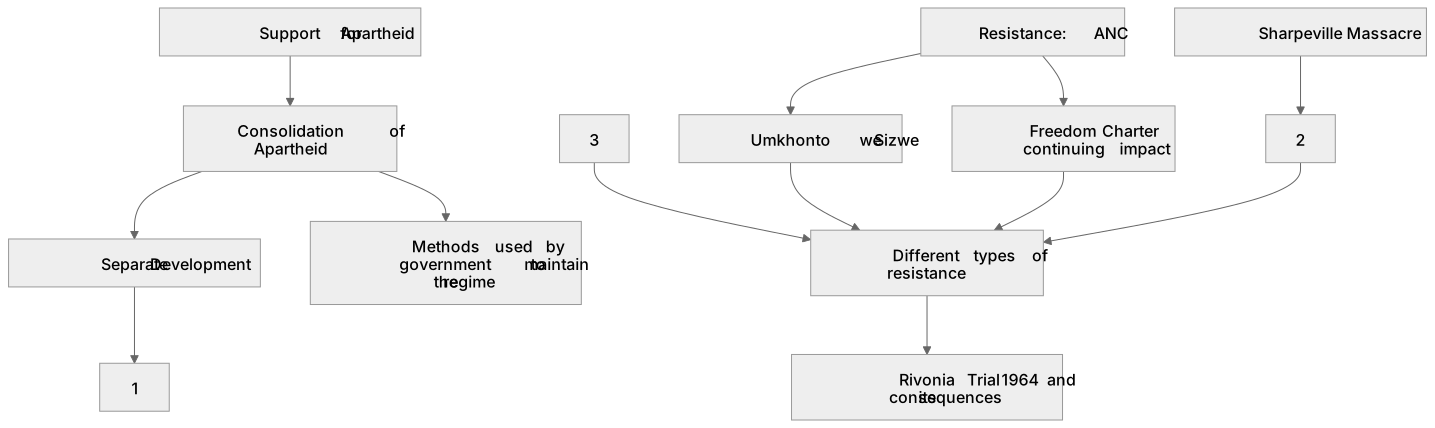
1Box 1
2Box 2
3Box 3
There is more to this lesson
The full lesson goes on to check your understanding and help you earn the marks. Create a free account to carry on, with your progress saved.
A week of Premium from your first lesson · Then the free plan continues · No card, no charge
Test your understanding of South Africa 1960–1994: The People and the State (J410/05) - Opposition to the Apartheid regime c.1960s: The consolidation of Apartheid – Separate Development and the establishment of the Bantustans; nature and extent of support for Apartheid; methods used by government to maintain the Apartheid regime; the Sharpeville Massacre and its impact; reasons for, methods of and impact of different types of resistance to the Apartheid regime, including the ANC, continuing impact of the Freedom Charter and Umkhonto we Sizwe and Poqo; the Rivonia Trial 1964 and its consequences.
Active recall beats re-reading. Take an instant quiz now to test what you’ve learned and lock it into long-term memory.
A week of Premium from your first lesson · Then the free plan continues · No card, no charge