OCR · GCSE · History
Course version: J410 · Version from Mar 2026
The People and the State (J410/05) - The collapse of apartheid…
Full specification wording
South Africa 1960–1994: The People and the State (J410/05) - The collapse of apartheid c.1980s–1994: Growing pressure on the regime, including the impact of sanctions, the United Democratic Front, the growth and impact of mass resistance; the growth of Inkatha, ‘civil war’ and the impact on Black communities; opposition to the 1983 constitution; the State of Emergency 1985–1990; divisions within the National Party government and the failure of ‘total strategy’, including the impact of the defeat at Cuito Cuanavale; the role of leading figures, including FW de Klerk, Ramaphosa and Mandela; negotiations between the government and the ANC; unbanning of the ANC, Pan African Congress and the South African Communist Party; the first free elections in 1994.
This topic explains how apartheid collapsed between the 1980s and 1994.
Checked against the OCR J410 specification (opens in a new tab) on .
- 3 key terms
Study notes
From the checked teaching notes for this specification point.
The idea
This topic explains how apartheid collapsed between the 1980s and 1994. Pressure on the regime grew through international sanctions and through the United Democratic Front, a broad coalition that coordinated mass resistance. The growth of Inkatha under Buthelezi contributed to violent 'civil war' that harmed Black communities. Many opposed the 1983 constitution, which excluded Black South Africans from the new parliament. The State of Emergency of 1985–1990 showed the regime's repression. Divisions grew within the National Party, and 'total strategy' failed, including after the defeat at Cuito Cuanavale. Leading figures such as FW de Klerk, Ramaphosa and Mandela shaped negotiations between the government and the ANC. The ANC, Pan African Congress and South African Communist Party were unbanned, leading to the first free elections in 1994.
What earns the marks
- Explains how sanctions and the United Democratic Front increased pressure on the regime.
- Describes the growth of Inkatha and the 'civil war' that affected Black communities.
- Identifies opposition to the 1983 constitution and the State of Emergency 1985–1990 as signs of crisis.
- Explains the failure of 'total strategy', including the impact of the defeat at Cuito Cuanavale.
- Links the roles of de Klerk, Ramaphosa and Mandela to negotiations and the unbanning of the ANC, PAC and SACP.
- Identifies the first free elections in 1994 as the outcome of the collapse of apartheid.
Common mistakes and how to put them right
Confuses the United Democratic Front with the ANC.
Put it right: Keep them as distinct organisations.
Places the first free elections in the wrong year.
Put it right: State 1994 accurately.
Treats the State of Emergency as ending in 1985.
Put it right: Give the range 1985–1990.
Exam tips
- Match each option to the correct organisation, date or figure before choosing.
- Eliminate options that misstate the year of an event such as the 1994 elections.
- Check that the chosen option explains pressure on the regime or a step towards its collapse.
Try the lesson
The start of the South Africa 1960–1994: The People and the State (J410/05) - The collapse of apartheid c.1980s–1994: Growing pressure on the regime, including the impact of sanctions, the United Democratic Front, the growth and impact of mass resistance; the growth of Inkatha, ‘civil war’ and the impact on Black communities; opposition to the 1983 constitution; the State of Emergency 1985–1990; divisions within the National Party government and the failure of ‘total strategy’, including the impact of the defeat at Cuito Cuanavale; the role of leading figures, including FW de Klerk, Ramaphosa and Mandela; negotiations between the government and the ANC; unbanning of the ANC, Pan African Congress and the South African Communist Party; the first free elections in 1994. lesson, made from checked teaching notes for this specification point.
Have a go first
In which year did South Africa hold its first free elections in which all races could vote?
Listen
This topic explains how apartheid collapsed between the 1980s and 1994. Pressure on the regime grew through international sanctions and through the United Democratic Front, a broad coalition that coordinated mass resistance. The growth of Inkatha under Buthelezi contributed to violent 'civil war' that harmed Black communities. Many opposed the 1983 constitution, which excluded Black South Africans from the new parliament. The State of Emergency of 1985–1990 showed the regime's repression. Divisions grew within the National Party, and 'total strategy' failed, including after the defeat at Cuito Cuanavale. Leading figures such as FW de Klerk, Ramaphosa and Mandela shaped negotiations between the government and the ANC. The ANC, Pan African Congress and South African Communist Party were unbanned, leading to the first free elections in 1994. A strong answer earns marks for these points. Explains how sanctions and the United Democratic Front increased pressure on the regime. Describes the growth of Inkatha and the 'civil war' that affected Black communities. Identifies opposition to the 1983 constitution and the State of Emergency 1985–1990 as signs of crisis. Explains the failure of 'total strategy', including the impact of the defeat at Cuito Cuanavale. Exam tip: Match each option to the correct organisation, date or figure before choosing.
See it
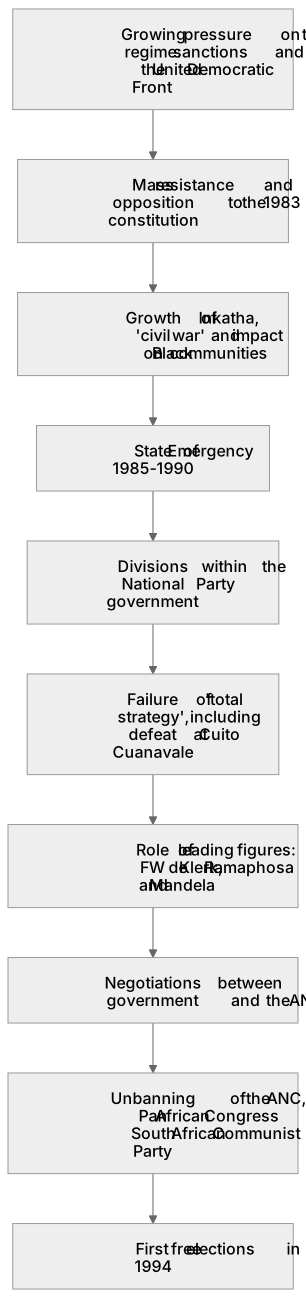
Put the events in order
Put these events in the order they happened, earliest first.
- 1. Opposition to the new constitution excluding Black South Africans
- 2. First free elections held as apartheid collapsed
- 3. State of Emergency imposed and maintained by the regime
Key words
Say what each word means before you turn the card.
Sanctions and the United Democratic Front
Try answering aloud or in your head before turning the card.
Inkatha, 'civil war' and impact on Black communities
Try answering aloud or in your head before turning the card.
Failure of 'total strategy' and Cuito Cuanavale
Try answering aloud or in your head before turning the card.
See every definition
- Sanctions and the United Democratic Front
- International sanctions and a broad coalition that coordinated mass resistance increased pressure on the regime.
- Inkatha, 'civil war' and impact on Black communities
- The growth of Inkatha under Buthelezi contributed to violent 'civil war' that harmed Black communities.
- Failure of 'total strategy' and Cuito Cuanavale
- Divisions grew within the National Party, and 'total strategy' failed, including after the defeat at Cuito Cuanavale.
Label the diagram
Some boxes have lost their names. Pick the right name for each number.
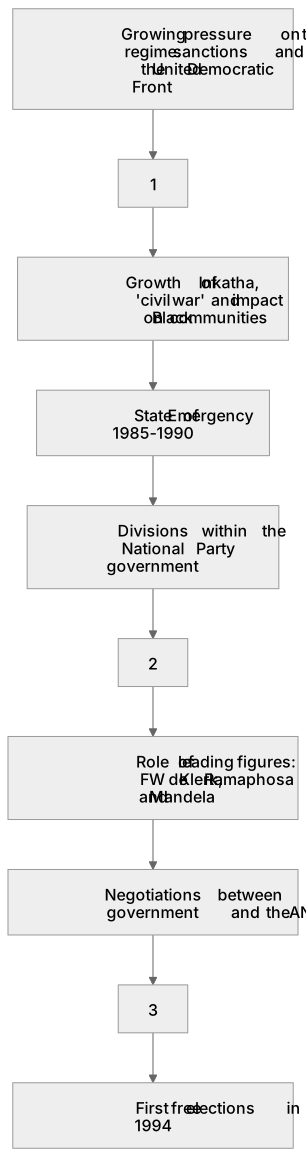
1Box 1
2Box 2
3Box 3
There is more to this lesson
The full lesson goes on to check your understanding and help you earn the marks. Create a free account to carry on, with your progress saved.
A week of Premium from your first lesson · Then the free plan continues · No card, no charge
Test your understanding of South Africa 1960–1994: The People and the State (J410/05) - The collapse of apartheid c.1980s–1994: Growing pressure on the regime, including the impact of sanctions, the United Democratic Front, the growth and impact of mass resistance; the growth of Inkatha, ‘civil war’ and the impact on Black communities; opposition to the 1983 constitution; the State of Emergency 1985–1990; divisions within the National Party government and the failure of ‘total strategy’, including the impact of the defeat at Cuito Cuanavale; the role of leading figures, including FW de Klerk, Ramaphosa and Mandela; negotiations between the government and the ANC; unbanning of the ANC, Pan African Congress and the South African Communist Party; the first free elections in 1994.
Active recall beats re-reading. Take an instant quiz now to test what you’ve learned and lock it into long-term memory.
A week of Premium from your first lesson · Then the free plan continues · No card, no charge