OCR · GCSE · History
Course version: J410 · Version from Mar 2026
Patterns of Migration (J410/11) - When immigrant groups arrived, why and…
Full specification wording
Urban Environments: Patterns of Migration (J410/11) - When immigrant groups arrived, why and from where: Where people migrated from and why.
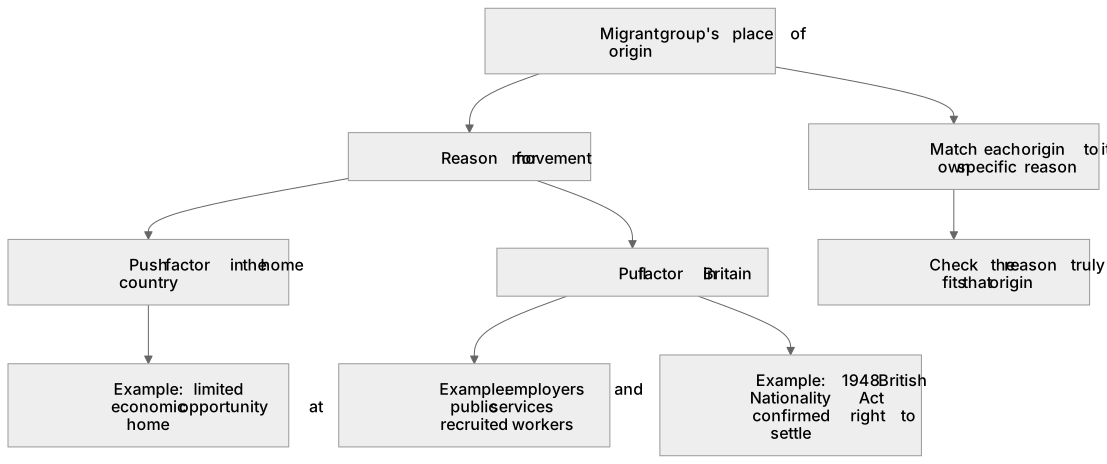
This topic asks you to link two things for each migrant group in the period you study: the place of origin and the reason for movement.
Checked against the OCR J410 specification (opens in a new tab) on .
- 4 key terms
Study notes
From the checked teaching notes for this specification point.
The idea
This topic asks you to link two things for each migrant group in the period you study: the place of origin and the reason for movement. A strong answer names a specific source country or region, then gives the push or pull factor that explains the move. For example, people arriving from the Caribbean in the decades after the Second World War came partly because British employers and public services recruited workers and because the 1948 British Nationality Act confirmed their right to settle, while limited economic opportunity at home acted as a push factor. Learn origins and causes as a matched pair, and be ready to choose the option that correctly joins a named origin to a valid reason rather than a plausible-sounding but mismatched one.
What earns the marks
- Names a specific country or region of origin and links it to a valid push or pull reason for migration.
- Distinguishes a push factor operating in the country of origin from a pull factor operating in Britain.
- Rejects an option that pairs a real origin with a reason belonging to a different migrant group.
- Identifies recruitment, legislation or economic hardship as a reason only where it genuinely applies to the named group.
Common mistakes and how to put them right
Treats every migrant group as sharing one single cause.
Put it right: Match each named origin to its own specific reason.
Confuses a push factor with a pull factor.
Put it right: State clearly whether the cause lay in the home country or in Britain.
Accepts an option because the country name looks familiar.
Put it right: Check that the stated reason actually fits that group.
Exam tips
- Read all options before choosing, because several may name real countries.
- Ask yourself for each option whether the reason truly belongs to that origin.
- Revise origins and reasons as paired facts so recall is quick under time pressure.
Try the lesson
The start of the Urban Environments: Patterns of Migration (J410/11) - When immigrant groups arrived, why and from where: Where people migrated from and why. lesson, made from checked teaching notes for this specification point.
Have a go first
In the 1950s and 1960s, many people moved to British cities from which region to fill labour shortages in transport and the NHS?
Listen
This topic asks you to link two things for each migrant group in the period you study: the place of origin and the reason for movement. A strong answer names a specific source country or region, then gives the push or pull factor that explains the move. For example, people arriving from the Caribbean in the decades after the Second World War came partly because British employers and public services recruited workers and because the 1948 British Nationality Act confirmed their right to settle, while limited economic opportunity at home acted as a push factor. Learn origins and causes as a matched pair, and be ready to choose the option that correctly joins a named origin to a valid reason rather than a plausible-sounding but mismatched one. A strong answer earns marks for these points. Names a specific country or region of origin and links it to a valid push or pull reason for migration. Distinguishes a push factor operating in the country of origin from a pull factor operating in Britain. Rejects an option that pairs a real origin with a reason belonging to a different migrant group. Identifies recruitment, legislation or economic hardship as a reason only where it genuinely applies to the named group. Exam tip: Read all options before choosing, because several may name real countries.
See it
Key words
Say what each word means before you turn the card.
Places of origin of migrant groups
Try answering aloud or in your head before turning the card.
Push and pull factors
Try answering aloud or in your head before turning the card.
Recruitment and legislation as causes
Try answering aloud or in your head before turning the card.
Economic hardship as a cause
Try answering aloud or in your head before turning the card.
See every definition
- Places of origin of migrant groups
- The specific country or region from which a named migrant group came, which must be linked to a valid reason for migration.
- Push and pull factors
- A push factor operates in the country of origin, while a pull factor operates in Britain; state clearly which side the cause lay on.
- Recruitment and legislation as causes
- Reasons for migration that must be identified only where they genuinely apply to the named group.
- Economic hardship as a cause
- A reason for migration that must be identified only where it genuinely applies to the named group.
Label the diagram
Some boxes have lost their names. Pick the right name for each number.
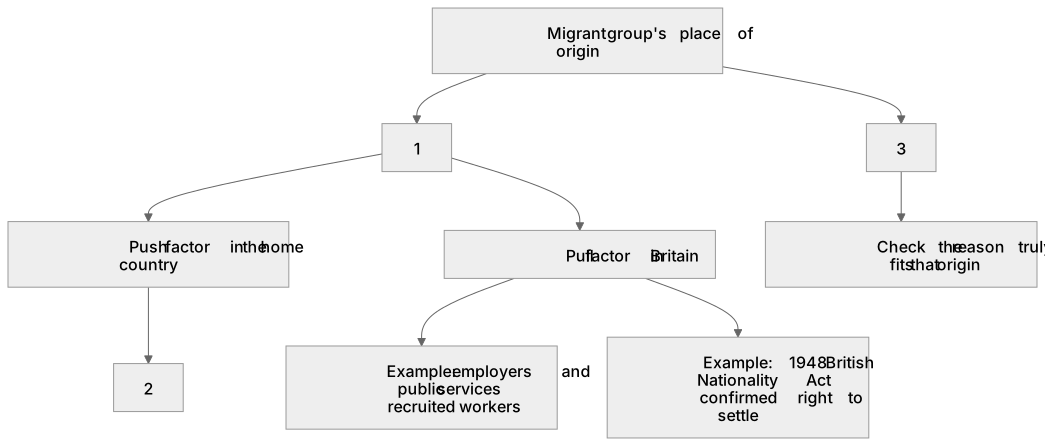
1Box 1
2Box 2
3Box 3
There is more to this lesson
The full lesson goes on to check your understanding and help you earn the marks. Create a free account to carry on, with your progress saved.
A week of Premium from your first lesson · Then the free plan continues · No card, no charge
Test your understanding of Urban Environments: Patterns of Migration (J410/11) - When immigrant groups arrived, why and from where: Where people migrated from and why.
Active recall beats re-reading. Take an instant quiz now to test what you’ve learned and lock it into long-term memory.
A week of Premium from your first lesson · Then the free plan continues · No card, no charge