Pearson Edexcel · A-Level · History
Course version: 9HI0 · Version from Sept 2015
Cultural change in the 1920s: the Jazz Age; the Harlem Renaissance;…
Full specification wording
Boom and crash, 1920–29: Cultural change in the 1920s: the Jazz Age; the Harlem Renaissance; growing popularity of baseball; radio and the cinema; American literature.
Cultural change in the 1920s transformed American society, driven by rising prosperity and new technologies.
Checked against the Pearson Edexcel 9HI0 specification (opens in a new tab) on .
- Point 4 of 4
- 4 key terms
Study notes
From the checked teaching notes for this specification point.
The idea
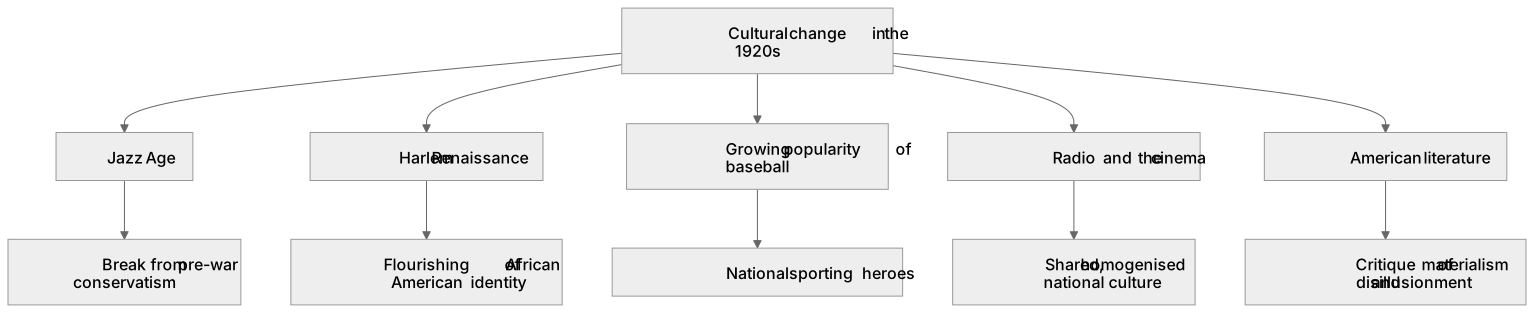
Cultural change in the 1920s transformed American society, driven by rising prosperity and new technologies. The Jazz Age symbolised a break from pre-war conservatism, with jazz music becoming the soundtrack for a more permissive youth culture. Concurrently, the Harlem Renaissance fostered a profound flourishing of African American identity through art, music, and literature, challenging racial stereotypes. Mass entertainment expanded rapidly; the growing popularity of baseball created national sporting heroes like Babe Ruth, while radio and the cinema forged a shared, homogenised national culture. Despite this vibrancy, American literature of the era, notably works by the 'Lost Generation' such as F. Scott Fitzgerald, often provided a sharp critique of the decade's materialism, superficiality, and underlying disillusionment.
What earns the marks
- Evaluate how the Jazz Age reflected broader cultural change in the 1920s and challenged traditional moral standards.
- Analyse the significance of the Harlem Renaissance in articulating African American cultural pride and intellectualism.
- Assess the role of radio and the cinema in creating a homogenised mass culture and elevating celebrities.
- Examine the growing popularity of baseball as a reflection of increased leisure time and the commercialisation of sport.
- Interpret how American literature, particularly the 'Lost Generation', critiqued the materialism and spiritual emptiness of the era.
Common mistakes and how to put them right
Treating the Harlem Renaissance as merely a musical movement.
Put it right by emphasising its profound literary, artistic, and intellectual dimensions.
Assuming radio and the cinema reached all Americans equally.
Put it right by noting that rural and impoverished communities often lacked access to these new cultural mediums.
Conflating the exuberance of the Jazz Age with the themes of American literature.
Put it right by highlighting that writers like Fitzgerald and Hemingway were deeply critical of the era's excesses.
Exam tips
- Link cultural change in the 1920s to economic developments, showing how increased disposable income and leisure time fuelled the growing popularity of baseball, radio, and the cinema.
- Use specific cultural figures—such as Langston Hughes for the Harlem Renaissance or Babe Ruth for baseball—to substantiate your evaluation of cultural shifts.
Try the lesson
The start of the Boom and crash, 1920–29: Cultural change in the 1920s: the Jazz Age; the Harlem Renaissance; growing popularity of baseball; radio and the cinema; American literature. lesson, made from checked teaching notes for this specification point.
Have a go first
Which cultural movement of the 1920s celebrated Black American artistic achievement in music, literature and art?
Listen
Cultural change in the 1920s transformed American society, driven by rising prosperity and new technologies. The Jazz Age symbolised a break from pre-war conservatism, with jazz music becoming the soundtrack for a more permissive youth culture. Concurrently, the Harlem Renaissance fostered a profound flourishing of African American identity through art, music, and literature, challenging racial stereotypes. Mass entertainment expanded rapidly; the growing popularity of baseball created national sporting heroes like Babe Ruth, while radio and the cinema forged a shared, homogenised national culture. Despite this vibrancy, American literature of the era, notably works by the 'Lost Generation' such as F. Scott Fitzgerald, often provided a sharp critique of the decade's materialism, superficiality, and underlying disillusionment. A strong answer earns marks for these points. Evaluate how the Jazz Age reflected broader cultural change in the 1920s and challenged traditional moral standards. Analyse the significance of the Harlem Renaissance in articulating African American cultural pride and intellectualism. Assess the role of radio and the cinema in creating a homogenised mass culture and elevating celebrities. Examine the growing popularity of baseball as a reflection of increased leisure time and the commercialisation of sport. A common slip: Treating the Harlem Renaissance as merely a musical movement. Instead, emphasising its profound literary, artistic, and intellectual dimensions. Exam tip: Link cultural change in the 1920s to economic developments, showing how increased disposable income and leisure time fuelled the growing popularity of baseball, radio, and the cinema.
See it
Key words
Say what each word means before you turn the card.
Harlem Renaissance
Try answering aloud or in your head before turning the card.
Jazz Age
Try answering aloud or in your head before turning the card.
American literature
Try answering aloud or in your head before turning the card.
radio and the cinema
Try answering aloud or in your head before turning the card.
See every definition
- Harlem Renaissance
- A profound flourishing of African American identity through art, music, and literature, challenging racial stereotypes.
- Jazz Age
- A symbol of a break from pre-war conservatism, with jazz music becoming the soundtrack for a more permissive youth culture.
- American literature
- Works of the era, notably by the 'Lost Generation' such as F. Scott Fitzgerald, that often provided a sharp critique of the decade's materialism, superficiality, and underlying disillusionment.
- radio and the cinema
- New cultural mediums that forged a shared, homogenised national culture.
Label the diagram
Some boxes have lost their names. Pick the right name for each number.
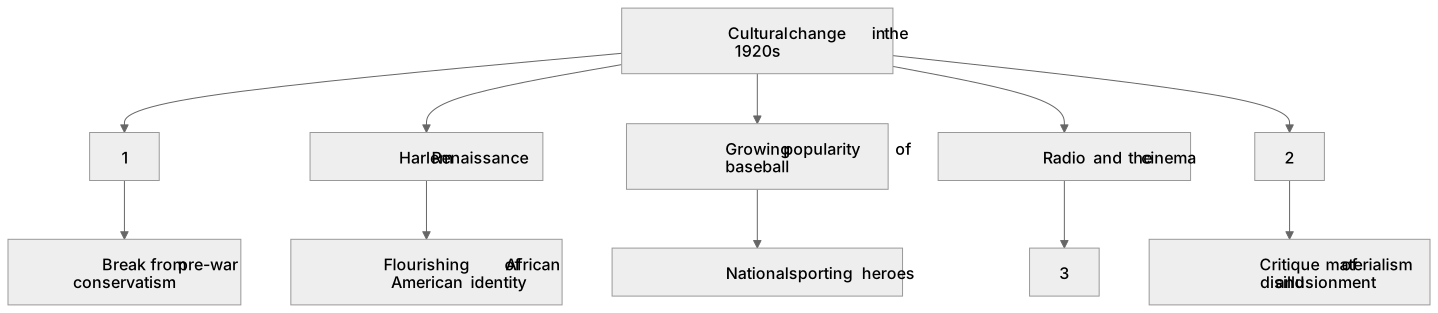
1Box 1
2Box 2
3Box 3
There is more to this lesson
The full lesson goes on to check your understanding and help you earn the marks. Create a free account to carry on, with your progress saved.
A week of Premium from your first lesson · Then the free plan continues · No card, no charge
Test your understanding of Boom and crash, 1920–29: Cultural change in the 1920s: the Jazz Age; the Harlem Renaissance; growing popularity of baseball; radio and the cinema; American literature.
Active recall beats re-reading. Take an instant quiz now to test what you’ve learned and lock it into long-term memory.
A week of Premium from your first lesson · Then the free plan continues · No card, no charge