Pearson Edexcel · A-Level · History
Course version: 9HI0 · Version from Sept 2015
Changes in society; immigration and the ‘Red Scare’; the Ku Klux Klan;…
Full specification wording
Boom and crash, 1920–29: Changes in society; immigration and the ‘Red Scare’; the Ku Klux Klan; prohibition and organised crime; the changing role of women.
The 1920s witnessed profound changes in society, characterised by a clash between modern urbanism and traditional rural values.
Checked against the Pearson Edexcel 9HI0 specification (opens in a new tab) on .
- Point 3 of 4
- 4 key terms
Study notes
From the checked teaching notes for this specification point.
The idea
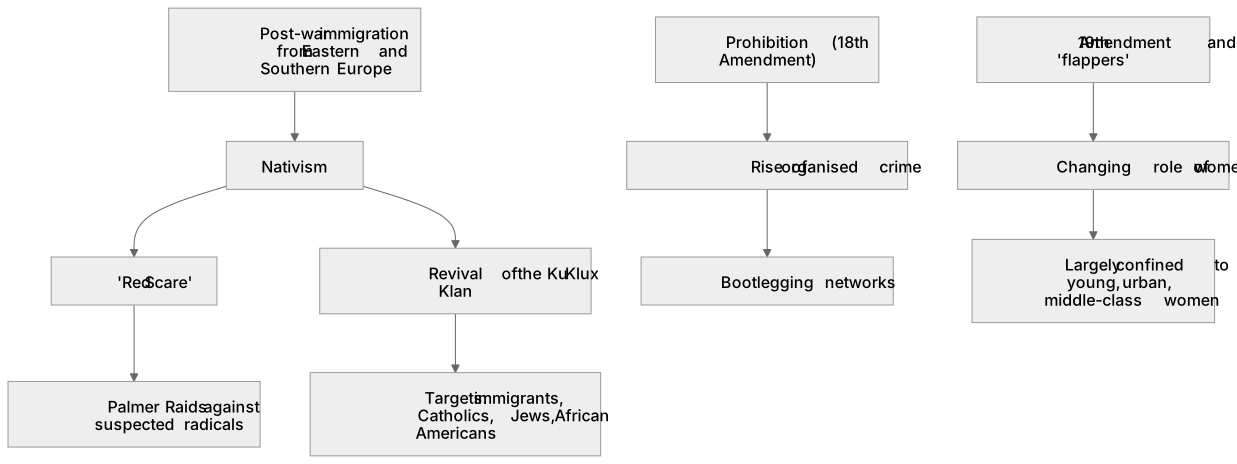
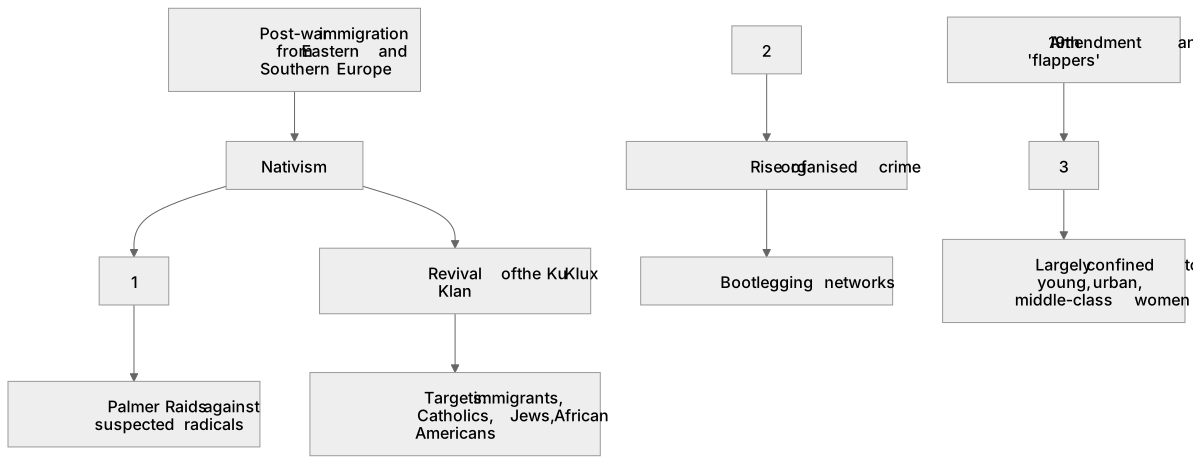
The 1920s witnessed profound changes in society, characterised by a clash between modern urbanism and traditional rural values. Post-war immigration from Eastern and Southern Europe fuelled nativism, culminating in the 'Red Scare' and the Palmer Raids against suspected radicals. This reactionary climate spurred the revival of the Ku Klux Klan, which expanded its bigotry to target immigrants, Catholics, and Jews alongside African Americans. Prohibition, enacted via the 18th Amendment, aimed to enforce moral purity but instead catalysed the rise of organised crime, as syndicates controlled lucrative bootlegging networks. Meanwhile, the changing role of women was highlighted by the 19th Amendment and the emergence of 'flappers', though these liberating social shifts were largely confined to young, urban, middle-class women.
What earns the marks
- Analyse how post-war immigration and the 'Red Scare' reflected deep-seated nativist anxieties and political paranoia.
- Evaluate the resurgence of the Ku Klux Klan as a reactionary movement against perceived threats to traditional American values.
- Assess the social impact of prohibition, specifically how it fostered widespread lawlessness and the expansion of organised crime.
- Examine the changing role of women, contrasting the liberated image of the 'flapper' with the enduring domestic expectations for the majority.
- Synthesise these changes in society to evaluate the overarching tension between modernism and traditionalism in the 1920s.
Common mistakes and how to put them right
Assuming the 'Red Scare' was solely anti-communist.
Put it right by noting it also targeted anarchists, socialists, and new immigrants.
Overstating the changing role of women.
Put it right by acknowledging that while 'flappers' were culturally significant, most women remained in traditional domestic roles with limited economic advancement.
Viewing the Ku Klux Klan as exclusively a Southern, anti-Black organisation.
Put it right by highlighting its national reach in the 1920s and its targeting of immigrants, Catholics, and Jews.
Exam tips
- Use specific legislative examples, such as the Emergency Quota Act (1921) or the Volstead Act, to anchor your analysis of immigration and prohibition.
- When discussing changes in society, explicitly evaluate the extent of change versus continuity, particularly regarding the changing role of women.
Try the lesson
The start of the Boom and crash, 1920–29: Changes in society; immigration and the ‘Red Scare’; the Ku Klux Klan; prohibition and organised crime; the changing role of women. lesson, made from checked teaching notes for this specification point.
Have a go first
Which group grew rapidly in the United States during 1920–21 as a result of the ‘Red Scare’?
Listen
The 1920s witnessed profound changes in society, characterised by a clash between modern urbanism and traditional rural values. Post-war immigration from Eastern and Southern Europe fuelled nativism, culminating in the 'Red Scare' and the Palmer Raids against suspected radicals. This reactionary climate spurred the revival of the Ku Klux Klan, which expanded its bigotry to target immigrants, Catholics, and Jews alongside African Americans. Prohibition, enacted via the 18th Amendment, aimed to enforce moral purity but instead catalysed the rise of organised crime, as syndicates controlled lucrative bootlegging networks. Meanwhile, the changing role of women was highlighted by the 19th Amendment and the emergence of 'flappers', though these liberating social shifts were largely confined to young, urban, middle-class women. A strong answer earns marks for these points. Analyse how post-war immigration and the 'Red Scare' reflected deep-seated nativist anxieties and political paranoia. Evaluate the resurgence of the Ku Klux Klan as a reactionary movement against perceived threats to traditional American values. Assess the social impact of prohibition, specifically how it fostered widespread lawlessness and the expansion of organised crime. Examine the changing role of women, contrasting the liberated image of the 'flapper' with the enduring domestic expectations for the majority. A common slip: Assuming the 'Red Scare' was solely anti-communist. Instead, noting it also targeted anarchists, socialists, and new immigrants. Exam tip: Use specific legislative examples, such as the Emergency Quota Act (1921) or the Volstead Act, to anchor your analysis of immigration and prohibition.
See it
Key words
Say what each word means before you turn the card.
Nativism and political extremism
Try answering aloud or in your head before turning the card.
The failure of moral legislation
Try answering aloud or in your head before turning the card.
Modernity versus traditionalism
Try answering aloud or in your head before turning the card.
The changing role of women
Try answering aloud or in your head before turning the card.
See every definition
- Nativism and political extremism
- Post-war immigration from Eastern and Southern Europe fuelled nativism, culminating in the 'Red Scare' and the Palmer Raids against suspected radicals.
- The failure of moral legislation
- Prohibition, enacted via the 18th Amendment, aimed to enforce moral purity but instead catalysed the rise of organised crime, as syndicates controlled lucrative bootlegging networks.
- Modernity versus traditionalism
- The 1920s witnessed profound changes in society, characterised by a clash between modern urbanism and traditional rural values.
- The changing role of women
- Highlighted by the 19th Amendment and the emergence of 'flappers', though these liberating social shifts were largely confined to young, urban, middle-class women.
Label the diagram
Some boxes have lost their names. Pick the right name for each number.
1Box 1
2Box 2
3Box 3
There is more to this lesson
The full lesson goes on to check your understanding and help you earn the marks. Create a free account to carry on, with your progress saved.
A week of Premium from your first lesson · Then the free plan continues · No card, no charge
Test your understanding of Boom and crash, 1920–29: Changes in society; immigration and the ‘Red Scare’; the Ku Klux Klan; prohibition and organised crime; the changing role of women.
Active recall beats re-reading. Take an instant quiz now to test what you’ve learned and lock it into long-term memory.
A week of Premium from your first lesson · Then the free plan continues · No card, no charge