Pearson Edexcel · A-Level · History
Course version: 9HI0 · Version from Sept 2015
The economic boom of the 1920s: mass production; technological advances…
Full specification wording
Boom and crash, 1920–29: The economic boom of the 1920s: mass production; technological advances and their impact on leisure; the automobile; hire purchase; laissez faire; farmers, black Americans and limits to the boom.
The 1920s economic boom requires rigorous A-Level analysis of its drivers and limits.
Checked against the Pearson Edexcel 9HI0 specification (opens in a new tab) on .
- Point 1 of 4
- 4 key terms
Study notes
From the checked teaching notes for this specification point.
The idea
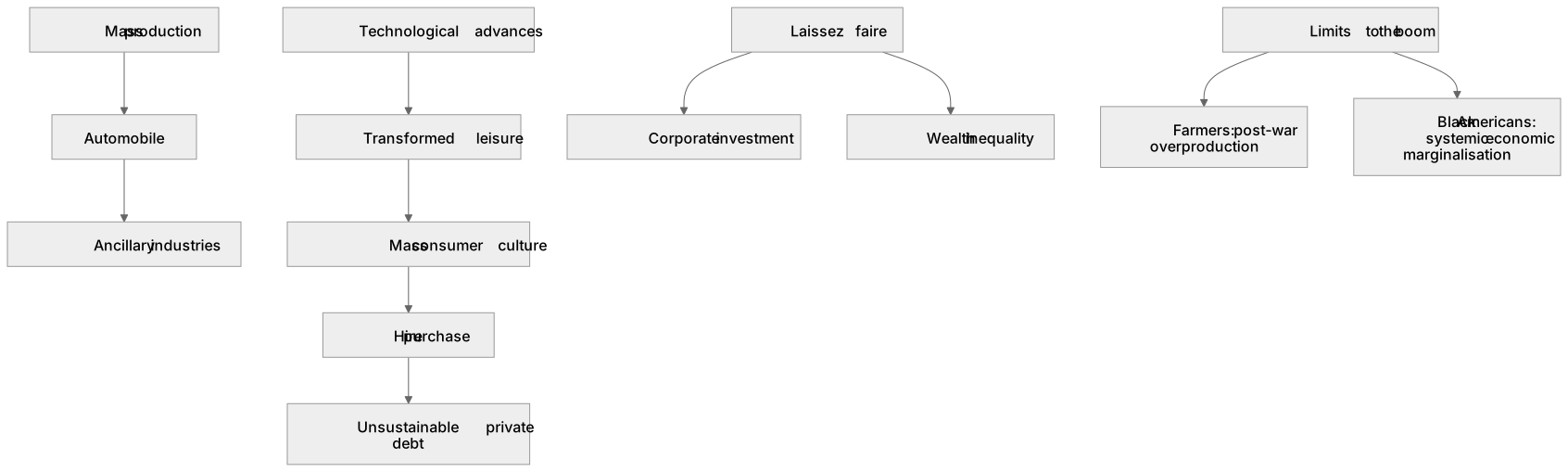
The 1920s economic boom requires rigorous A-Level analysis of its drivers and limits. Mass production revolutionised output, making the automobile a catalyst for ancillary industries. Technological advances transformed leisure, fostering a consumer culture via cinema and radio. This consumption was leveraged through hire purchase, masking demand fragility. Republican laissez faire policies stimulated corporate investment but exacerbated wealth inequality. Crucially, the boom was structurally limited: farmers suffered a severe post-war depression due to overproduction, while black Americans, trapped in sharecropping or facing systemic discrimination, were largely excluded from prosperity.
What earns the marks
- Analyses the structural impact of mass production and the automobile on the wider economy, evaluating their role as catalysts for industrial expansion.
- Assesses how technological advances in electrification and media transformed leisure, creating a mass consumer culture.
- Evaluates the dual role of hire purchase in artificially stimulating consumer demand while creating unsustainable private debt.
- Critically examines laissez faire policies, such as Mellon's tax reductions, assessing their contribution to both the boom and wealth inequality.
- Evaluates the limits to the boom by analysing the structural economic exclusion of farmers and black Americans.
Common mistakes and how to put them right
Providing a descriptive narrative of 1920s consumer goods without economic analysis.
Put it right: Focus on the macroeconomic impact of mass production and technological advances on structural growth.
Treating laissez faire as a complete absence of government intervention.
Put it right: Analyse active Republican interventions, such as protectionist tariffs and regressive tax policies, that shaped the boom.
Stating farmers and black Americans were simply 'poor'.
Put it right: Provide precise economic reasons for the limits to the boom, such as post-war overproduction for farmers and systemic economic marginalisation for black Americans.
Exam tips
- Weigh the relative importance of different factors, such as mass production versus laissez faire, in driving the economic boom of the 1920s.
- Use the experiences of farmers and black Americans to construct a nuanced argument about the structural limits and fragility of the boom.
Try the lesson
The start of the Boom and crash, 1920–29: The economic boom of the 1920s: mass production; technological advances and their impact on leisure; the automobile; hire purchase; laissez faire; farmers, black Americans and limits to the boom. lesson, made from checked teaching notes for this specification point.
Have a go first
Which method of buying goods spread widely in the United States during the 1920s and allowed consumers to pay for products in instalments?
Listen
The 1920s economic boom requires rigorous A-Level analysis of its drivers and limits. Mass production revolutionised output, making the automobile a catalyst for ancillary industries. Technological advances transformed leisure, fostering a consumer culture via cinema and radio. This consumption was leveraged through hire purchase, masking demand fragility. Republican laissez faire policies stimulated corporate investment but exacerbated wealth inequality. Crucially, the boom was structurally limited: farmers suffered a severe post-war depression due to overproduction, while black Americans, trapped in sharecropping or facing systemic discrimination, were largely excluded from prosperity. A strong answer earns marks for these points. Analyses the structural impact of mass production and the automobile on the wider economy, evaluating their role as catalysts for industrial expansion. Assesses how technological advances in electrification and media transformed leisure, creating a mass consumer culture. Evaluates the dual role of hire purchase in artificially stimulating consumer demand while creating unsustainable private debt. Critically examines laissez faire policies, such as Mellon's tax reductions, assessing their contribution to both the boom and wealth inequality. A common slip: Providing a descriptive narrative of 1920s consumer goods without economic analysis. Instead, Focus on the macroeconomic impact of mass production and technological advances on structural growth. Exam tip: Weigh the relative importance of different factors, such as mass production versus laissez faire, in driving the economic boom of the 1920s.
See it
Key words
Say what each word means before you turn the card.
Mass production
Try answering aloud or in your head before turning the card.
Hire purchase
Try answering aloud or in your head before turning the card.
Laissez faire
Try answering aloud or in your head before turning the card.
Limits to the boom
Try answering aloud or in your head before turning the card.
See every definition
- Mass production
- A method that revolutionised output and made the automobile a catalyst for ancillary industries.
- Hire purchase
- A way of leveraging consumption that artificially stimulated consumer demand while creating unsustainable private debt, masking demand fragility.
- Laissez faire
- Republican policies that stimulated corporate investment but exacerbated wealth inequality.
- Limits to the boom
- Structural constraints whereby farmers suffered a severe post-war depression due to overproduction and black Americans were largely excluded from prosperity.
Label the diagram
Some boxes have lost their names. Pick the right name for each number.
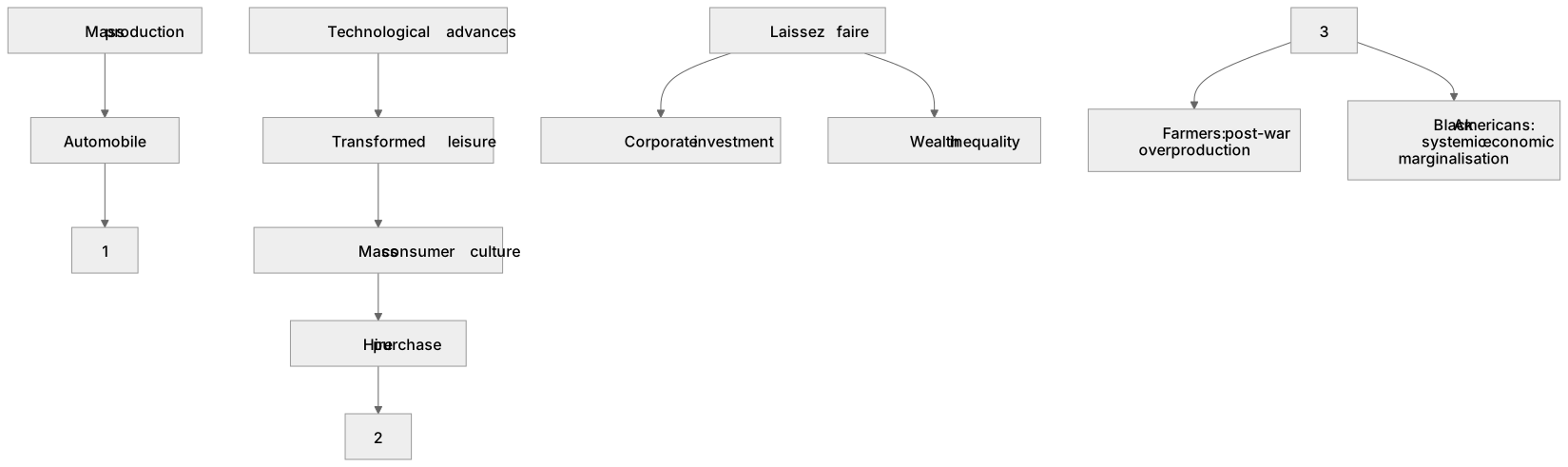
1Box 1
2Box 2
3Box 3
There is more to this lesson
The full lesson goes on to check your understanding and help you earn the marks. Create a free account to carry on, with your progress saved.
A week of Premium from your first lesson · Then the free plan continues · No card, no charge
Test your understanding of Boom and crash, 1920–29: The economic boom of the 1920s: mass production; technological advances and their impact on leisure; the automobile; hire purchase; laissez faire; farmers, black Americans and limits to the boom.
Active recall beats re-reading. Take an instant quiz now to test what you’ve learned and lock it into long-term memory.
A week of Premium from your first lesson · Then the free plan continues · No card, no charge