Pearson Edexcel · A-Level · History
Course version: 9HI0 · Version from Sept 2015
Causes of the crash of 1929: the Wall Street Crash; overproduction; land…
Full specification wording
Boom and crash, 1920–29: Causes of the crash of 1929: the Wall Street Crash; overproduction; land speculation; the bull market; weaknesses of the banking system.
The 1929 crash resulted from complex, interconnected economic flaws.
Checked against the Pearson Edexcel 9HI0 specification (opens in a new tab) on .
- Point 2 of 4
- 4 key terms
Study notes
From the checked teaching notes for this specification point.
The idea
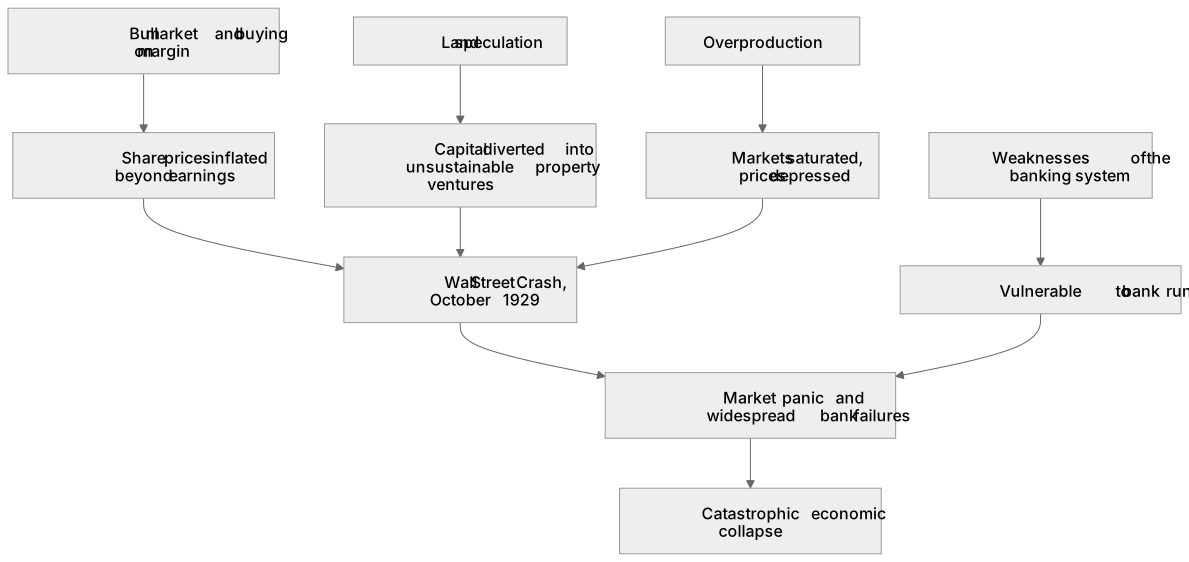
The 1929 crash resulted from complex, interconnected economic flaws. The bull market fostered a culture of buying on margin, artificially inflating share prices beyond corporate earnings. This speculative fever extended to land speculation, notably the Florida land boom, which diverted capital into unsustainable property ventures. Overproduction in agriculture and manufacturing saturated markets, depressing prices and exposing underconsumption. Crucially, weaknesses of the banking system—characterised by unregulated, independent unit banks and lack of deposit insurance—meant that when the Wall Street Crash occurred in October 1929, market panic rapidly triggered widespread bank failures. The Crash acted as the catalyst, transforming structural vulnerabilities into a catastrophic economic collapse.
What earns the marks
- Evaluate how the bull market and margin buying artificially inflated stock prices, creating an unsustainable financial bubble.
- Analyse the role of land speculation, such as the Florida land boom, in demonstrating the era's risky investment practices.
- Assess overproduction in agriculture and industry as a fundamental structural weakness that suppressed prices and profits.
- Explain how weaknesses of the banking system, particularly the prevalence of vulnerable unit banks, amplified the crisis.
- Examine the Wall Street Crash as the definitive trigger that shattered confidence and exposed underlying economic fragility.
Common mistakes and how to put them right
Treating the Wall Street Crash as the sole cause of the Depression.
Put it right by distinguishing it as a trigger that exposed structural flaws like overproduction.
Ignoring the specific weaknesses of the banking system.
Put it right by explaining how the fragmented unit banking structure lacked resilience against bank runs.
Conflating the bull market with general economic health.
Put it right by noting that stock speculation masked underlying issues like agricultural depression and land speculation collapses.
Exam tips
- When evaluating the causes of the crash of 1929, establish a hierarchy of causes, distinguishing between long-term structural weaknesses and short-term triggers.
- Use precise examples, such as the Florida land boom or the practice of buying on margin, to substantiate arguments about speculation.
Try the lesson
The start of the Boom and crash, 1920–29: Causes of the crash of 1929: the Wall Street Crash; overproduction; land speculation; the bull market; weaknesses of the banking system. lesson, made from checked teaching notes for this specification point.
Have a go first
What name is given to the long period of rising share prices on the New York Stock Exchange during the 1920s, when many investors bought shares expecting further gains?
Listen
The 1929 crash resulted from complex, interconnected economic flaws. The bull market fostered a culture of buying on margin, artificially inflating share prices beyond corporate earnings. This speculative fever extended to land speculation, notably the Florida land boom, which diverted capital into unsustainable property ventures. Overproduction in agriculture and manufacturing saturated markets, depressing prices and exposing underconsumption. Crucially, weaknesses of the banking system—characterised by unregulated, independent unit banks and lack of deposit insurance—meant that when the Wall Street Crash occurred in October 1929, market panic rapidly triggered widespread bank failures. The Crash acted as the catalyst, transforming structural vulnerabilities into a catastrophic economic collapse. A strong answer earns marks for these points. Evaluate how the bull market and margin buying artificially inflated stock prices, creating an unsustainable financial bubble. Analyse the role of land speculation, such as the Florida land boom, in demonstrating the era's risky investment practices. Assess overproduction in agriculture and industry as a fundamental structural weakness that suppressed prices and profits. Explain how weaknesses of the banking system, particularly the prevalence of vulnerable unit banks, amplified the crisis. A common slip: Treating the Wall Street Crash as the sole cause of the Depression. Instead, distinguishing it as a trigger that exposed structural flaws like overproduction. Exam tip: When evaluating the causes of the crash of 1929, establish a hierarchy of causes, distinguishing between long-term structural weaknesses and short-term triggers.
See it
Key words
Say what each word means before you turn the card.
Bull market
Try answering aloud or in your head before turning the card.
Land speculation
Try answering aloud or in your head before turning the card.
Overproduction
Try answering aloud or in your head before turning the card.
Weaknesses of the banking system
Try answering aloud or in your head before turning the card.
See every definition
- Bull market
- A market that fostered a culture of buying on margin, artificially inflating share prices beyond corporate earnings.
- Land speculation
- Risky investment practice, notably the Florida land boom, which diverted capital into unsustainable property ventures.
- Overproduction
- Saturation of markets in agriculture and manufacturing, depressing prices and exposing underconsumption.
- Weaknesses of the banking system
- Unregulated, independent unit banks and lack of deposit insurance, so market panic rapidly triggered widespread bank failures.
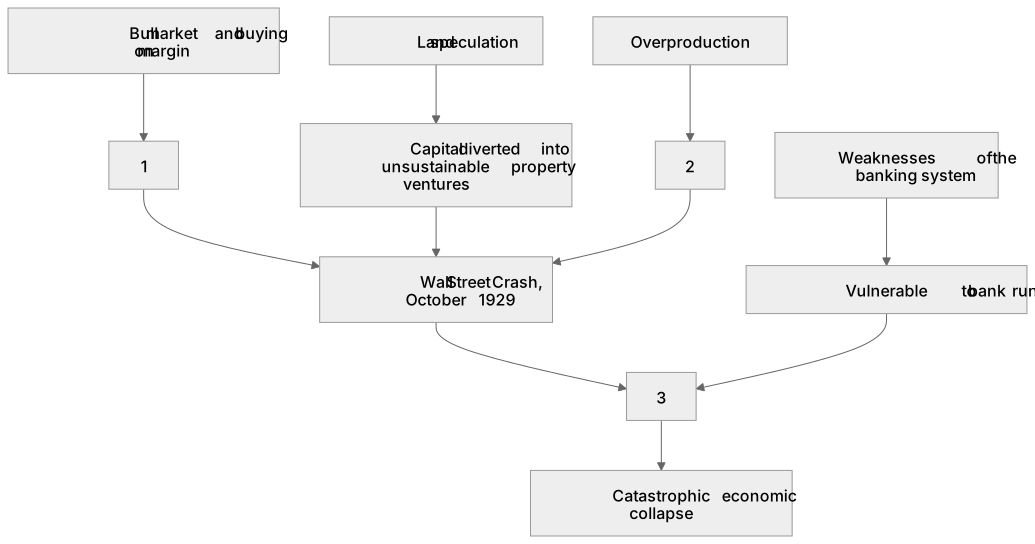
Label the diagram
Some boxes have lost their names. Pick the right name for each number.
1Box 1
2Box 2
3Box 3
There is more to this lesson
The full lesson goes on to check your understanding and help you earn the marks. Create a free account to carry on, with your progress saved.
A week of Premium from your first lesson · Then the free plan continues · No card, no charge
Test your understanding of Boom and crash, 1920–29: Causes of the crash of 1929: the Wall Street Crash; overproduction; land speculation; the bull market; weaknesses of the banking system.
Active recall beats re-reading. Take an instant quiz now to test what you’ve learned and lock it into long-term memory.
A week of Premium from your first lesson · Then the free plan continues · No card, no charge