Pearson Edexcel · A-Level · History
Course version: 9HI0 · Version from Sept 2015
Government, 1953–85: changes in leaders’ control of the state across the…
Full specification wording
Communist government in the USSR, 1917–85: Government, 1953–85: changes in leaders’ control of the state across the period; Khrushchev’s attempts to reform government including de-Stalinisation; the return to stability under Brezhnev, 1964–82; growing political stagnation, 1982-85.
After Stalin died in 1953, collective leadership gave way to Khrushchev's personal rule.
Checked against the Pearson Edexcel 9HI0 specification (opens in a new tab) on .
- Point 3 of 3
- 4 key terms
Study notes
From the checked teaching notes for this specification point.
The idea
After Stalin died in 1953, collective leadership gave way to Khrushchev's personal rule. He tried to reform government by reducing the secret police's arbitrary power, separating party and state roles, and promoting de-Stalinisation: the 1956 Secret Speech condemned Stalin's crimes, and destalinisation removed his cult from public life. But reform destabilised the elite and his erratic style led to his removal in 1964. Brezhnev restored stability through collective leadership, cadres' security ('stability of cadres') and conservative appointments, but this bred gerontocracy and corruption. From 1982 to 1985, under Andropov and then Chernenko, ageing leaders and economic decline produced growing political stagnation, with little reform before Gorbachev.
What earns the marks
- Explains how leadership control changed from collective rule after 1953 to Khrushchev's personal dominance, then back to collective stability under Brezhnev.
- Identifies Khrushchev's reforms: limiting secret police powers, party-state separation, and de-Stalinisation including the 1956 Secret Speech and removal of Stalin's cult.
- Assesses the consequences of de-Stalinisation: elite insecurity, opposition, and contribution to Khrushchev's fall in 1964.
- Explains Brezhnev's return to stability: 'stability of cadres', conservative appointments, and suppression of reform, 1964–82.
- Analyses growing political stagnation, 1982–85: ageing leadership under Andropov and Chernenko, corruption, and economic decline.
- Evaluates the extent of change across the whole period, comparing leaders' control and the limits of reform.
Common mistakes and how to put them right
Treating de-Stalinisation as only a cultural thaw.
Put it right: It also involved political reform, such as reducing terror and restructuring party-state relations.
Assuming Brezhnev's stability was purely positive.
Put it right: It also meant stagnation, gerontocracy, and resistance to necessary reform.
Confusing Andropov and Chernenko's short terms.
Put it right: Andropov (1982–84) tried limited anti-corruption measures, while Chernenko (1984–85) was largely inactive.
Overstating Khrushchev's success; correction: his reforms were partial and contributed to his removal in 1964.
Exam tips
- Plan essays around change and continuity in leaders' control, using specific dates and terms like de-Stalinisation and stability of cadres.
- Use the 1953–85 timeframe to structure comparisons: Khrushchev's reform, Brezhnev's stability, and stagnation under Andropov and Chernenko.
- Support arguments with precise evidence, such as the 1956 Secret Speech, the 1964 removal, and the ageing Politburo of the early 1980s.
- Address the wording 'changes in leaders' control' by analysing how far each leader dominated the state apparatus.
Try the lesson
The start of the Communist government in the USSR, 1917–85: Government, 1953–85: changes in leaders’ control of the state across the period; Khrushchev’s attempts to reform government including de-Stalinisation; the return to stability under Brezhnev, 1964–82; growing political stagnation, 1982-85. lesson, made from checked teaching notes for this specification point.
Have a go first
Which leader of the Soviet Union delivered the 'Secret Speech' attacking Stalin's crimes to the Twentieth Party Congress in 1956?
Listen
After Stalin died in 1953, collective leadership gave way to Khrushchev's personal rule. He tried to reform government by reducing the secret police's arbitrary power, separating party and state roles, and promoting de-Stalinisation: the 1956 Secret Speech condemned Stalin's crimes, and destalinisation removed his cult from public life. But reform destabilised the elite and his erratic style led to his removal in 1964. Brezhnev restored stability through collective leadership, cadres' security ('stability of cadres') and conservative appointments, but this bred gerontocracy and corruption. From 1982 to 1985, under Andropov and then Chernenko, ageing leaders and economic decline produced growing political stagnation, with little reform before Gorbachev. A strong answer earns marks for these points. Explains how leadership control changed from collective rule after 1953 to Khrushchev's personal dominance, then back to collective stability under Brezhnev. Identifies Khrushchev's reforms: limiting secret police powers, party-state separation, and de-Stalinisation including the 1956 Secret Speech and removal of Stalin's cult. Assesses the consequences of de-Stalinisation: elite insecurity, opposition, and contribution to Khrushchev's fall in 1964. Explains Brezhnev's return to stability: 'stability of cadres', conservative appointments, and suppression of reform, 1964–82. A common slip: Treating de-Stalinisation as only a cultural thaw. Instead, it also involved political reform, such as reducing terror and restructuring party-state relations. Exam tip: Plan essays around change and continuity in leaders' control, using specific dates and terms like de-Stalinisation and stability of cadres.
See it
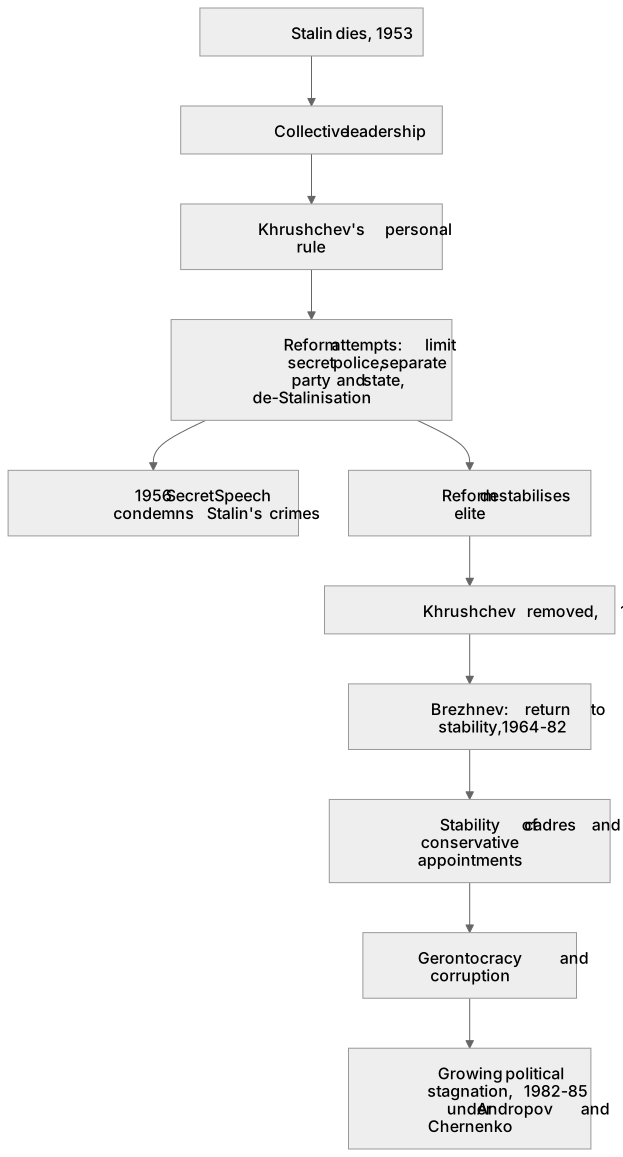
Put the events in order
Put these events in the order they happened, earliest first.
- 1. Andropov began leading amid growing stagnation
- 2. Stalin died, ending his rule
- 3. Khrushchev removed from power
- 4. Secret Speech condemned Stalin's crimes
Key words
Say what each word means before you turn the card.
De-Stalinisation
Try answering aloud or in your head before turning the card.
Stability and stagnation
Try answering aloud or in your head before turning the card.
Leadership and control
Try answering aloud or in your head before turning the card.
Reform and reaction
Try answering aloud or in your head before turning the card.
See every definition
- De-Stalinisation
- The 1956 Secret Speech condemned Stalin's crimes, and this process removed his cult from public life.
- Stability and stagnation
- Brezhnev restored stability through collective leadership and conservative appointments, but this bred gerontocracy and corruption, and from 1982 to 1985 ageing leaders and economic decline produced growing political stagnation.
- Leadership and control
- Collective leadership after 1953 gave way to Khrushchev's personal rule, then back to collective stability under Brezhnev.
- Reform and reaction
- Khrushchev tried to reform government by reducing the secret police's arbitrary power and separating party and state roles, but reform destabilised the elite and led to his removal in 1964.
Label the diagram
Some boxes have lost their names. Pick the right name for each number.
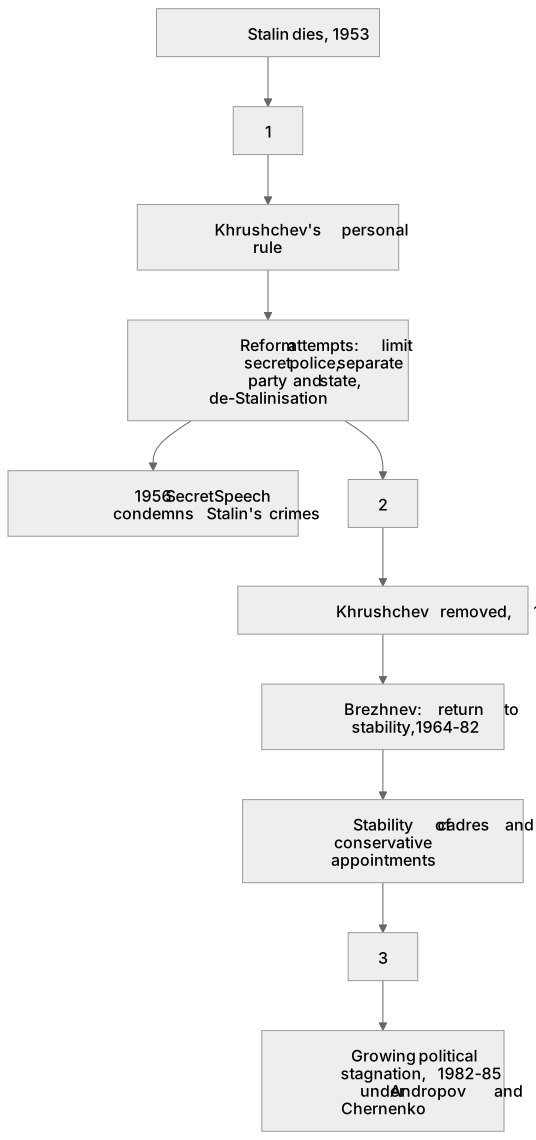
1Box 1
2Box 2
3Box 3
There is more to this lesson
The full lesson goes on to check your understanding and help you earn the marks. Create a free account to carry on, with your progress saved.
A week of Premium from your first lesson · Then the free plan continues · No card, no charge
Test your understanding of Communist government in the USSR, 1917–85: Government, 1953–85: changes in leaders’ control of the state across the period; Khrushchev’s attempts to reform government including de-Stalinisation; the return to stability under Brezhnev, 1964–82; growing political stagnation, 1982-85.
Active recall beats re-reading. Take an instant quiz now to test what you’ve learned and lock it into long-term memory.
A week of Premium from your first lesson · Then the free plan continues · No card, no charge