Pearson Edexcel · A-Level · History
Course version: 9HI0 · Version from Sept 2015
Stalin in power, 1928–53: the elimination of opponents in government and…
Full specification wording
Communist government in the USSR, 1917–85: Stalin in power, 1928–53: the elimination of opponents in government and party; the purges of the 1930s; Stalin’s power over party and state.
Between 1928 and 1953, Stalin eliminated rivals and consolidated a personal dictatorship.
Checked against the Pearson Edexcel 9HI0 specification (opens in a new tab) on .
- Point 2 of 3
- 4 key terms
Study notes
From the checked teaching notes for this specification point.
The idea
Between 1928 and 1953, Stalin eliminated rivals and consolidated a personal dictatorship. After defeating the Left and Right oppositions, he used the 1930s purges to remove Old Bolsheviks, army officers and ordinary citizens. The show trials (1936–38) and the Great Terror, directed by the NKVD under Yezhov, removed potential challengers. Stalin controlled the party through the Secretariat and the Politburo, and the state through the NKVD and the army. By 1939, the party and state were subordinated to Stalin's will. After 1945, the Leningrad Affair and the Doctors' Plot showed continued repression. Stalin's power rested on terror, propaganda and patronage, making the USSR a totalitarian state.
What earns the marks
- Explains how Stalin eliminated opponents in government and party, including the defeat of the Left and Right oppositions and the removal of Old Bolsheviks.
- Analyses the purges of the 1930s, including the show trials (1936–38), the Great Terror and the role of the NKVD under Yezhov.
- Assesses Stalin's power over the party, including control of the Secretariat, the Politburo and the party congresses.
- Evaluates Stalin's power over the state, including the NKVD, the army and the government apparatus.
- Uses specific evidence, such as the assassination of Kirov (1934), the Trial of the Sixteen (1936) and the Leningrad Affair (1949), to support analysis.
- Develops a judgement on the extent to which Stalin's power was total by 1953, considering terror, propaganda and patronage.
Common mistakes and how to put them right
Assuming the purges were only in the 1930s.
Put it right: Repression continued after 1945, for example the Leningrad Affair and the Doctors' Plot.
Confusing the NKVD with the Cheka.
Put it right: The NKVD was the secret police in the 1930s, while the Cheka was the earlier organisation under Lenin.
Treating the show trials as genuine legal proceedings.
Put it right: They were staged to eliminate opponents and intimidate the population.
Overlooking Stalin's control of the party apparatus.
Put it right: Control of the Secretariat allowed Stalin to appoint loyalists and remove rivals.
Exam tips
- Structure your answer around the three clauses: elimination of opponents, the purges of the 1930s, and Stalin's power over party and state.
- Use precise dates and names, such as 1934, 1936–38, Yezhov, Kirov and the Trial of the Sixteen, to support your analysis.
- Make a clear judgement about how far Stalin's power was total by 1953, and support it with evidence from both party and state.
- Link terror, propaganda and patronage to explain how Stalin maintained control, rather than listing events.
Try the lesson
The start of the Communist government in the USSR, 1917–85: Stalin in power, 1928–53: the elimination of opponents in government and party; the purges of the 1930s; Stalin’s power over party and state. lesson, made from checked teaching notes for this specification point.
Have a go first
Which leading Bolshevik was executed in 1936 after a show trial, having been a prominent critic of Stalin?
Listen
Between 1928 and 1953, Stalin eliminated rivals and consolidated a personal dictatorship. After defeating the Left and Right oppositions, he used the 1930s purges to remove Old Bolsheviks, army officers and ordinary citizens. The show trials (1936–38) and the Great Terror, directed by the NKVD under Yezhov, removed potential challengers. Stalin controlled the party through the Secretariat and the Politburo, and the state through the NKVD and the army. By 1939, the party and state were subordinated to Stalin's will. After 1945, the Leningrad Affair and the Doctors' Plot showed continued repression. Stalin's power rested on terror, propaganda and patronage, making the USSR a totalitarian state. A strong answer earns marks for these points. Explains how Stalin eliminated opponents in government and party, including the defeat of the Left and Right oppositions and the removal of Old Bolsheviks. Analyses the purges of the 1930s, including the show trials (1936–38), the Great Terror and the role of the NKVD under Yezhov. Assesses Stalin's power over the party, including control of the Secretariat, the Politburo and the party congresses. Evaluates Stalin's power over the state, including the NKVD, the army and the government apparatus. A common slip: Assuming the purges were only in the 1930s. Instead, repression continued after 1945, for example the Leningrad Affair and the Doctors' Plot. Exam tip: Structure your answer around the three clauses: elimination of opponents, the purges of the 1930s, and Stalin's power over party and state.
See it
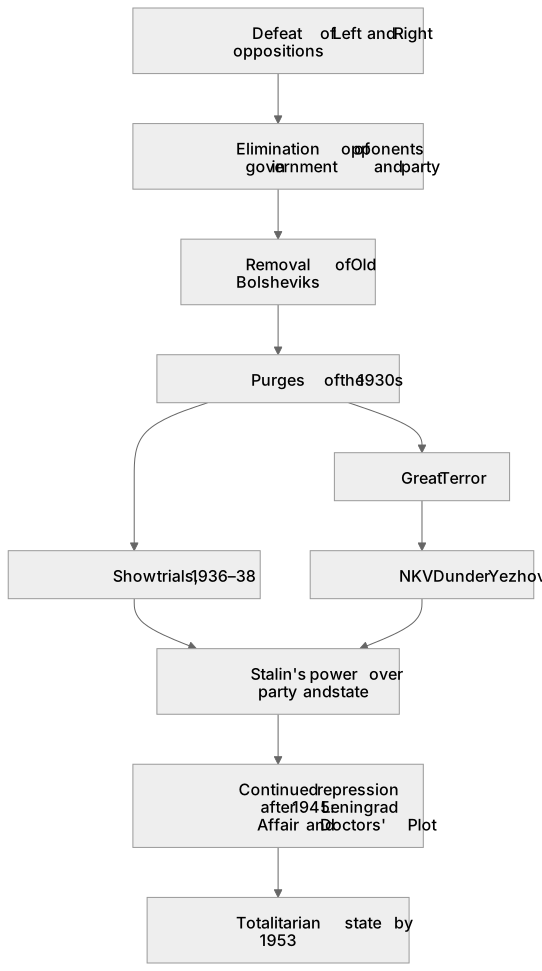
Put the events in order
Put these events in the order they happened, earliest first.
- 1. Assassination of Kirov
- 2. The Leningrad Affair
- 3. Trial of the Sixteen
Watch it explained
What is the one idea the video explains? Say it in a sentence.
Read the described scene instead
Between 1928 and 1953, Stalin eliminated rivals and consolidated a personal dictatorship in the USSR. After defeating the Left and Right oppositions, he used the purges of the 1930s to remove Old Bolsheviks, army officers and ordinary citizens. By 1939, the party and state were subordinated to Stalin's will. Stalin first removed organised opposition inside the party. He defeated the Left Opposition, then the Right Opposition, so no rival faction could challenge his leadership. The assassination of Kirov in 1934 became a pretext for wider repression. Old Bolsheviks, who had helped make the revolution, were among those removed. The purges of the 1930s turned repression into a system. The show trials of 1936 to 1938 were staged to eliminate opponents and intimidate the population. The Trial of the Sixteen in 1936 was one example. The Great Terror was directed by the NKVD under Yezhov. It removed potential challengers across the party, the army and ordinary citizens. Stalin's power over the party rested on its apparatus. Control of the Secretariat allowed him to appoint loyalists and remove rivals. The Politburo and party congresses were also brought under his control. This patronage helped make the party an instrument of Stalin's will. Stalin controlled the state through the NKVD, the army and the government apparatus. The NKVD was the instrument of terror. The army was purged as part of removing potential challengers. Repression continued after 1945: the Leningrad Affair in 1949 and the Doctors' Plot showed this. Avoid four common errors. Do not assume the purges were only in the 1930s: the Leningrad Affair and the Doctors' Plot show repression after 1945. Do not confuse the NKVD with the Cheka: the NKVD was the secret police in the 1930s, while the Cheka was the earlier organisation under Lenin. Do not treat the show trials as genuine legal proceedings; they were staged to eliminate opponents and intimidate the population. And do not overlook the Secretariat, because control of it let Stalin place loyalists and remove rivals. By 1953, Stalin's dictatorship rested on terror, propaganda and patronage. The party and state had been subordinated to his will. This is why historians describe the USSR under Stalin as a totalitarian state. Pause briefly and think: which mattered more, terror or patronage? Then use evidence from both party and state to judge how total Stalin's power was by 1953.
Key words
Say what each word means before you turn the card.
Elimination of opponents
Try answering aloud or in your head before turning the card.
Purges and show trials
Try answering aloud or in your head before turning the card.
Stalin's power
Try answering aloud or in your head before turning the card.
Party and state control
Try answering aloud or in your head before turning the card.
See every definition
- Elimination of opponents
- The removal of rivals in government and party, including the defeat of the Left and Right oppositions and the removal of Old Bolsheviks.
- Purges and show trials
- The purges of the 1930s, including the show trials (1936–38) and the Great Terror, directed by the NKVD under Yezhov, which removed potential challengers.
- Stalin's power
- Control over party and state, resting on terror, propaganda and patronage, making the USSR a totalitarian state.
- Party and state control
- Control of the party through the Secretariat and the Politburo, and of the state through the NKVD and the army.
Label the diagram
Some boxes have lost their names. Pick the right name for each number.
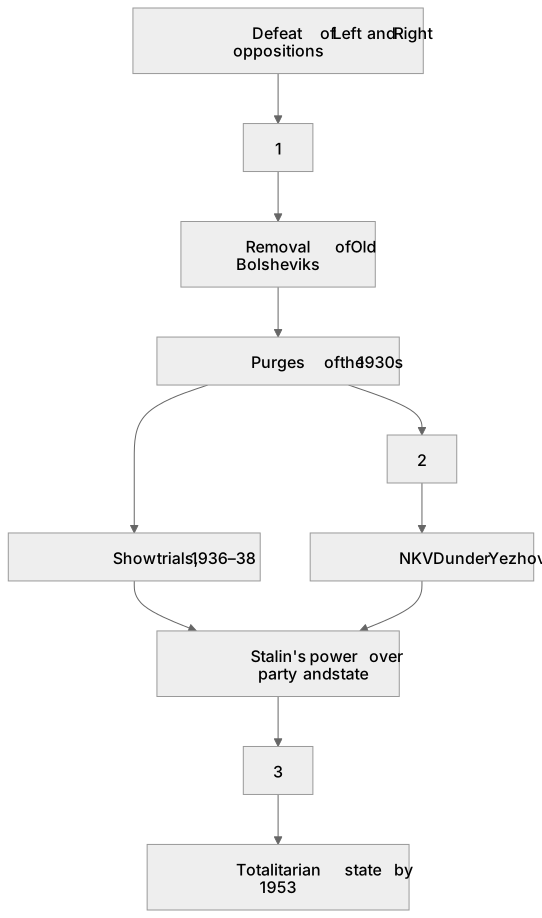
1Box 1
2Box 2
3Box 3
There is more to this lesson
The full lesson goes on to check your understanding and help you earn the marks. Create a free account to carry on, with your progress saved.
A week of Premium from your first lesson · Then the free plan continues · No card, no charge
Test your understanding of Communist government in the USSR, 1917–85: Stalin in power, 1928–53: the elimination of opponents in government and party; the purges of the 1930s; Stalin’s power over party and state.
Active recall beats re-reading. Take an instant quiz now to test what you’ve learned and lock it into long-term memory.
A week of Premium from your first lesson · Then the free plan continues · No card, no charge