Pearson Edexcel · A-Level · History
Course version: 9HI0 · Version from Sept 2015
Government of India Act and its impact, 1935–39: partial implementation;…
Full specification wording
Consultation and confrontation, 1930–42: Government of India Act and its impact, 1935–39: partial implementation; nationalist response. Outcome of the 1937 elections; rejuvenation of the Muslim League; divisions within Congress; attitudes towards the British Raj.
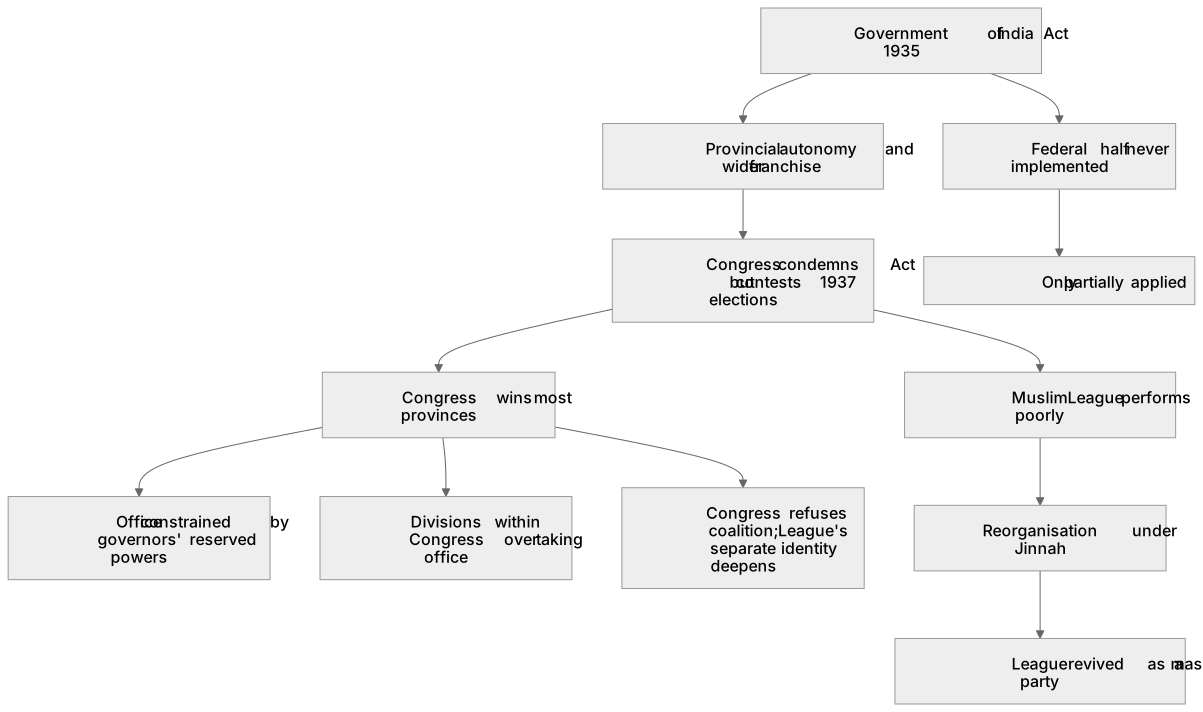
The Government of India Act 1935 created provincial autonomy and a wider franchise, but the federal half was never implemented, so it was only partially applied.
Checked against the Pearson Edexcel 9HI0 specification (opens in a new tab) on .
- Point 3 of 4
- 4 key terms
Study notes
From the checked teaching notes for this specification point.
The idea
The Government of India Act 1935 created provincial autonomy and a wider franchise, but the federal half was never implemented, so it was only partially applied. Congress condemned it yet contested the 1937 elections and won most provinces, then governed and found office constrained by governors' reserved powers. The Muslim League performed poorly, prompting reorganisation under Jinnah, which revived it as a mass party. Congress's refusal to share power in coalition deepened the League's separate identity. Divisions within Congress appeared between office-holders and those fearing compromise with the Raj. Attitudes to British rule ranged from cooperation to outright opposition.
What earns the marks
- Explains that the 1935 Act granted provincial autonomy and extended the franchise but the proposed All-India Federation was never implemented, so implementation was partial.
- Analyses the 1937 election results: Congress ministries in most provinces, League weakness, and the significance of the results for both parties.
- Explains how the League's poor showing led to reorganisation and rejuvenation under Jinnah, including membership drives and a clearer separate-Muslim platform.
- Assesses divisions within Congress between those willing to take office and those who saw cooperation as betrayal, and how this shaped nationalist politics.
- Evaluates attitudes towards the British Raj, from Congress's conditional cooperation to League's growing distrust and other groups' positions.
Common mistakes and how to put them right
Treating the 1935 Act as fully implemented.
Put it right by noting the federal provisions were never brought into operation.
Assuming the 1937 elections were a triumph for the Muslim League.
Put it right by stating Congress won most provinces while the League's performance was weak.
Presenting Congress as united.
Put it right by explaining the internal divisions over accepting office and the limits of provincial power.
Exam tips
- Link each development to the theme of consultation versus confrontation, showing how partial reform pushed some nationalists towards confrontation.
- Use precise dates and terms such as provincial autonomy, reserved powers and the 1937 elections to anchor analysis.
- Compare Congress and League trajectories to show how the same Act produced different responses and long-term consequences.
Try the lesson
The start of the Consultation and confrontation, 1930–42: Government of India Act and its impact, 1935–39: partial implementation; nationalist response. Outcome of the 1937 elections; rejuvenation of the Muslim League; divisions within Congress; attitudes towards the British Raj. lesson, made from checked teaching notes for this specification point.
Have a go first
Under the Government of India Act 1935, which new institution was created to interpret the constitution and resolve disputes between the central government and the provinces?
Listen
The Government of India Act 1935 created provincial autonomy and a wider franchise, but the federal half was never implemented, so it was only partially applied. Congress condemned it yet contested the 1937 elections and won most provinces, then governed and found office constrained by governors' reserved powers. The Muslim League performed poorly, prompting reorganisation under Jinnah, which revived it as a mass party. Congress's refusal to share power in coalition deepened the League's separate identity. Divisions within Congress appeared between office-holders and those fearing compromise with the Raj. Attitudes to British rule ranged from cooperation to outright opposition. A strong answer earns marks for these points. Explains that the 1935 Act granted provincial autonomy and extended the franchise but the proposed All-India Federation was never implemented, so implementation was partial. Analyses the 1937 election results: Congress ministries in most provinces, League weakness, and the significance of the results for both parties. Explains how the League's poor showing led to reorganisation and rejuvenation under Jinnah, including membership drives and a clearer separate-Muslim platform. Assesses divisions within Congress between those willing to take office and those who saw cooperation as betrayal, and how this shaped nationalist politics. A common slip: Treating the 1935 Act as fully implemented. Instead, noting the federal provisions were never brought into operation. Exam tip: Link each development to the theme of consultation versus confrontation, showing how partial reform pushed some nationalists towards confrontation.
See it
Key words
Say what each word means before you turn the card.
Partial constitutional reform
Try answering aloud or in your head before turning the card.
Electoral politics and outcomes
Try answering aloud or in your head before turning the card.
Party reorganisation and revival
Try answering aloud or in your head before turning the card.
Nationalist divisions and attitudes to British rule
Try answering aloud or in your head before turning the card.
See every definition
- Partial constitutional reform
- The 1935 Act granted provincial autonomy and extended the franchise, but the proposed All-India Federation was never implemented, so it was only partially applied.
- Electoral politics and outcomes
- Congress condemned the Act yet contested the 1937 elections and won most provinces, while the Muslim League performed poorly.
- Party reorganisation and revival
- The League's poor showing led to reorganisation and rejuvenation under Jinnah, including membership drives and a clearer separate-Muslim platform.
- Nationalist divisions and attitudes to British rule
- Divisions appeared within Congress between office-holders and those fearing compromise with the Raj, while attitudes ranged from cooperation to outright opposition.
Label the diagram
Some boxes have lost their names. Pick the right name for each number.
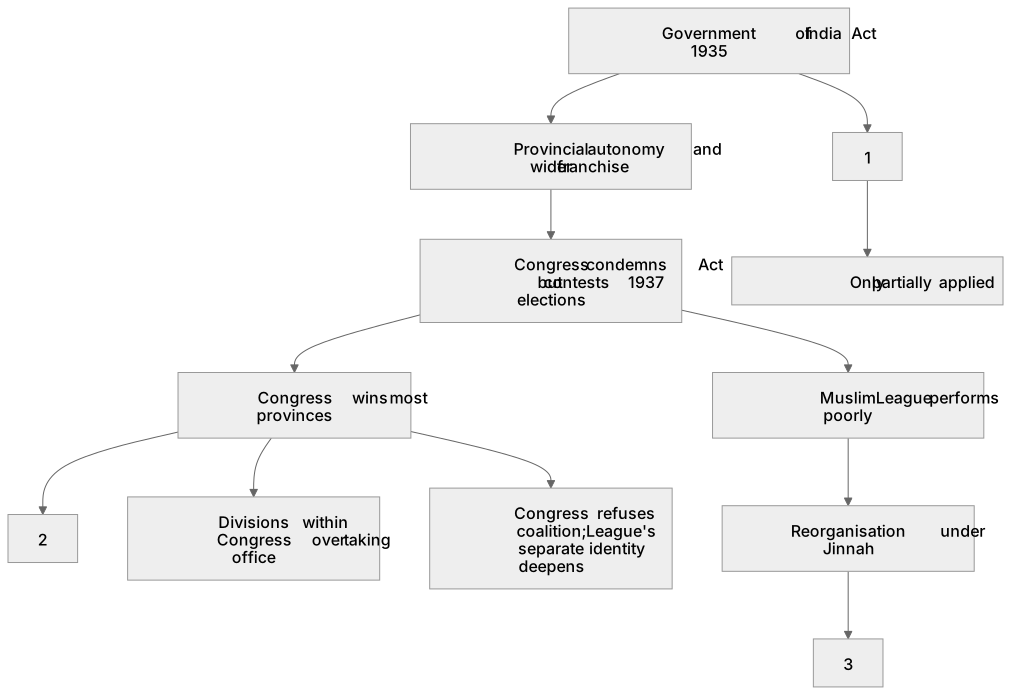
1Box 1
2Box 2
3Box 3
There is more to this lesson
The full lesson goes on to check your understanding and help you earn the marks. Create a free account to carry on, with your progress saved.
A week of Premium from your first lesson · Then the free plan continues · No card, no charge
Test your understanding of Consultation and confrontation, 1930–42: Government of India Act and its impact, 1935–39: partial implementation; nationalist response. Outcome of the 1937 elections; rejuvenation of the Muslim League; divisions within Congress; attitudes towards the British Raj.
Active recall beats re-reading. Take an instant quiz now to test what you’ve learned and lock it into long-term memory.
A week of Premium from your first lesson · Then the free plan continues · No card, no charge