Pearson Edexcel · A-Level · History
Course version: 9HI0 · Version from Sept 2015
The failure of the Popular Front 1936: election of February 1936;…
Full specification wording
Creation and destabilisation of the Second Republic, 1930–36: The failure of the Popular Front 1936: election of February 1936; political instability and social unrest; the significance of Sotelo’s assassination; the attempted coup July 1936.
The Popular Front won the February 1936 elections, but its victory failed to bring stability.
Checked against the Pearson Edexcel 9HI0 specification (opens in a new tab) on .
- Point 4 of 4
- 3 key terms
Study notes
From the checked teaching notes for this specification point.
The idea
The Popular Front won the February 1936 elections, but its victory failed to bring stability. Political instability and social unrest escalated, characterised by strikes, land occupations, and violent clashes between left and right-wing factions. The assassination of José Calvo Sotelo, a leading right-wing politician, in July 1936 acted as a crucial catalyst for military rebellion. Because state police (Assault Guards) were involved in the killing, the government was blamed, providing a pretext for the right. The attempted coup in July 1936, led by generals including Franco, failed to take immediate control of major cities like Madrid, but it successfully fractured the country and sparked the Spanish Civil War, which ultimately destroyed the Second Republic in 1939.
What earns the marks
- Election of February 1936: the Popular Front, an electoral coalition of left-wing parties, secured a narrow victory, returning the left to power and polarising the nation.
- Political instability and social unrest: the election aftermath saw widespread strikes, illegal land seizures by peasants, and escalating retaliatory violence between political extremes.
- The attempted coup July 1936: military conspirators launched a rebellion that failed to seize total control of Spain, resulting in a divided nation and the outbreak of the Spanish Civil War.
Common mistakes and how to put them right
Thinking the Popular Front was a single political party.
Put it right: It was an electoral coalition of various left-wing and republican parties united primarily to defeat the right.
Stating the July 1936 coup marked the immediate end of the Second Republic.
Put it right: The coup failed to take full control, sparking a Civil War; the Republic survived in divided form until 1939.
Attributing Sotelo's assassination solely to independent militants.
Put it right: The involvement of the state police (Guardia de Asalto) was crucial, as it allowed the right to blame the government and justify the coup.
Exam tips
- Use precise dates, such as the election on 16 February 1936 and the coup on 17–18 July 1936.
- When discussing Sotelo's assassination, explicitly mention the Assault Guards to explain why the government was held responsible by the right.
Try the lesson
The start of the Creation and destabilisation of the Second Republic, 1930–36: The failure of the Popular Front 1936: election of February 1936; political instability and social unrest; the significance of Sotelo’s assassination; the attempted coup July 1936. lesson, made from checked teaching notes for this specification point.
Have a go first
In which month and year did the Popular Front win the Spanish general election?
Listen
The Popular Front won the February 1936 elections, but its victory failed to bring stability. Political instability and social unrest escalated, characterised by strikes, land occupations, and violent clashes between left and right-wing factions. The assassination of José Calvo Sotelo, a leading right-wing politician, in July 1936 acted as a crucial catalyst for military rebellion. Because state police (Assault Guards) were involved in the killing, the government was blamed, providing a pretext for the right. The attempted coup in July 1936, led by generals including Franco, failed to take immediate control of major cities like Madrid, but it successfully fractured the country and sparked the Spanish Civil War, which ultimately destroyed the Second Republic in 1939. A strong answer earns marks for these points. Election of February 1936: the Popular Front, an electoral coalition of left-wing parties, secured a narrow victory, returning the left to power and polarising the nation. Political instability and social unrest: the election aftermath saw widespread strikes, illegal land seizures by peasants, and escalating retaliatory violence between political extremes. The significance of Sotelo’s assassination: the July 1936 murder of the right-wing leader by leftist militants and state police (Assault Guards) outraged the right and provided the immediate justification for a military uprising. The attempted coup July 1936: military conspirators launched a rebellion that failed to seize total control of Spain, resulting in a divided nation and the outbreak of the Spanish Civil War. A common slip: Thinking the Popular Front was a single political party. Instead, It was an electoral coalition of various left-wing and republican parties united primarily to defeat the right. Exam tip: Use precise dates, such as the election on 16 February 1936 and the coup on 17–18 July 1936.
See it
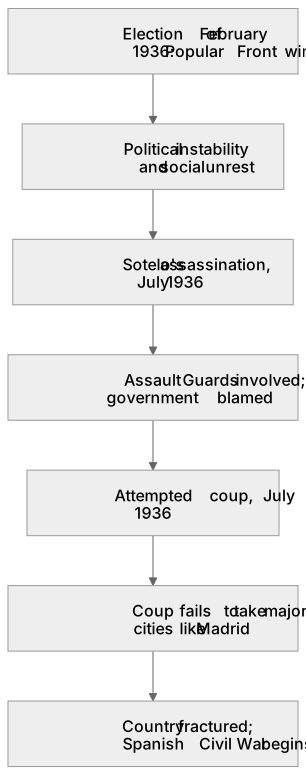
Put it in order
Put these steps in the order they happen.
- 1. Country fractured; Spanish Civil War begins
- 2. Coup fails to take major cities like Madrid
- 3. Sotelo's assassination, July 1936
- 4. Attempted coup, July 1936
- 5. Election of February 1936: Popular Front wins
- 6. Political instability and social unrest
- 7. Assault Guards involved; government blamed
Key words
Say what each word means before you turn the card.
Political instability and social unrest
Try answering aloud or in your head before turning the card.
The significance of Sotelo’s assassination
Try answering aloud or in your head before turning the card.
The attempted coup July 1936
Try answering aloud or in your head before turning the card.
See every definition
- Political instability and social unrest
- The election aftermath saw widespread strikes, illegal land seizures by peasants, and escalating retaliatory violence between political extremes.
- The significance of Sotelo’s assassination
- The July 1936 murder of the right-wing leader by leftist militants and state police outraged the right and provided the immediate justification for a military uprising.
- The attempted coup July 1936
- Military conspirators launched a rebellion that failed to seize total control of Spain, resulting in a divided nation and the outbreak of the Spanish Civil War.
Label the diagram
Some boxes have lost their names. Pick the right name for each number.
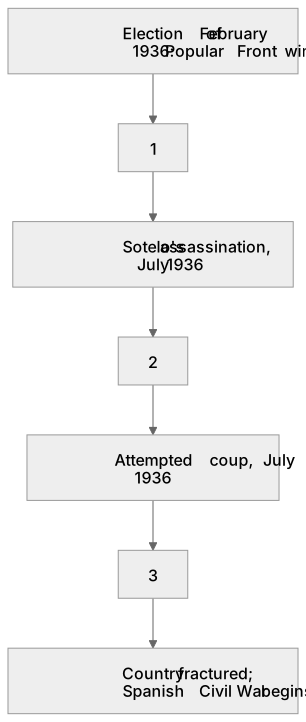
1Box 1
2Box 2
3Box 3
There is more to this lesson
The full lesson goes on to check your understanding and help you earn the marks. Create a free account to carry on, with your progress saved.
A week of Premium from your first lesson · Then the free plan continues · No card, no charge
Test your understanding of Creation and destabilisation of the Second Republic, 1930–36: The failure of the Popular Front 1936: election of February 1936; political instability and social unrest; the significance of Sotelo’s assassination; the attempted coup July 1936.
Active recall beats re-reading. Take an instant quiz now to test what you’ve learned and lock it into long-term memory.
A week of Premium from your first lesson · Then the free plan continues · No card, no charge