Pearson Edexcel · A-Level · History
Course version: 9HI0 · Version from Sept 2015
Years of reaction, 1933–36: creation of CEDA; impact of the 1933…
Full specification wording
Creation and destabilisation of the Second Republic, 1930–36: Years of reaction, 1933–36: creation of CEDA; impact of the 1933 elections; undoing the reforms of 1931–33; the Asturias rising and its consequences; formation of the Popular Front.
The period 1933–36 saw a rightward shift in Spanish politics.
Checked against the Pearson Edexcel 9HI0 specification (opens in a new tab) on .
- Point 3 of 4
- 3 key terms
Study notes
From the checked teaching notes for this specification point.
The idea
The period 1933–36 saw a rightward shift in Spanish politics. The creation of CEDA, a Catholic conservative party, mobilised right-wing support. The 1933 elections brought a centre-right government, which began undoing the reforms of 1931–33, including land reform and labour laws. This provoked the Asturias rising in 1934, a leftist revolt that was brutally suppressed, deepening polarisation. In response, left-wing parties formed the Popular Front, an electoral alliance that would win the 1936 elections. Thus, the years 1933–36 were a time of reaction and counter-reaction, setting the stage for the Civil War.
What earns the marks
- Explain the creation of CEDA as a Catholic conservative party that aimed to defend religion and property, and its role in mobilising the right.
- Analyse the impact of the 1933 elections, including the victory of the centre-right and the exclusion of the left from power.
- Describe how the reforms of 1931–33 were undone, such as the reversal of land reform and the repeal of labour legislation.
- Account for the Asturias rising of 1934, its causes and consequences, including the brutal suppression by the army and the subsequent polarisation.
- Explain the formation of the Popular Front as a left-wing electoral alliance in response to the right's actions.
Common mistakes and how to put them right
Confusing CEDA with a fascist party.
Put it right: CEDA was conservative and Catholic but not fascist, though it cooperated with the right.
Assuming the 1933 elections were won by a single party.
Put it right: They were won by a coalition of centre-right parties, not just CEDA.
Believing the Asturias rising was a general strike.
Put it right: It was a revolutionary uprising in Asturias, mainly by miners, though it had support elsewhere.
Exam tips
- Use specific examples, such as the reversal of the 1932 Agrarian Reform Law, to illustrate the undoing of reforms.
- When discussing the Asturias rising, mention the role of the army under Franco and the subsequent repression.
- Link the formation of the Popular Front to the failures of the right's reaction, showing causation.
Try the lesson
The start of the Creation and destabilisation of the Second Republic, 1930–36: Years of reaction, 1933–36: creation of CEDA; impact of the 1933 elections; undoing the reforms of 1931–33; the Asturias rising and its consequences; formation of the Popular Front. lesson, made from checked teaching notes for this specification point.
Have a go first
Which right-wing Catholic party was founded in 1933 under the leadership of José María Gil-Robles?
Listen
The period 1933–36 saw a rightward shift in Spanish politics. The creation of CEDA, a Catholic conservative party, mobilised right-wing support. The 1933 elections brought a centre-right government, which began undoing the reforms of 1931–33, including land reform and labour laws. This provoked the Asturias rising in 1934, a leftist revolt that was brutally suppressed, deepening polarisation. In response, left-wing parties formed the Popular Front, an electoral alliance that would win the 1936 elections. Thus, the years 1933–36 were a time of reaction and counter-reaction, setting the stage for the Civil War. A strong answer earns marks for these points. Explain the creation of CEDA as a Catholic conservative party that aimed to defend religion and property, and its role in mobilising the right. Analyse the impact of the 1933 elections, including the victory of the centre-right and the exclusion of the left from power. Describe how the reforms of 1931–33 were undone, such as the reversal of land reform and the repeal of labour legislation. Account for the Asturias rising of 1934, its causes and consequences, including the brutal suppression by the army and the subsequent polarisation. Exam tip: Use specific examples, such as the reversal of the 1932 Agrarian Reform Law, to illustrate the undoing of reforms.
See it
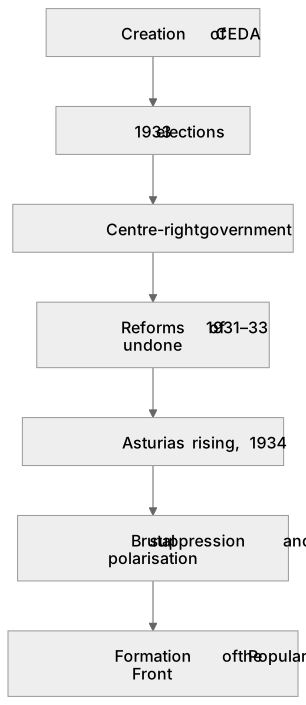
Put it in order
Put these steps in the order they happen.
- 1. Formation of the Popular Front
- 2. Brutal suppression and polarisation
- 3. Centre-right government
- 4. Asturias rising, 1934
- 5. Creation of CEDA
- 6. 1933 elections
- 7. Reforms of 1931–33 undone
Key words
Say what each word means before you turn the card.
Polarisation of Spanish politics
Try answering aloud or in your head before turning the card.
Reaction against reform
Try answering aloud or in your head before turning the card.
Formation of electoral alliances
Try answering aloud or in your head before turning the card.
See every definition
- Polarisation of Spanish politics
- The deepening of divisions between left and right, which the brutal suppression of the Asturias rising intensified.
- Reaction against reform
- The centre-right government's undoing of the reforms of 1931–33, including land reform and labour laws.
- Formation of electoral alliances
- Left-wing parties formed the Popular Front, an electoral alliance that would win the 1936 elections.
Label the diagram
Some boxes have lost their names. Pick the right name for each number.
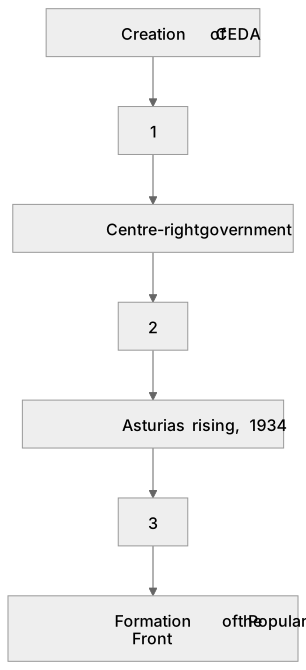
1Box 1
2Box 2
3Box 3
There is more to this lesson
The full lesson goes on to check your understanding and help you earn the marks. Create a free account to carry on, with your progress saved.
A week of Premium from your first lesson · Then the free plan continues · No card, no charge
Test your understanding of Creation and destabilisation of the Second Republic, 1930–36: Years of reaction, 1933–36: creation of CEDA; impact of the 1933 elections; undoing the reforms of 1931–33; the Asturias rising and its consequences; formation of the Popular Front.
Active recall beats re-reading. Take an instant quiz now to test what you’ve learned and lock it into long-term memory.
A week of Premium from your first lesson · Then the free plan continues · No card, no charge