Pearson Edexcel · A-Level · History
Course version: 9HI0 · Version from Sept 2015
Philip Augustus and the collapse of Henry’s power, 1180– 89: the deaths of…
Full specification wording
Crises of the Angevin Empire, 1170–89: Philip Augustus and the collapse of Henry’s power, 1180– 89: the deaths of the Young King and Geoffrey; Richard and John’s ambitions and treachery; the alliance of Philip and Richard against Henry; Henry’s defeat in 1189.
Between 1180 and 1189, Henry II’s power collapsed due to a combination of dynastic tragedy, family treachery, and the rising power of Philip Augustus of France.
Checked against the Pearson Edexcel 9HI0 specification (opens in a new tab) on .
- Point 4 of 4
- 4 key terms
Study notes
From the checked teaching notes for this specification point.
The idea
Between 1180 and 1189, Henry II’s power collapsed due to a combination of dynastic tragedy, family treachery, and the rising power of Philip Augustus of France. The deaths of the Young King (1183) and Geoffrey (1186) removed two potential rivals but also destabilised the succession, leaving Richard and John to compete for inheritance. Richard, supported by Philip Augustus, rebelled against his father in 1188–89, fearing that Henry favoured John. The alliance of Philip and Richard proved decisive: Henry was defeated at Ballan (1189) and forced to submit at Azay-le-Rideau, where he agreed to terms that included doing homage to Philip and recognising Richard as heir. Henry died shortly after, on 6 July 1189, leaving a weakened Angevin Empire. This period illustrates how internal family divisions and external Capetian pressure combined to bring about Henry’s downfall.
What earns the marks
- Explains the impact of the deaths of the Young King (1183) and Geoffrey (1186) on the Angevin succession and Henry’s political position.
- Analyses the ambitions and treachery of Richard and John, including their shifting alliances and rivalry for power.
- Describes the formation and significance of the alliance between Philip Augustus and Richard against Henry II.
- Assesses the reasons for Henry’s defeat in 1189, including military setbacks, diplomatic isolation, and failing health.
- Evaluates the consequences of Henry’s defeat, such as the terms of the peace at Azay-le-Rideau and the succession of Richard I.
Common mistakes and how to put them right
Assuming that the deaths of Henry’s older sons automatically secured Richard’s succession.
Put it right: Recognise that Henry’s reluctance to confirm Richard as heir fuelled Richard’s rebellion.
Portraying Philip Augustus as merely a mediator rather than an active opponent.
Put it right: Emphasise Philip’s strategic role in supporting Richard and weakening Henry.
Treating Henry’s defeat in 1189 as solely a military event.
Put it right: Consider the political, diplomatic, and personal factors, including Henry’s illness and the desertion of key supporters.
Exam tips
- Use precise chronology: 1183 (Young King’s death), 1186 (Geoffrey’s death), 1189 (Henry’s defeat and death) to structure your answer.
- When discussing Richard’s treachery, explain his motives: fear of disinheritance and ambition to secure the succession.
- Link the collapse of Henry’s power to the broader theme of Angevin vulnerability: internal divisions and the Capetian threat.
Try the lesson
The start of the Crises of the Angevin Empire, 1170–89: Philip Augustus and the collapse of Henry’s power, 1180– 89: the deaths of the Young King and Geoffrey; Richard and John’s ambitions and treachery; the alliance of Philip and Richard against Henry; Henry’s defeat in 1189. lesson, made from checked teaching notes for this specification point.
Have a go first
In which year did Henry II die after his defeat by Philip Augustus and Richard?
Listen
Between 1180 and 1189, Henry II’s power collapsed due to a combination of dynastic tragedy, family treachery, and the rising power of Philip Augustus of France. The deaths of the Young King (1183) and Geoffrey (1186) removed two potential rivals but also destabilised the succession, leaving Richard and John to compete for inheritance. Richard, supported by Philip Augustus, rebelled against his father in 1188–89, fearing that Henry favoured John. The alliance of Philip and Richard proved decisive: Henry was defeated at Ballan (1189) and forced to submit at Azay-le-Rideau, where he agreed to terms that included doing homage to Philip and recognising Richard as heir. Henry died shortly after, on 6 July 1189, leaving a weakened Angevin Empire. This period illustrates how internal family divisions and external Capetian pressure combined to bring about Henry’s downfall. A strong answer earns marks for these points. Explains the impact of the deaths of the Young King (1183) and Geoffrey (1186) on the Angevin succession and Henry’s political position. Analyses the ambitions and treachery of Richard and John, including their shifting alliances and rivalry for power. Describes the formation and significance of the alliance between Philip Augustus and Richard against Henry II. Assesses the reasons for Henry’s defeat in 1189, including military setbacks, diplomatic isolation, and failing health. A common slip: assuming that the deaths of Henry’s older sons automatically secured Richard’s succession. Instead, recognise that Henry’s reluctance to confirm Richard as heir fuelled Richard’s rebellion. Exam tip: Use precise chronology: 1183 (Young King’s death), 1186 (Geoffrey’s death), 1189 (Henry’s defeat and death) to structure your answer.
See it
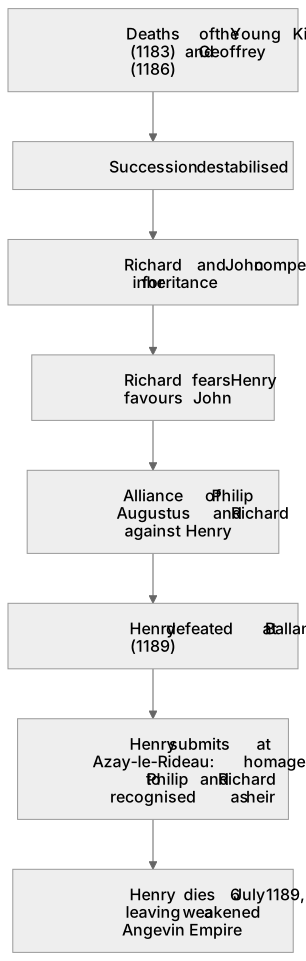
Put it in order
Put these steps in the order they happen.
- 1. Alliance of Philip Augustus and Richard against Henry
- 2. Henry dies 6 July 1189, leaving a weakened Angevin Empire
- 3. Henry defeated at Ballan (1189)
- 4. Deaths of the Young King (1183) and Geoffrey (1186)
- 5. Succession destabilised
- 6. Henry submits at Azay-le-Rideau: homage to Philip and Richard recognised as heir
- 7. Richard and John compete for inheritance
- 8. Richard fears Henry favours John
Put the events in order
Put these events in the order they happened, earliest first.
- 1. Death of the Young King
- 2. Henry defeated at Ballan and forced to submit at Azay-le-Rideau
- 3. Death of Geoffrey
Key words
Say what each word means before you turn the card.
Dynastic politics and succession
Try answering aloud or in your head before turning the card.
Family betrayal and ambition
Try answering aloud or in your head before turning the card.
Anglo-French relations and Capetian expansion
Try answering aloud or in your head before turning the card.
Collapse of royal authority
Try answering aloud or in your head before turning the card.
See every definition
- Dynastic politics and succession
- The deaths of the Young King and Geoffrey destabilised the succession, leaving Richard and John to compete for inheritance.
- Family betrayal and ambition
- Richard and John's ambitions and treachery, including their shifting alliances and rivalry for power, contributed to Henry's downfall.
- Anglo-French relations and Capetian expansion
- The alliance of Philip and Richard against Henry proved decisive, illustrating external Capetian pressure on the Angevin Empire.
- Collapse of royal authority
- Henry's power collapsed between 1180 and 1189 through dynastic tragedy, family treachery and the rising power of Philip Augustus.
Label the diagram
Some boxes have lost their names. Pick the right name for each number.
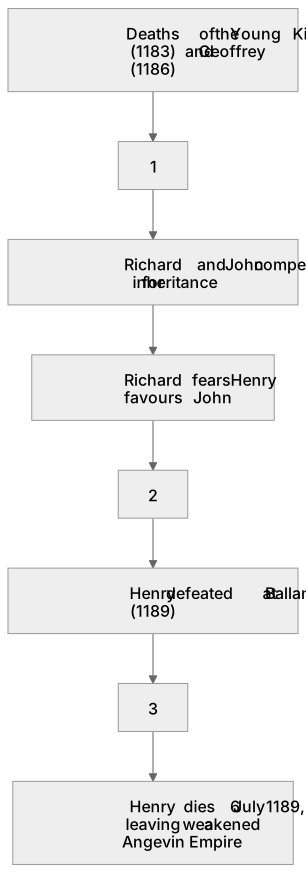
1Box 1
2Box 2
3Box 3
There is more to this lesson
The full lesson goes on to check your understanding and help you earn the marks. Create a free account to carry on, with your progress saved.
A week of Premium from your first lesson · Then the free plan continues · No card, no charge
Test your understanding of Crises of the Angevin Empire, 1170–89: Philip Augustus and the collapse of Henry’s power, 1180– 89: the deaths of the Young King and Geoffrey; Richard and John’s ambitions and treachery; the alliance of Philip and Richard against Henry; Henry’s defeat in 1189.
Active recall beats re-reading. Take an instant quiz now to test what you’ve learned and lock it into long-term memory.
A week of Premium from your first lesson · Then the free plan continues · No card, no charge