Pearson Edexcel · A-Level · History
Course version: 9HI0 · Version from Sept 2015
The defeat of the Great Rebellion: Henry’s victories in England and the…
Full specification wording
Crises of the Angevin Empire, 1170–89: The defeat of the Great Rebellion: Henry’s victories in England and the Angevin lands; the expulsion of invaders from Normandy; the capture of William the Lion; the short- term impact of Henry’s victories on royal power, 1174–80.
The Great Rebellion of 1173–74 saw Henry II face a coalition of his sons, the King of France, and disaffected nobles.
Checked against the Pearson Edexcel 9HI0 specification (opens in a new tab) on .
- Point 3 of 4
- 4 key terms
Study notes
From the checked teaching notes for this specification point.
The idea
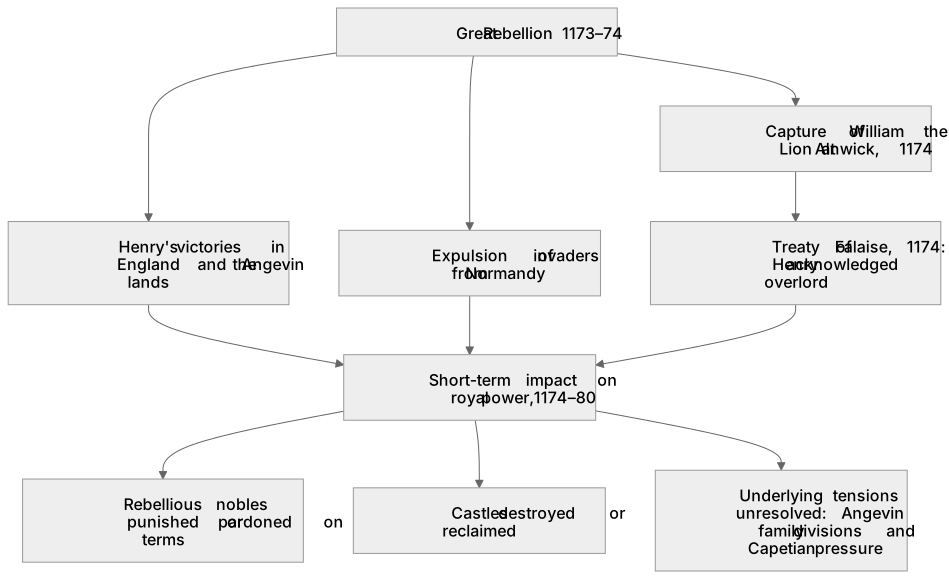
The Great Rebellion of 1173–74 saw Henry II face a coalition of his sons, the King of France, and disaffected nobles. Henry’s victory rested on rapid, decisive action: he defeated rebel forces in England and the Angevin lands, expelled invaders from Normandy, and captured William the Lion, King of Scots, at Alnwick in 1174. These successes restored his authority and demonstrated the effectiveness of his military and diplomatic leadership. In the short term, 1174–80, royal power was strengthened: rebellious nobles were punished or pardoned on terms, castles were destroyed or reclaimed, and the Scottish king was forced to accept the Treaty of Falaise (1174), acknowledging Henry as overlord. However, the underlying tensions within the Angevin family and the growing power of the French crown remained unresolved, setting the stage for later crises.
What earns the marks
- Explains Henry’s victories in England and the Angevin lands as a combination of military skill, loyalist support, and rapid response to rebellion.
- Describes the expulsion of invaders from Normandy, including the role of Henry’s forces in securing the duchy by 1174.
- Analyses the capture of William the Lion at Alnwick (1174) and its consequences, such as the Treaty of Falaise and Scottish submission.
- Assesses the short-term impact of Henry’s victories on royal power, 1174–80, including the restoration of order, punishment of rebels, and strengthened control over nobles and church.
- Evaluates the extent to which these victories resolved the underlying causes of the rebellion, noting that family divisions and Capetian pressure persisted.
Common mistakes and how to put them right
Treating the Great Rebellion as a single event rather than a series of campaigns across England, Normandy, and Anjou.
Put it right: Recognise it as a multi-theatre conflict requiring coordinated royal responses.
Assuming the capture of William the Lion ended all Scottish resistance permanently.
Put it right: Note that the Treaty of Falaise was later annulled by Richard I, and Scottish independence was restored.
Overstating the long-term security gained by Henry II after 1174.
Put it right: Acknowledge that the short-term recovery did not remove the structural threats from the Capetian monarchy or his sons’ ambitions.
Exam tips
- Use specific dates and places (e.g., Alnwick 1174, Treaty of Falaise 1174) to support your arguments and show precise knowledge.
- When discussing the short-term impact, distinguish between immediate restoration of order and the unresolved political tensions that persisted after 1180.
- Link Henry’s victories to the broader theme of royal power: consider how far they strengthened the Angevin Empire and how they were perceived by contemporaries.
Try the lesson
The start of the Crises of the Angevin Empire, 1170–89: The defeat of the Great Rebellion: Henry’s victories in England and the Angevin lands; the expulsion of invaders from Normandy; the capture of William the Lion; the short- term impact of Henry’s victories on royal power, 1174–80. lesson, made from checked teaching notes for this specification point.
Have a go first
In which year did Henry II's forces capture William the Lion, King of Scots, during the defeat of the Great Rebellion?
Listen
The Great Rebellion of 1173–74 saw Henry II face a coalition of his sons, the King of France, and disaffected nobles. Henry’s victory rested on rapid, decisive action: he defeated rebel forces in England and the Angevin lands, expelled invaders from Normandy, and captured William the Lion, King of Scots, at Alnwick in 1174. These successes restored his authority and demonstrated the effectiveness of his military and diplomatic leadership. In the short term, 1174–80, royal power was strengthened: rebellious nobles were punished or pardoned on terms, castles were destroyed or reclaimed, and the Scottish king was forced to accept the Treaty of Falaise (1174), acknowledging Henry as overlord. However, the underlying tensions within the Angevin family and the growing power of the French crown remained unresolved, setting the stage for later crises. A strong answer earns marks for these points. Explains Henry’s victories in England and the Angevin lands as a combination of military skill, loyalist support, and rapid response to rebellion. Describes the expulsion of invaders from Normandy, including the role of Henry’s forces in securing the duchy by 1174. Analyses the capture of William the Lion at Alnwick (1174) and its consequences, such as the Treaty of Falaise and Scottish submission. Assesses the short-term impact of Henry’s victories on royal power, 1174–80, including the restoration of order, punishment of rebels, and strengthened control over nobles and church. A common slip: treating the Great Rebellion as a single event rather than a series of campaigns across England, Normandy, and Anjou. Instead, recognise it as a multi-theatre conflict requiring coordinated royal responses. Exam tip: Use specific dates and places (e.g., Alnwick 1174, Treaty of Falaise 1174) to support your arguments and show precise knowledge.
See it
Key words
Say what each word means before you turn the card.
Royal authority and rebellion
Try answering aloud or in your head before turning the card.
Military leadership and strategy
Try answering aloud or in your head before turning the card.
Diplomacy and overlordship
Try answering aloud or in your head before turning the card.
Short-term recovery versus long-term instability
Try answering aloud or in your head before turning the card.
See every definition
- Royal authority and rebellion
- Henry's victories restored his authority, with rebellious nobles punished or pardoned on terms and castles destroyed or reclaimed.
- Military leadership and strategy
- Victory rested on rapid, decisive action, defeating rebel forces in England and the Angevin lands and expelling invaders from Normandy.
- Diplomacy and overlordship
- The Scottish king was forced to accept the Treaty of Falaise, acknowledging Henry as overlord.
- Short-term recovery versus long-term instability
- Royal power was strengthened in the short term, but underlying tensions within the Angevin family and the growing power of the French crown remained unresolved.
Label the diagram
Some boxes have lost their names. Pick the right name for each number.
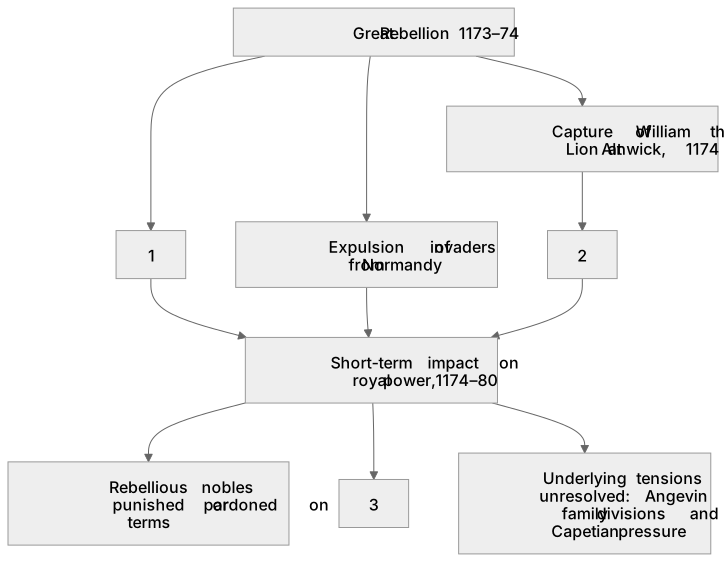
1Box 1
2Box 2
3Box 3
There is more to this lesson
The full lesson goes on to check your understanding and help you earn the marks. Create a free account to carry on, with your progress saved.
A week of Premium from your first lesson · Then the free plan continues · No card, no charge
Test your understanding of Crises of the Angevin Empire, 1170–89: The defeat of the Great Rebellion: Henry’s victories in England and the Angevin lands; the expulsion of invaders from Normandy; the capture of William the Lion; the short- term impact of Henry’s victories on royal power, 1174–80.
Active recall beats re-reading. Take an instant quiz now to test what you’ve learned and lock it into long-term memory.
A week of Premium from your first lesson · Then the free plan continues · No card, no charge