Pearson Edexcel · A-Level · History
Course version: 9HI0 · Version from Sept 2015
Bolshevik economic policies: state capitalism; War Communism; the Tambov…
Full specification wording
Defending the Bolshevik revolution, October 1917–24: Bolshevik economic policies: state capitalism; War Communism; the Tambov rising and the Kronstadt mutiny; economic and political results of the New Economic Policy; the ban on factions 1921.
Bolshevik economic policy evolved under pressure.
Checked against the Pearson Edexcel 9HI0 specification (opens in a new tab) on .
- Point 2 of 4
- 4 key terms
Study notes
From the checked teaching notes for this specification point.
The idea
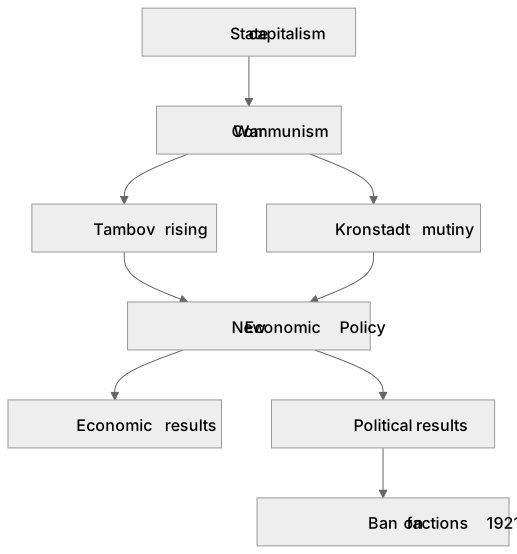
Bolshevik economic policy evolved under pressure. State capitalism (late 1917–mid 1918) allowed limited private trade and foreign concessions while nationalising banks and large industry. War Communism (1918–1921) introduced grain requisitioning, nationalisation of all industry and labour discipline to win the civil war, but caused famine and unrest. The Tambov rising (1920–1921) and Kronstadt mutiny (March 1921) were major rebellions against Bolshevik rule, forcing a rethink. The New Economic Policy (NEP) from 1921 replaced requisitioning with a tax in kind, permitted small private businesses and some foreign investment, and revived the economy, but created political tensions. In 1921, the ban on factions outlawed organised opposition within the party, strengthening central control.
What earns the marks
- Defines state capitalism as an early Bolshevik policy that combined nationalisation of banks and large industry with some private enterprise and foreign concessions, aiming to stabilise the economy.
- Explains War Communism as a set of emergency measures including grain requisitioning, nationalisation of industry, and labour conscription, designed to supply the Red Army and manage the civil war economy.
- Analyses the economic results of the NEP: recovery in agriculture and small-scale industry, but also inequality, unemployment and the emergence of 'Nepmen'.
- Evaluates how these policies and events shaped the Bolsheviks' ability to maintain power and the nature of the Soviet state by 1924.
Common mistakes and how to put them right
Confusing state capitalism with War Communism.
Put it right: Clearly distinguish the two policies and their timeframes.
Treating the Kronstadt mutiny as a peasant uprising.
Put it right: Identify the participants accurately and link to broader unrest.
Assuming the NEP was purely economic.
Put it right: Discuss both economic and political results.
Exam tips
- When comparing economic policies, consider their aims, methods and outcomes, and use specific examples such as the grain requisitioning or the tax in kind.
- Link the Tambov rising and Kronstadt mutiny to the introduction of the NEP, showing how unrest influenced policy change.
- For questions on the ban on factions, explain its significance for party unity and the development of one-party rule.
Try the lesson
The start of the Defending the Bolshevik revolution, October 1917–24: Bolshevik economic policies: state capitalism; War Communism; the Tambov rising and the Kronstadt mutiny; economic and political results of the New Economic Policy; the ban on factions 1921. lesson, made from checked teaching notes for this specification point.
Have a go first
Which policy did the Bolsheviks introduce in 1921 to replace War Communism and allow limited private trade?
Listen
Bolshevik economic policy evolved under pressure. State capitalism (late 1917–mid 1918) allowed limited private trade and foreign concessions while nationalising banks and large industry. War Communism (1918–1921) introduced grain requisitioning, nationalisation of all industry and labour discipline to win the civil war, but caused famine and unrest. The Tambov rising (1920–1921) and Kronstadt mutiny (March 1921) were major rebellions against Bolshevik rule, forcing a rethink. The New Economic Policy (NEP) from 1921 replaced requisitioning with a tax in kind, permitted small private businesses and some foreign investment, and revived the economy, but created political tensions. In 1921, the ban on factions outlawed organised opposition within the party, strengthening central control. A strong answer earns marks for these points. Defines state capitalism as an early Bolshevik policy that combined nationalisation of banks and large industry with some private enterprise and foreign concessions, aiming to stabilise the economy. Explains War Communism as a set of emergency measures including grain requisitioning, nationalisation of industry, and labour conscription, designed to supply the Red Army and manage the civil war economy. Describes the Tambov rising (1920–1921) as a peasant rebellion against grain requisitioning and Bolshevik rule, and the Kronstadt mutiny (March 1921) as a sailors' revolt demanding soviet democracy, both of which alarmed the leadership. Analyses the economic results of the NEP: recovery in agriculture and small-scale industry, but also inequality, unemployment and the emergence of 'Nepmen'. A common slip: Confusing state capitalism with War Communism: state capitalism allowed some private trade and foreign concessions, while War Communism involved extensive nationalisation and grain requisitioning. Instead, clearly distinguish the two policies and their timeframes. Exam tip: When comparing economic policies, consider their aims, methods and outcomes, and use specific examples such as the grain requisitioning or the tax in kind.
See it
Put the events in order
Put these events in the order they happened, earliest first.
- 1. War Communism introduced grain requisitioning and nationalisation of all industry
- 2. Kronstadt mutiny alarmed the leadership
- 3. Tambov rising began as a peasant rebellion against Bolshevik rule
Key words
Say what each word means before you turn the card.
state capitalism
Try answering aloud or in your head before turning the card.
War Communism
Try answering aloud or in your head before turning the card.
New Economic Policy
Try answering aloud or in your head before turning the card.
ban on factions
Try answering aloud or in your head before turning the card.
See every definition
- state capitalism
- An early Bolshevik policy that combined nationalisation of banks and large industry with some private enterprise and foreign concessions, aiming to stabilise the economy.
- War Communism
- A set of emergency measures including grain requisitioning, nationalisation of industry and labour conscription, designed to supply the Red Army and manage the civil war economy.
- New Economic Policy
- A policy from 1921 that replaced requisitioning with a tax in kind, permitted small private businesses and some foreign investment, and revived the economy but created political tensions.
- ban on factions
- A 1921 measure that outlawed organised opposition within the party, strengthening central control and accompanying the New Economic Policy.
Label the diagram
Some boxes have lost their names. Pick the right name for each number.
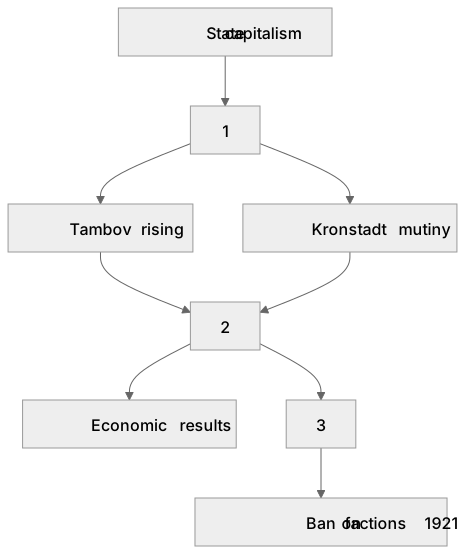
1Box 1
2Box 2
3Box 3
There is more to this lesson
The full lesson goes on to check your understanding and help you earn the marks. Create a free account to carry on, with your progress saved.
A week of Premium from your first lesson · Then the free plan continues · No card, no charge
Test your understanding of Defending the Bolshevik revolution, October 1917–24: Bolshevik economic policies: state capitalism; War Communism; the Tambov rising and the Kronstadt mutiny; economic and political results of the New Economic Policy; the ban on factions 1921.
Active recall beats re-reading. Take an instant quiz now to test what you’ve learned and lock it into long-term memory.
A week of Premium from your first lesson · Then the free plan continues · No card, no charge