Pearson Edexcel · A-Level · History
Course version: 9HI0 · Version from Sept 2015
Defeat of domestic enemies: the Social Revolutionaries, national…
Full specification wording
Defending the Bolshevik revolution, October 1917–24: Defeat of domestic enemies: the Social Revolutionaries, national minorities and the Whites; Trotsky and the Red Army; the geography of the civil war; the defeat of Kolchak, Denikin and Yudenich.
The Bolsheviks faced diverse domestic enemies: Right Social Revolutionaries (SRs) angered by the Constituent Assembly's dissolution, Left SRs who rebelled in 1918, national minorities seeking…
Checked against the Pearson Edexcel 9HI0 specification (opens in a new tab) on .
- Point 3 of 4
- 4 key terms
Study notes
From the checked teaching notes for this specification point.
The idea
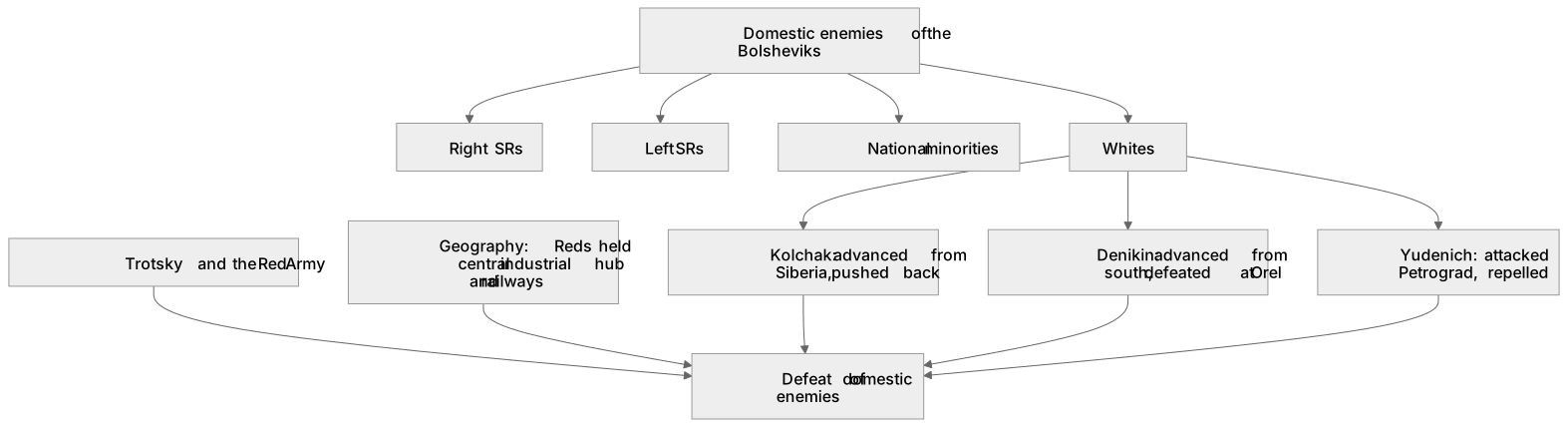
The Bolsheviks faced diverse domestic enemies: Right Social Revolutionaries (SRs) angered by the Constituent Assembly's dissolution, Left SRs who rebelled in 1918, national minorities seeking independence, and the Whites. Trotsky transformed the Red Army using conscription, strict discipline, and former tsarist officers. Geography heavily influenced the civil war: the Reds controlled the central industrial hub and rail network, while the Whites were dispersed on the periphery. Kolchak advanced from Siberia in 1919 but was defeated; Denikin moved north from the south but was stopped at Orel; Yudenich threatened Petrograd but was repulsed. These defeats secured Bolshevik survival.
What earns the marks
- Right SRs opposed Bolshevik rule following the Constituent Assembly dissolution, while Left SRs (initial coalition partners) rebelled in July 1918 over the Treaty of Brest-Litovsk.
- National minorities such as Ukrainians and Poles fought for independence, forcing the Reds to fight on multiple fronts.
- The Whites were a loose coalition of monarchists, liberals and socialists who lacked a unified command and clear political aims.
- Trotsky built the Red Army through conscription, discipline and the use of former tsarist officers (military specialists), and used an armoured train to coordinate fronts.
- Geography favoured the Reds: they held the central industrial heartland and the railway network, enabling rapid troop movement between fronts.
- Kolchak's forces advanced from Siberia in spring 1919 but were pushed back by the Red Army and lost support due to harsh treatment of peasants.
- Denikin's Volunteer Army advanced from the south towards Moscow in 1919 but was defeated at Orel and retreated to the Crimea.
- Yudenich's attack on Petrograd in October 1919 was repelled by Trotsky's forces, ending the immediate threat to the Bolshevik capital.
Common mistakes and how to put them right
Treating the Whites as a single unified army.
Put it right: The Whites were a loose coalition of different groups with conflicting aims, which hindered coordination.
Conflating Right and Left SRs as uniformly opposed to the Bolsheviks from October 1917.
Put it right: Left SRs were coalition partners until July 1918, when they rebelled over the Treaty of Brest-Litovsk.
Stating that Trotsky refused to use former tsarist officers.
Put it right: Trotsky actively recruited them as military specialists, despite opposition from some Bolsheviks.
Exam tips
- When discussing the defeat of domestic enemies, link each group to a specific front or event to show understanding of the civil war's complexity.
- Use geographical factors to explain Bolshevik advantages, such as control of railways and central position, rather than just listing battles.
Try the lesson
The start of the Defending the Bolshevik revolution, October 1917–24: Defeat of domestic enemies: the Social Revolutionaries, national minorities and the Whites; Trotsky and the Red Army; the geography of the civil war; the defeat of Kolchak, Denikin and Yudenich. lesson, made from checked teaching notes for this specification point.
Have a go first
Which figure served as the Bolsheviks' Commissar for War and was chiefly responsible for organising the Red Army during the civil war?
Listen
The Bolsheviks faced diverse domestic enemies: Right Social Revolutionaries (SRs) angered by the Constituent Assembly's dissolution, Left SRs who rebelled in 1918, national minorities seeking independence, and the Whites. Trotsky transformed the Red Army using conscription, strict discipline, and former tsarist officers. Geography heavily influenced the civil war: the Reds controlled the central industrial hub and rail network, while the Whites were dispersed on the periphery. Kolchak advanced from Siberia in 1919 but was defeated; Denikin moved north from the south but was stopped at Orel; Yudenich threatened Petrograd but was repulsed. These defeats secured Bolshevik survival. A strong answer earns marks for these points. Right SRs opposed Bolshevik rule following the Constituent Assembly dissolution, while Left SRs (initial coalition partners) rebelled in July 1918 over the Treaty of Brest-Litovsk. National minorities such as Ukrainians and Poles fought for independence, forcing the Reds to fight on multiple fronts. The Whites were a loose coalition of monarchists, liberals and socialists who lacked a unified command and clear political aims. Trotsky built the Red Army through conscription, discipline and the use of former tsarist officers (military specialists), and used an armoured train to coordinate fronts. A common slip: treating the Whites as a single unified army. Instead, the Whites were a loose coalition of different groups with conflicting aims, which hindered coordination. Exam tip: When discussing the defeat of domestic enemies, link each group to a specific front or event to show understanding of the civil war's complexity.
See it
Key words
Say what each word means before you turn the card.
Leadership and organisation
Try answering aloud or in your head before turning the card.
Geography and logistics
Try answering aloud or in your head before turning the card.
Opposition and resistance
Try answering aloud or in your head before turning the card.
Consolidation of power
Try answering aloud or in your head before turning the card.
See every definition
- Leadership and organisation
- Trotsky built the Red Army through conscription, discipline and the use of former tsarist officers, and used an armoured train to coordinate fronts.
- Geography and logistics
- The Reds held the central industrial heartland and the railway network, enabling rapid troop movement between fronts, while the Whites were dispersed on the periphery.
- Opposition and resistance
- Domestic enemies included Right SRs angered by the Constituent Assembly's dissolution, Left SRs who rebelled in 1918, national minorities seeking independence, and the Whites.
- Consolidation of power
- The defeats of Kolchak, Denikin and Yudenich secured Bolshevik survival.
Label the diagram
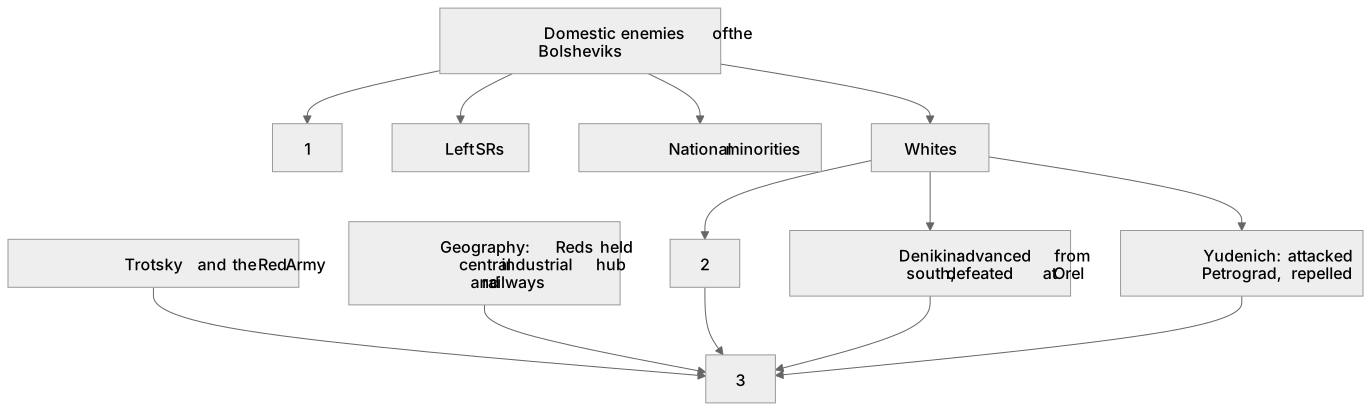
Some boxes have lost their names. Pick the right name for each number.
1Box 1
2Box 2
3Box 3
There is more to this lesson
The full lesson goes on to check your understanding and help you earn the marks. Create a free account to carry on, with your progress saved.
A week of Premium from your first lesson · Then the free plan continues · No card, no charge
Test your understanding of Defending the Bolshevik revolution, October 1917–24: Defeat of domestic enemies: the Social Revolutionaries, national minorities and the Whites; Trotsky and the Red Army; the geography of the civil war; the defeat of Kolchak, Denikin and Yudenich.
Active recall beats re-reading. Take an instant quiz now to test what you’ve learned and lock it into long-term memory.
A week of Premium from your first lesson · Then the free plan continues · No card, no charge