Pearson Edexcel · A-Level · History
Course version: 9HI0 · Version from Sept 2015
Controlling the economy, 1933–45: attempting economic recovery, 1933–36;…
Full specification wording
Economic development and policies, 1918–89: Controlling the economy, 1933–45: attempting economic recovery, 1933–36; creating a command economy, 1936– 39; changing living standards 1933–39; impact of war, 1939–45.
This topic examines state control of the economy from 1933 to 1945.
Checked against the Pearson Edexcel 9HI0 specification (opens in a new tab) on .
- Point 2 of 3
- 4 key terms
Study notes
From the checked teaching notes for this specification point.
The idea
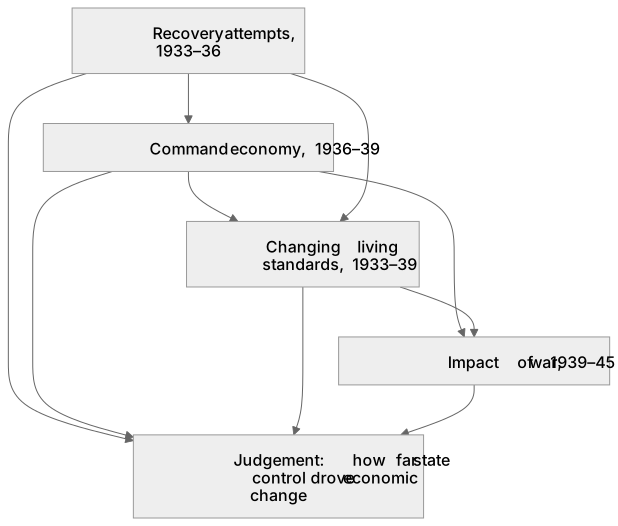
This topic examines state control of the economy from 1933 to 1945. Begin with recovery attempts in 1933–36: public works, rearmament and measures to cut unemployment, and judge how far they revived output. Then study the command economy of 1936–39, including central planning, targets and the priority given to heavy industry and armaments, and assess the costs as well as achievements. Next analyse changing living standards 1933–39, comparing workers, peasants, women and consumers, and weighing rising employment against shortages, rationing and coercion. Finally evaluate the impact of war, 1939–45: evacuation of industry, total mobilisation and the human and economic price. Use production figures, plans and testimony as evidence, and argue about the degree of state control and its consequences rather than narrating events.
What earns the marks
- Explains recovery attempts 1933–36, such as public works and rearmament, and evaluates their effect on unemployment and output.
- Analyses the command economy 1936–39: central planning, targets and heavy-industry priorities, with their achievements and costs.
- Judges changing living standards 1933–39 across workers, peasants, women and consumers, using employment, wages and shortages as evidence.
- Evaluates the impact of war 1939–45, including industrial relocation, total mobilisation and human and economic costs.
- Sustains a judgement about how far state control, rather than other factors, drove economic change.
Common mistakes and how to put them right
Equating recovery with prosperity.
Put it right by distinguishing falling unemployment from low real wages and shortages.
Treating plans as automatically fulfilled.
Put it right by noting shortfalls, bottlenecks and coercion.
Assuming war only damaged the economy.
Put it right by weighing industrial relocation and mobilisation against devastation.
Exam tips
- Use a plan or production figure as evidence, then explain what it shows about state control.
- Compare social groups when assessing living standards, rather than generalising.
- Frame conclusions around degrees of control and their consequences.
Try the lesson
The start of the Economic development and policies, 1918–89: Controlling the economy, 1933–45: attempting economic recovery, 1933–36; creating a command economy, 1936– 39; changing living standards 1933–39; impact of war, 1939–45. lesson, made from checked teaching notes for this specification point.
Have a go first
Which policy was introduced by the Nazi regime in 1933 to stimulate economic recovery and reduce mass unemployment?
Listen
This topic examines state control of the economy from 1933 to 1945. Begin with recovery attempts in 1933–36: public works, rearmament and measures to cut unemployment, and judge how far they revived output. Then study the command economy of 1936–39, including central planning, targets and the priority given to heavy industry and armaments, and assess the costs as well as achievements. Next analyse changing living standards 1933–39, comparing workers, peasants, women and consumers, and weighing rising employment against shortages, rationing and coercion. Finally evaluate the impact of war, 1939–45: evacuation of industry, total mobilisation and the human and economic price. Use production figures, plans and testimony as evidence, and argue about the degree of state control and its consequences rather than narrating events. A strong answer earns marks for these points. Explains recovery attempts 1933–36, such as public works and rearmament, and evaluates their effect on unemployment and output. Analyses the command economy 1936–39: central planning, targets and heavy-industry priorities, with their achievements and costs. Judges changing living standards 1933–39 across workers, peasants, women and consumers, using employment, wages and shortages as evidence. Evaluates the impact of war 1939–45, including industrial relocation, total mobilisation and human and economic costs. A common slip: Equating recovery with prosperity. Instead, distinguishing falling unemployment from low real wages and shortages. Exam tip: Use a plan or production figure as evidence, then explain what it shows about state control.
See it
Key words
Say what each word means before you turn the card.
State-led recovery
Try answering aloud or in your head before turning the card.
Central planning and targets
Try answering aloud or in your head before turning the card.
Living standards under control
Try answering aloud or in your head before turning the card.
War and total mobilisation
Try answering aloud or in your head before turning the card.
See every definition
- State-led recovery
- Attempts in 1933–36, such as public works and rearmament, to revive output and cut unemployment, judged by how far they did so.
- Central planning and targets
- The command economy of 1936–39, in which plans and targets set priorities for heavy industry and armaments, with achievements and costs.
- Living standards under control
- Changing living standards 1933–39 across workers, peasants, women and consumers, weighing rising employment against shortages, rationing and coercion.
- War and total mobilisation
- The impact of war 1939–45, including evacuation of industry and total mobilisation, weighed against the human and economic price.
Label the diagram
Some boxes have lost their names. Pick the right name for each number.
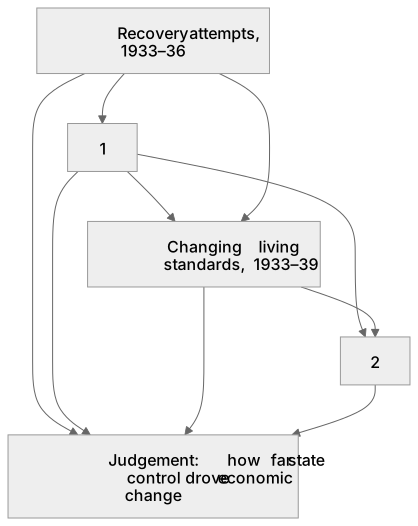
1Box 1
2Box 2
There is more to this lesson
The full lesson goes on to check your understanding and help you earn the marks. Create a free account to carry on, with your progress saved.
A week of Premium from your first lesson · Then the free plan continues · No card, no charge
Test your understanding of Economic development and policies, 1918–89: Controlling the economy, 1933–45: attempting economic recovery, 1933–36; creating a command economy, 1936– 39; changing living standards 1933–39; impact of war, 1939–45.
Active recall beats re-reading. Take an instant quiz now to test what you’ve learned and lock it into long-term memory.
A week of Premium from your first lesson · Then the free plan continues · No card, no charge