Pearson Edexcel · A-Level · History
Course version: 9HI0 · Version from Sept 2015
Creating a social market economy, 1945–89: economic recovery, 1945–55; the…
Full specification wording
Economic development and policies, 1918–89: Creating a social market economy, 1945–89: economic recovery, 1945–55; the ‘economic miracle’, 1955–66; surviving economic challenges, 1966–1989. Integration into the European economy, 1949–89; changing living standards, 1945–89.
This topic examines West Germany's economic transformation.
Checked against the Pearson Edexcel 9HI0 specification (opens in a new tab) on .
- Point 3 of 3
- 4 key terms
Study notes
From the checked teaching notes for this specification point.
The idea
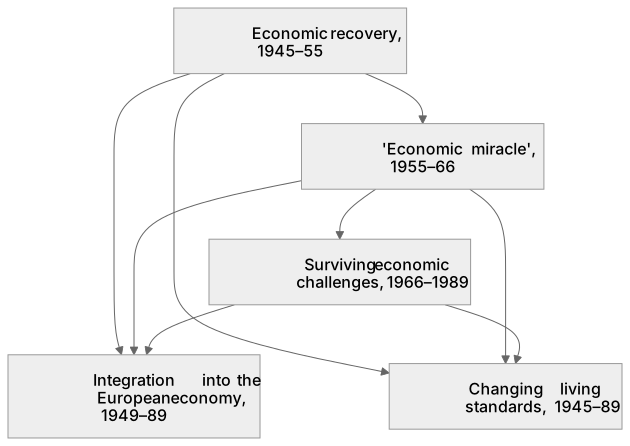
This topic examines West Germany's economic transformation. Creating a social market economy, 1945–89, combined free-market competition with social welfare, aiding economic recovery, 1945–55, via currency reform (1948) and Marshall Aid. The 'economic miracle', 1955–66, saw rapid growth, full employment and rising exports. Surviving economic challenges, 1966–1989, involved managing the 1966–67 recession, 1970s oil shocks, and rising unemployment. Integration into the European economy, 1949–89, included the ECSC (1951) and EEC (1957), boosting trade. Changing living standards, 1945–89, saw marked improvements in wages, consumer goods and welfare, though inequalities persisted.
What earns the marks
- Explains how creating a social market economy blended free-market principles with social welfare, promoting economic recovery, 1945–55.
- Assesses the causes and extent of the 'economic miracle', 1955–66, including export growth and labour supply.
- Evaluates surviving economic challenges, 1966–1989, such as the 1966–67 recession, the 1973 oil crisis, and rising unemployment.
- Analyses West Germany's integration into the European economy, 1949–89, including the ECSC and EEC.
- Assesses changing living standards, 1945–89, considering wages, consumption, welfare and regional or social disparities.
Common mistakes and how to put them right
Treating the 'economic miracle' as solely due to Marshall Aid.
Put it right: Recognise multiple factors, including currency reform, Erhard's policies, and a skilled labour force.
Assuming living standards rose uniformly.
Put it right: Note that prosperity was uneven, with guest workers and some groups facing poorer conditions.
Confusing the dates of European integration.
Put it right: The ECSC was established in 1951 and the EEC in 1957.
Exam tips
- Use specific economic data, such as GDP growth rates or unemployment figures, to support arguments.
- Link economic developments to their social and political consequences to show depth.
- Compare different periods to highlight change and continuity across 1945–89.
Try the lesson
The start of the Economic development and policies, 1918–89: Creating a social market economy, 1945–89: economic recovery, 1945–55; the ‘economic miracle’, 1955–66; surviving economic challenges, 1966–1989. Integration into the European economy, 1949–89; changing living standards, 1945–89. lesson, made from checked teaching notes for this specification point.
Have a go first
Which currency replaced the Reichsmark in the western occupation zones in June 1948 as part of the move towards a social market economy?
Listen
This topic examines West Germany's economic transformation. Creating a social market economy, 1945–89, combined free-market competition with social welfare, aiding economic recovery, 1945–55, via currency reform (1948) and Marshall Aid. The 'economic miracle', 1955–66, saw rapid growth, full employment and rising exports. Surviving economic challenges, 1966–1989, involved managing the 1966–67 recession, 1970s oil shocks, and rising unemployment. Integration into the European economy, 1949–89, included the ECSC (1951) and EEC (1957), boosting trade. Changing living standards, 1945–89, saw marked improvements in wages, consumer goods and welfare, though inequalities persisted. A strong answer earns marks for these points. Explains how creating a social market economy blended free-market principles with social welfare, promoting economic recovery, 1945–55. Assesses the causes and extent of the 'economic miracle', 1955–66, including export growth and labour supply. Evaluates surviving economic challenges, 1966–1989, such as the 1966–67 recession, the 1973 oil crisis, and rising unemployment. Analyses West Germany's integration into the European economy, 1949–89, including the ECSC and EEC. A common slip: treating the 'economic miracle' as solely due to Marshall Aid. Instead, recognise multiple factors, including currency reform, Erhard's policies, and a skilled labour force. Exam tip: Use specific economic data, such as GDP growth rates or unemployment figures, to support arguments.
See it
Put the events in order
Put these events in the order they happened, earliest first.
- 1. Oil crisis among economic challenges
- 2. Currency reform aided economic recovery
- 3. Establishment of the EEC
- 4. Establishment of the ECSC
Key words
Say what each word means before you turn the card.
Social market economy
Try answering aloud or in your head before turning the card.
Economic miracle
Try answering aloud or in your head before turning the card.
Economic challenges
Try answering aloud or in your head before turning the card.
European integration
Try answering aloud or in your head before turning the card.
See every definition
- Social market economy
- A system combining free-market competition with social welfare, which aided economic recovery in 1945–55.
- Economic miracle
- Rapid growth, full employment and rising exports seen in 1955–66.
- Economic challenges
- Difficulties from 1966 to 1989 including the 1966–67 recession, 1970s oil shocks and rising unemployment.
- European integration
- Integration into the European economy, 1949–89, including the ECSC and EEC, which boosted trade.
Label the diagram
Some boxes have lost their names. Pick the right name for each number.
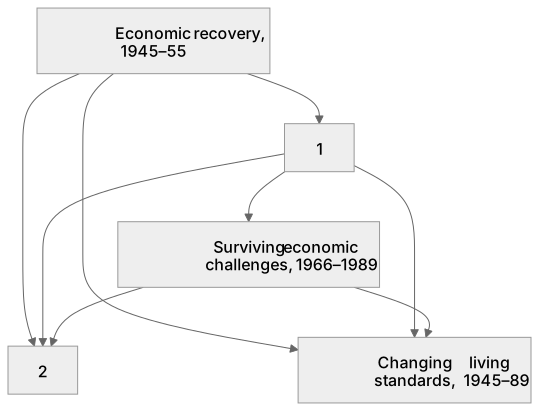
1Box 1
2Box 2
There is more to this lesson
The full lesson goes on to check your understanding and help you earn the marks. Create a free account to carry on, with your progress saved.
A week of Premium from your first lesson · Then the free plan continues · No card, no charge
Test your understanding of Economic development and policies, 1918–89: Creating a social market economy, 1945–89: economic recovery, 1945–55; the ‘economic miracle’, 1955–66; surviving economic challenges, 1966–1989. Integration into the European economy, 1949–89; changing living standards, 1945–89.
Active recall beats re-reading. Take an instant quiz now to test what you’ve learned and lock it into long-term memory.
A week of Premium from your first lesson · Then the free plan continues · No card, no charge