Pearson Edexcel · A-Level · History
Course version: 9HI0 · Version from Sept 2015
The post-war division of Germany; the Soviet zone; creation of the…
Full specification wording
Establishing and consolidating communist rule in the GDR, c1949–61: The post-war division of Germany; the Soviet zone; creation of the Socialist Unity Party (SED) 1946; growing divisions among the victor powers; formation of the GDR 1949.
After 1945 the victor powers divided Germany into four occupation zones, with the Soviet zone in the east.
Checked against the Pearson Edexcel 9HI0 specification (opens in a new tab) on .
- Point 1 of 4
- 4 key terms
Study notes
From the checked teaching notes for this specification point.
The idea
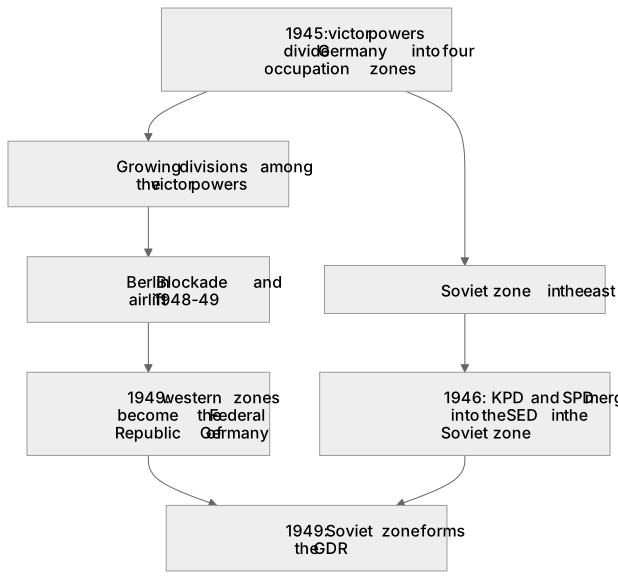
After 1945 the victor powers divided Germany into four occupation zones, with the Soviet zone in the east. In 1946 the Soviet Military Administration forced the merger of the KPD and SPD in its zone into the Socialist Unity Party (SED), giving communists a dominant but not sole voice. Growing divisions among the victor powers over reparations, economic policy and Germany's future turned the zones into rival political and economic systems. The Berlin Blockade and airlift of 1948–49 hardened this split. In 1949 the western zones became the Federal Republic of Germany, and the Soviet zone responded by forming the German Democratic Republic (GDR). This sequence explains how a single defeated state became two rival republics and why the GDR's founding was tied to Soviet policy and Cold War confrontation.
What earns the marks
- Explains the four-power occupation framework established in 1945 and locates the Soviet zone in the east of Germany.
- Explains that the SED was created in 1946 through the merger of the KPD and SPD in the Soviet zone, and that this gave organised communists a dominant position in zonal politics.
- Analyses how disagreements among the victor powers over reparations, economic reconstruction and the political future of Germany produced growing division rather than joint administration.
- Links the Berlin Blockade and airlift of 1948–49 to the hardening of the East–West split and the move towards separate states.
- Explains the formation of the GDR in 1949 as the Soviet-zone response to the creation of the Federal Republic of Germany in the western zones.
- Uses accurate chronology and causation to show how division, party merger and state formation connect rather than treating them as isolated events.
Common mistakes and how to put them right
Treating the SED as a completely new party with no predecessor organisations.
Put it right: Explain that it was formed by merging the KPD and SPD in the Soviet zone in 1946.
Assuming the GDR was created at the same moment as the western Federal Republic without explaining the sequence.
Put it right: Show that the western state came first in 1949 and the GDR followed as the Soviet-zone response.
Describing the division of Germany as a single event in 1945.
Put it right: Present it as a process running from zonal occupation through growing victor-power divisions to the formation of two states by 1949.
Exam tips
- Build answers around causation: show how each development created conditions for the next, from zonal division to SED merger to separate states.
- Use precise dates and names, including 1945, 1946, 1948–49 and 1949, to anchor the narrative and avoid vague chronology.
- When assessing significance, distinguish between Soviet actions inside its zone and wider victor-power conflict, then explain how the two interacted.
Try the lesson
The start of the Establishing and consolidating communist rule in the GDR, c1949–61: The post-war division of Germany; the Soviet zone; creation of the Socialist Unity Party (SED) 1946; growing divisions among the victor powers; formation of the GDR 1949. lesson, made from checked teaching notes for this specification point.
Have a go first
In which year was the Socialist Unity Party (SED) created in the Soviet zone of Germany?
Listen
After 1945 the victor powers divided Germany into four occupation zones, with the Soviet zone in the east. In 1946 the Soviet Military Administration forced the merger of the KPD and SPD in its zone into the Socialist Unity Party (SED), giving communists a dominant but not sole voice. Growing divisions among the victor powers over reparations, economic policy and Germany's future turned the zones into rival political and economic systems. The Berlin Blockade and airlift of 1948–49 hardened this split. In 1949 the western zones became the Federal Republic of Germany, and the Soviet zone responded by forming the German Democratic Republic (GDR). This sequence explains how a single defeated state became two rival republics and why the GDR's founding was tied to Soviet policy and Cold War confrontation. A strong answer earns marks for these points. Explains the four-power occupation framework established in 1945 and locates the Soviet zone in the east of Germany. Explains that the SED was created in 1946 through the merger of the KPD and SPD in the Soviet zone, and that this gave organised communists a dominant position in zonal politics. Analyses how disagreements among the victor powers over reparations, economic reconstruction and the political future of Germany produced growing division rather than joint administration. Links the Berlin Blockade and airlift of 1948–49 to the hardening of the East–West split and the move towards separate states. A common slip: Treating the SED as a completely new party with no predecessor organisations. Instead, explain that it was formed by merging the KPD and SPD in the Soviet zone in 1946. Exam tip: Build answers around causation: show how each development created conditions for the next, from zonal division to SED merger to separate states.
See it
Key words
Say what each word means before you turn the card.
Post-war occupation and the division of Germany
Try answering aloud or in your head before turning the card.
Communist consolidation through party merger
Try answering aloud or in your head before turning the card.
Growing Cold War divisions among the victor powers
Try answering aloud or in your head before turning the card.
The emergence of two German states by 1949
Try answering aloud or in your head before turning the card.
See every definition
- Post-war occupation and the division of Germany
- After 1945 the victor powers divided Germany into four occupation zones, with the Soviet zone in the east.
- Communist consolidation through party merger
- In 1946 the Soviet Military Administration forced the merger of the KPD and SPD in its zone into the Socialist Unity Party (SED), giving communists a dominant but not sole voice.
- Growing Cold War divisions among the victor powers
- Growing divisions among the victor powers over reparations, economic policy and Germany's future turned the zones into rival political and economic systems.
- The emergence of two German states by 1949
- In 1949 the western zones became the Federal Republic of Germany, and the Soviet zone responded by forming the German Democratic Republic (GDR).
Label the diagram
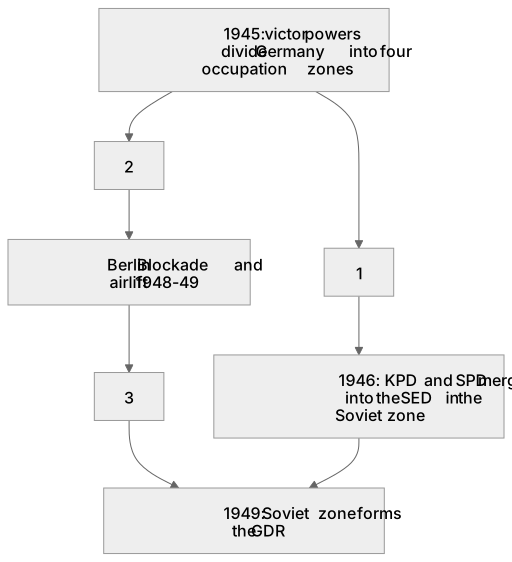
Some boxes have lost their names. Pick the right name for each number.
1Box 1
2Box 2
3Box 3
There is more to this lesson
The full lesson goes on to check your understanding and help you earn the marks. Create a free account to carry on, with your progress saved.
A week of Premium from your first lesson · Then the free plan continues · No card, no charge
Test your understanding of Establishing and consolidating communist rule in the GDR, c1949–61: The post-war division of Germany; the Soviet zone; creation of the Socialist Unity Party (SED) 1946; growing divisions among the victor powers; formation of the GDR 1949.
Active recall beats re-reading. Take an instant quiz now to test what you’ve learned and lock it into long-term memory.
A week of Premium from your first lesson · Then the free plan continues · No card, no charge