Pearson Edexcel · A-Level · History
Course version: 9HI0 · Version from Sept 2015
The system of government: the head of state; the Volkskammer; the…
Full specification wording
Establishing and consolidating communist rule in the GDR, c1949–61: The system of government: the head of state; the Volkskammer; the Länderkammer; the dominance of the SED and its General Secretary, Ulbricht.
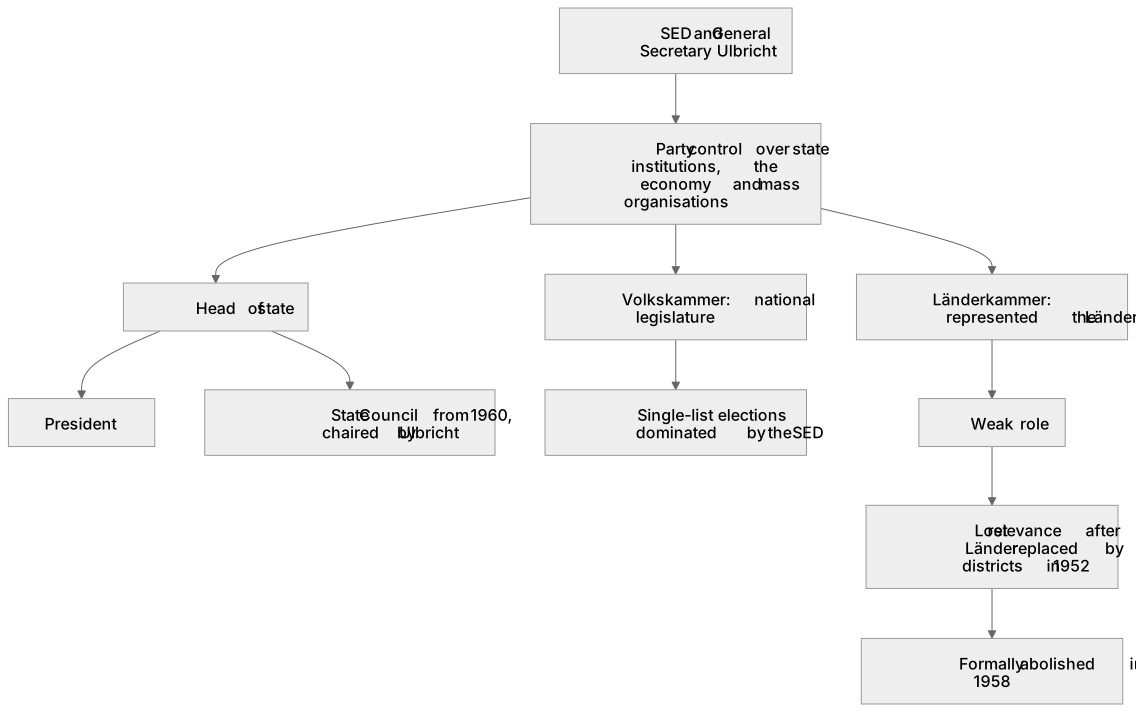
The GDR's 1949 constitution created a system of government that appeared pluralist but concentrated real power in the SED.
Checked against the Pearson Edexcel 9HI0 specification (opens in a new tab) on .
- Point 2 of 4
- 4 key terms
Study notes
From the checked teaching notes for this specification point.
The idea
The GDR's 1949 constitution created a system of government that appeared pluralist but concentrated real power in the SED. The head of state was initially the President, a largely ceremonial figure; in 1960, this was replaced by the State Council, chaired by Ulbricht. The Volkskammer was the national legislature, elected on a single list dominated by the SED, so it legitimised decisions rather than debated them independently. The Länderkammer represented the Länder, but its role was weak; it lost relevance when the Länder were replaced by districts in 1952 and was formally abolished in 1958. Walter Ulbricht, as General Secretary of the SED, used party control over state institutions, the economy and mass organisations to dominate the GDR. This explains how the SED turned constitutional forms into instruments of one-party rule.
What earns the marks
- Identifies the head of state as initially the President, replaced in 1960 by the State Council, and explains that the office carried limited independent political power until Ulbricht assumed its chairmanship.
- Explains the role of the Volkskammer as the national legislature and how single-list elections and SED control limited genuine political competition.
- Explains the Länderkammer as a chamber representing the Länder and notes its weak influence, its decline after the 1952 district reforms, and its formal abolition in 1958.
- Analyses how the SED dominated state institutions, elections, mass organisations and the economy, making the constitution a framework for one-party rule rather than pluralist democracy.
- Explains Walter Ulbricht's position as General Secretary of the SED and how he used party authority to direct government and state policy.
- Evaluates the gap between the GDR's constitutional forms and the reality of SED control, using specific institutions as evidence.
Common mistakes and how to put them right
Assuming the Volkskammer was a genuinely competitive parliament.
Put it right: Explain that single-list elections and SED dominance meant it mainly approved decisions already made by the party.
Confusing the Länderkammer with the Volkskammer.
Put it right: Distinguish the national legislature from the chamber representing the Länder, and to note the Länderkammer's formal abolition in 1958.
Treating the President as the most powerful figure throughout the period.
Put it right: Explain that the presidency was largely ceremonial and was replaced in 1960 by the State Council, which Ulbricht chaired to consolidate his power.
Exam tips
- Use the constitution as a starting point, then explain how practice diverged from it, naming the Volkskammer, Länderkammer and head of state.
- Link institutional detail to the concept of one-party dominance, showing how the SED controlled nominations, elections and policy.
- Support claims about Ulbricht's dominance with examples of party control over state and society rather than treating his title alone as sufficient explanation.
Try the lesson
The start of the Establishing and consolidating communist rule in the GDR, c1949–61: The system of government: the head of state; the Volkskammer; the Länderkammer; the dominance of the SED and its General Secretary, Ulbricht. lesson, made from checked teaching notes for this specification point.
Have a go first
Which position did Walter Ulbricht assume in 1950, allowing him to exercise dominant political control over the GDR?
Listen
The GDR's 1949 constitution created a system of government that appeared pluralist but concentrated real power in the SED. The head of state was initially the President, a largely ceremonial figure; in 1960, this was replaced by the State Council, chaired by Ulbricht. The Volkskammer was the national legislature, elected on a single list dominated by the SED, so it legitimised decisions rather than debated them independently. The Länderkammer represented the Länder, but its role was weak; it lost relevance when the Länder were replaced by districts in 1952 and was formally abolished in 1958. Walter Ulbricht, as General Secretary of the SED, used party control over state institutions, the economy and mass organisations to dominate the GDR. This explains how the SED turned constitutional forms into instruments of one-party rule. A strong answer earns marks for these points. Identifies the head of state as initially the President, replaced in 1960 by the State Council, and explains that the office carried limited independent political power until Ulbricht assumed its chairmanship. Explains the role of the Volkskammer as the national legislature and how single-list elections and SED control limited genuine political competition. Explains the Länderkammer as a chamber representing the Länder and notes its weak influence, its decline after the 1952 district reforms, and its formal abolition in 1958. Analyses how the SED dominated state institutions, elections, mass organisations and the economy, making the constitution a framework for one-party rule rather than pluralist democracy. A common slip: Assuming the Volkskammer was a genuinely competitive parliament. Instead, explain that single-list elections and SED dominance meant it mainly approved decisions already made by the party. Exam tip: Use the constitution as a starting point, then explain how practice diverged from it, naming the Volkskammer, Länderkammer and head of state.
See it
Put the events in order
Put these events in the order they happened, earliest first.
- 1. Presidency replaced by the State Council
- 2. Constitution created a system of government appearing pluralist
- 3. Länderkammer formally abolished
- 4. Länder replaced by districts
Key words
Say what each word means before you turn the card.
Constitutional forms and one-party reality
Try answering aloud or in your head before turning the card.
SED dominance of state institutions
Try answering aloud or in your head before turning the card.
The role of Walter Ulbricht
Try answering aloud or in your head before turning the card.
Centralisation and the weakening of federal structures
Try answering aloud or in your head before turning the card.
See every definition
- Constitutional forms and one-party reality
- The gap between the GDR's pluralist-looking constitution and the concentration of real power in the SED, which turned constitutional forms into instruments of one-party rule.
- SED dominance of state institutions
- Party control over state institutions, elections, mass organisations and the economy, making the constitution a framework for one-party rule rather than pluralist democracy.
- The role of Walter Ulbricht
- As General Secretary of the SED he used party authority to direct government and state policy, and chaired the State Council from 1960.
- Centralisation and the weakening of federal structures
- The Länderkammer's role was weak, it lost relevance when the Länder were replaced by districts in 1952, and it was formally abolished in 1958.
Label the diagram
Some boxes have lost their names. Pick the right name for each number.
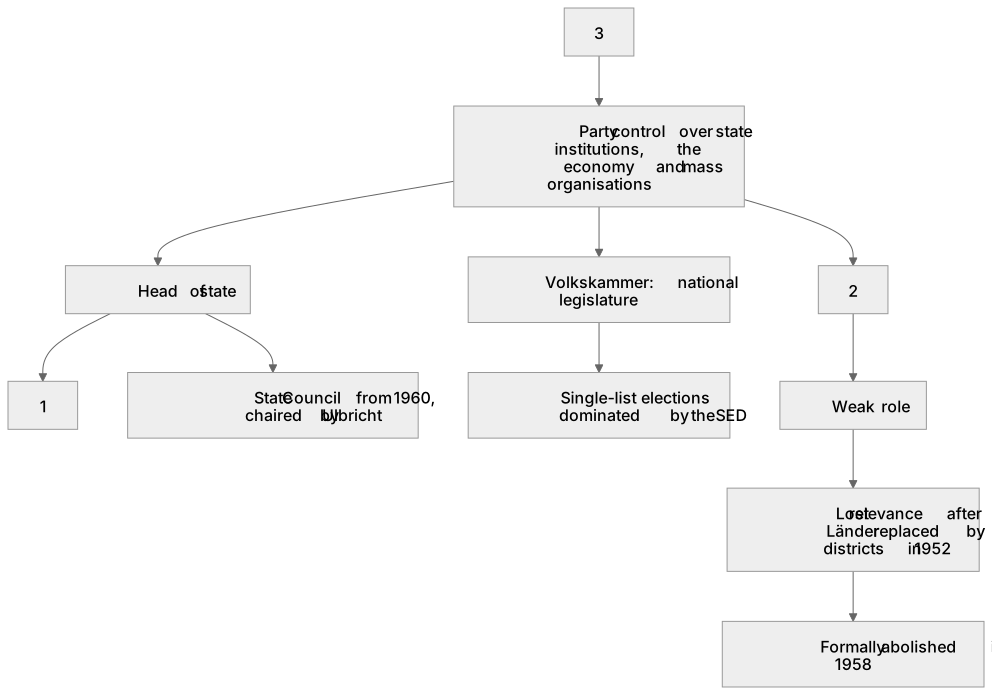
1Box 1
2Box 2
3Box 3
There is more to this lesson
The full lesson goes on to check your understanding and help you earn the marks. Create a free account to carry on, with your progress saved.
A week of Premium from your first lesson · Then the free plan continues · No card, no charge
Test your understanding of Establishing and consolidating communist rule in the GDR, c1949–61: The system of government: the head of state; the Volkskammer; the Länderkammer; the dominance of the SED and its General Secretary, Ulbricht.
Active recall beats re-reading. Take an instant quiz now to test what you’ve learned and lock it into long-term memory.
A week of Premium from your first lesson · Then the free plan continues · No card, no charge