Pearson Edexcel · A-Level · History
Course version: 9HI0 · Version from Sept 2015
China and the Korean War: its role in enhancing CCP control, suppressing…
Full specification wording
Establishing communist rule: China and the Korean War: its role in enhancing CCP control, suppressing opposition, and promoting national unity; the human and financial costs of intervention in Korea; China’s enhanced international prestige.
China intervened in the Korean War (1950–53) to support North Korea against UN forces.
Checked against the Pearson Edexcel 9HI0 specification (opens in a new tab) on .
- Point 4 of 4
- 4 key terms
Study notes
From the checked teaching notes for this specification point.
The idea
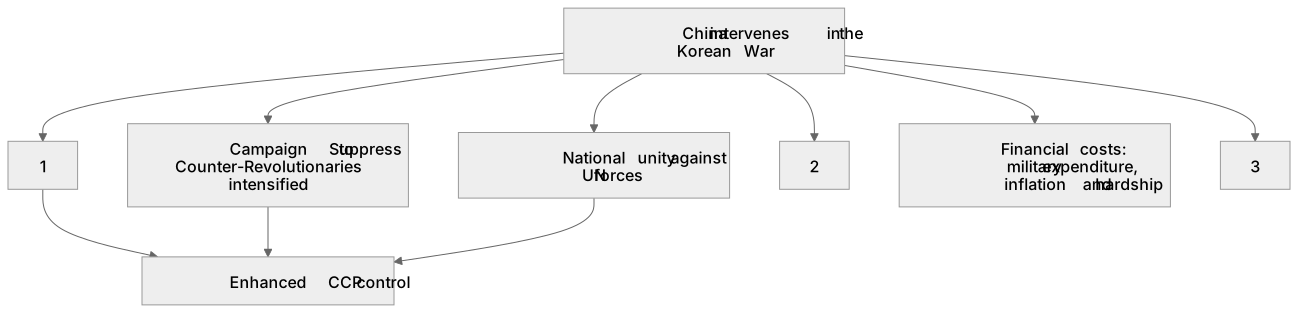
China intervened in the Korean War (1950–53) to support North Korea against UN forces. The war helped the CCP enhance control: it used the conflict to mobilise the population, suppress opposition (e.g., through the Campaign to Suppress Counter-Revolutionaries) and promote national unity against a foreign enemy. The human and financial costs were severe: hundreds of thousands of Chinese casualties and heavy military expenditure strained the economy. However, China’s intervention enhanced its international prestige, showing it as a major military power and raising its standing in the communist world. The war also secured a buffer zone on its border.
What earns the marks
- China intervened in the Korean War in October 1950, sending the People’s Volunteer Army to support North Korea, which helped to enhance CCP control by mobilising the population for war.
- The war was used to suppress opposition: the Campaign to Suppress Counter-Revolutionaries (1950–51) was intensified during the conflict, targeting perceived enemies of the state.
- The Korean War promoted national unity by rallying the Chinese people against the United Nations forces, portrayed as imperialist aggressors.
- The human costs were high: Chinese casualties are estimated at several hundred thousand, including deaths and wounded, which placed a heavy burden on society.
- The financial costs were significant: military expenditure increased, diverting resources from economic reconstruction and causing inflation and hardship.
- China’s intervention enhanced its international prestige, demonstrating military capability and establishing it as a leading communist power, though it also led to international isolation.
Common mistakes and how to put them right
Underestimating the human cost.
Put it right: Chinese casualties were in the hundreds of thousands, not minimal.
Assuming the war only had negative effects.
Put it right: It also enhanced CCP control and international prestige.
Confusing the Korean War with later conflicts.
Put it right: It occurred in 1950–53, before the Hundred Flowers campaign.
Overlooking the domestic use of the war to suppress opposition.
Put it right: The Campaign to Suppress Counter-Revolutionaries was intensified during this period.
Exam tips
- When discussing the Korean War, link it to the broader theme of establishing communist rule, especially how it was used to mobilise and control the population.
- Use specific figures for human and financial costs, such as approximate casualty numbers and increases in military spending.
- Explain how the war enhanced China’s international prestige, but also note the costs and the mixed nature of the outcome.
- Avoid treating the Korean War in isolation: connect it to other campaigns like the Suppress Counter-Revolutionaries campaign.
Try the lesson
The start of the Establishing communist rule: China and the Korean War: its role in enhancing CCP control, suppressing opposition, and promoting national unity; the human and financial costs of intervention in Korea; China’s enhanced international prestige. lesson, made from checked teaching notes for this specification point.
Have a go first
How did China's intervention in the Korean War affect the country's international standing in the early 1950s?
Listen
China intervened in the Korean War (1950–53) to support North Korea against UN forces. The war helped the CCP enhance control: it used the conflict to mobilise the population, suppress opposition (e.g., through the Campaign to Suppress Counter-Revolutionaries) and promote national unity against a foreign enemy. The human and financial costs were severe: hundreds of thousands of Chinese casualties and heavy military expenditure strained the economy. However, China’s intervention enhanced its international prestige, showing it as a major military power and raising its standing in the communist world. The war also secured a buffer zone on its border. A strong answer earns marks for these points. China intervened in the Korean War in October 1950, sending the People’s Volunteer Army to support North Korea, which helped to enhance CCP control by mobilising the population for war. The war was used to suppress opposition: the Campaign to Suppress Counter-Revolutionaries (1950–51) was intensified during the conflict, targeting perceived enemies of the state. The Korean War promoted national unity by rallying the Chinese people against the United Nations forces, portrayed as imperialist aggressors. The human costs were high: Chinese casualties are estimated at several hundred thousand, including deaths and wounded, which placed a heavy burden on society. Exam tip: When discussing the Korean War, link it to the broader theme of establishing communist rule, especially how it was used to mobilise and control the population.
See it

Key words
Say what each word means before you turn the card.
Consolidation of Communist control through external conflict
Try answering aloud or in your head before turning the card.
Suppression of domestic opposition
Try answering aloud or in your head before turning the card.
National unity and mobilisation
Try answering aloud or in your head before turning the card.
Human and economic costs of war
Try answering aloud or in your head before turning the card.
See every definition
- Consolidation of Communist control through external conflict
- The war helped the CCP enhance control by using the conflict to mobilise the population and promote national unity against a foreign enemy.
- Suppression of domestic opposition
- The war was used to suppress opposition, with the Campaign to Suppress Counter-Revolutionaries intensified during the conflict and targeting perceived enemies of the state.
- National unity and mobilisation
- The Korean War promoted national unity by rallying the Chinese people against the United Nations forces, portrayed as imperialist aggressors.
- Human and economic costs of war
- Chinese casualties are estimated at several hundred thousand, and increased military expenditure diverted resources from economic reconstruction and caused inflation and hardship.
Label the diagram
Some boxes have lost their names. Pick the right name for each number.
1Box 1
2Box 2
3Box 3
There is more to this lesson
The full lesson goes on to check your understanding and help you earn the marks. Create a free account to carry on, with your progress saved.
A week of Premium from your first lesson · Then the free plan continues · No card, no charge
Test your understanding of Establishing communist rule: China and the Korean War: its role in enhancing CCP control, suppressing opposition, and promoting national unity; the human and financial costs of intervention in Korea; China’s enhanced international prestige.
Active recall beats re-reading. Take an instant quiz now to test what you’ve learned and lock it into long-term memory.
A week of Premium from your first lesson · Then the free plan continues · No card, no charge