Pearson Edexcel · A-Level · History
Course version: 9HI0 · Version from Sept 2015
Defeating the CCP’s opponents: the ‘three antis’ and ‘five antis’…
Full specification wording
Establishing communist rule: Defeating the CCP’s opponents: the ‘three antis’ and ‘five antis’ movements; the use of terror against opponents of Communist rule; the reunification campaigns in Tibet, Xinjiang and Guangdong; the development of the Laogai system. The Hundred Flowers campaign 1957 and aftermath to 1965.
After 1949 the CCP used campaigns to eliminate opposition.
Checked against the Pearson Edexcel 9HI0 specification (opens in a new tab) on .
- Point 3 of 4
- 4 key terms
Study notes
From the checked teaching notes for this specification point.
The idea
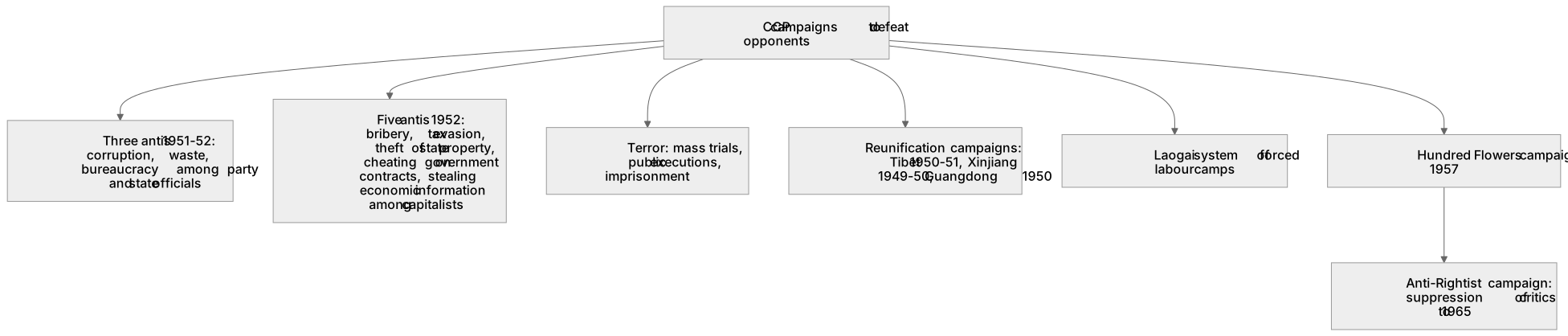
After 1949 the CCP used campaigns to eliminate opposition. The ‘three antis’ (1951–52) targeted corruption, waste and bureaucracy among party and state officials; the ‘five antis’ (1952) targeted bribery, tax evasion, theft of state property, cheating on government contracts and stealing economic information among capitalists. Terror was used: mass trials, public executions and imprisonment intimidated actual and potential opponents. Reunification campaigns brought Tibet (1950–51), Xinjiang (1949–50) and Guangdong (1950) under control, using military force and political reorganisation. The Laogai system of forced labour camps developed to punish and ‘reform’ opponents. The Hundred Flowers campaign (1957) encouraged criticism, then the Anti-Rightist campaign suppressed critics until 1965.
What earns the marks
- The ‘three antis’ movement (1951–52) targeted corruption, waste and bureaucracy among party and state officials, using mass criticism and punishment to enforce discipline.
- The ‘five antis’ movement (1952) targeted bribery, tax evasion, theft of state property, cheating on government contracts and stealing economic information among private business owners, weakening the capitalist class.
- Terror was used through public mass trials, executions and imprisonment to intimidate opponents and deter resistance, creating a climate of fear.
- Reunification campaigns in Tibet (1950–51), Xinjiang (1949–50) and Guangdong (1950) used military force and political reorganisation to bring peripheral regions under CCP control.
- The Laogai system developed as a network of forced labour camps for punishment and ‘reform’ of opponents, expanding after 1949 and becoming a key instrument of control.
- The Hundred Flowers campaign (1957) initially encouraged criticism of the party, but the subsequent Anti-Rightist campaign (1957–58) suppressed critics, and repression continued to 1965.
Common mistakes and how to put them right
Confusing the ‘three antis’ and ‘five antis’ movements.
Put it right: The ‘three antis’ targeted party and state officials, while the ‘five antis’ targeted private business owners.
Assuming the Hundred Flowers campaign was a genuine move towards democracy.
Put it right: It was a tactical relaxation that was reversed, leading to the Anti-Rightist campaign.
Overlooking the Laogai system or treating it as separate from other campaigns.
Put it right: It was part of the broader system of repression and should be linked to terror and control.
Misunderstanding the timing of the reunification campaigns.
Put it right: Tibet was incorporated in 1950–51, Xinjiang in 1949–50, and Guangdong in 1950, not all at once.
Exam tips
- When discussing terror, use specific examples such as public mass trials and executions to show how fear was used to suppress opposition.
- For the Hundred Flowers campaign, explain the shift from encouragement of criticism to the Anti-Rightist campaign, and link it to the broader theme of establishing control.
- Ensure you can name the five targets of the ‘five antis’ movement and the three targets of the ‘three antis’ movement accurately.
- Use the term ‘reunification campaigns’ but explain that these were military and political takeovers of regions like Tibet, Xinjiang and Guangdong.
Try the lesson
The start of the Establishing communist rule: Defeating the CCP’s opponents: the ‘three antis’ and ‘five antis’ movements; the use of terror against opponents of Communist rule; the reunification campaigns in Tibet, Xinjiang and Guangdong; the development of the Laogai system. The Hundred Flowers campaign 1957 and aftermath to 1965. lesson, made from checked teaching notes for this specification point.
Have a go first
Which group was the main target of the ‘five antis’ movement launched by the CCP in 1952?
Listen
After 1949 the CCP used campaigns to eliminate opposition. The ‘three antis’ (1951–52) targeted corruption, waste and bureaucracy among party and state officials; the ‘five antis’ (1952) targeted bribery, tax evasion, theft of state property, cheating on government contracts and stealing economic information among capitalists. Terror was used: mass trials, public executions and imprisonment intimidated actual and potential opponents. Reunification campaigns brought Tibet (1950–51), Xinjiang (1949–50) and Guangdong (1950) under control, using military force and political reorganisation. The Laogai system of forced labour camps developed to punish and ‘reform’ opponents. The Hundred Flowers campaign (1957) encouraged criticism, then the Anti-Rightist campaign suppressed critics until 1965. A strong answer earns marks for these points. The ‘three antis’ movement (1951–52) targeted corruption, waste and bureaucracy among party and state officials, using mass criticism and punishment to enforce discipline. The ‘five antis’ movement (1952) targeted bribery, tax evasion, theft of state property, cheating on government contracts and stealing economic information among private business owners, weakening the capitalist class. Terror was used through public mass trials, executions and imprisonment to intimidate opponents and deter resistance, creating a climate of fear. Reunification campaigns in Tibet (1950–51), Xinjiang (1949–50) and Guangdong (1950) used military force and political reorganisation to bring peripheral regions under CCP control. Exam tip: When discussing terror, use specific examples such as public mass trials and executions to show how fear was used to suppress opposition.
See it
Put the events in order
Put these events in the order they happened, earliest first.
- 1. Reunification campaign brought Guangdong under CCP control
- 2. Reunification campaign brought Xinjiang under CCP control
- 3. The Hundred Flowers campaign encouraged criticism of the party
- 4. The ‘three antis’ movement targeted party and state officials
- 5. The ‘five antis’ movement targeted private business owners
Key words
Say what each word means before you turn the card.
three antis
Try answering aloud or in your head before turning the card.
five antis
Try answering aloud or in your head before turning the card.
reunification campaigns
Try answering aloud or in your head before turning the card.
Laogai system
Try answering aloud or in your head before turning the card.
See every definition
- three antis
- Movement of 1951–52 that targeted corruption, waste and bureaucracy among party and state officials, using mass criticism and punishment to enforce discipline.
- five antis
- Movement of 1952 that targeted bribery, tax evasion, theft of state property, cheating on government contracts and stealing economic information among private business owners, weakening the capitalist class.
- reunification campaigns
- Military and political takeovers that brought Tibet, Xinjiang and Guangdong under CCP control, using military force and political reorganisation.
- Laogai system
- Network of forced labour camps for punishment and ‘reform’ of opponents, expanding after 1949 and becoming a key instrument of control.
Label the diagram
Some boxes have lost their names. Pick the right name for each number.
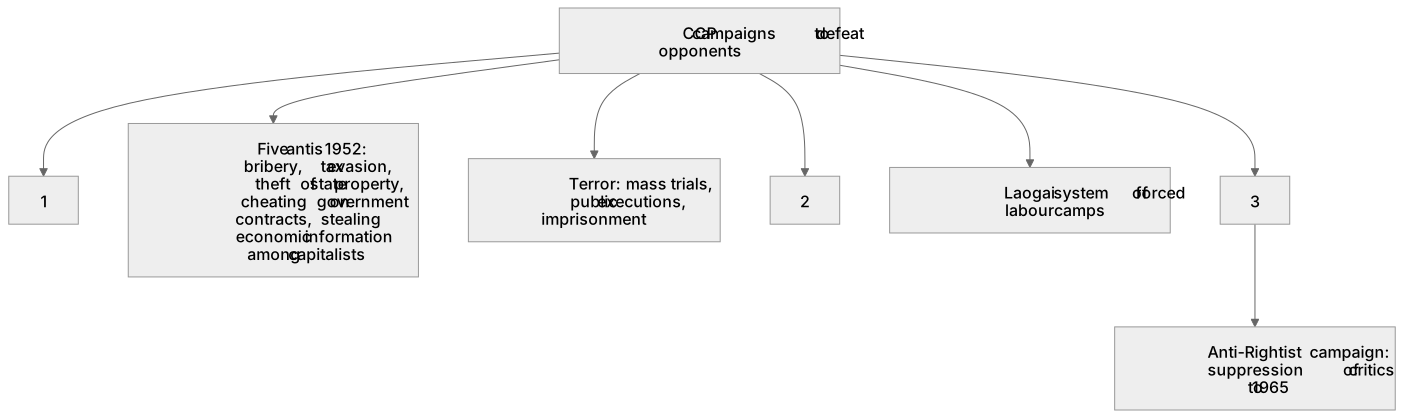
1Box 1
2Box 2
3Box 3
There is more to this lesson
The full lesson goes on to check your understanding and help you earn the marks. Create a free account to carry on, with your progress saved.
A week of Premium from your first lesson · Then the free plan continues · No card, no charge
Test your understanding of Establishing communist rule: Defeating the CCP’s opponents: the ‘three antis’ and ‘five antis’ movements; the use of terror against opponents of Communist rule; the reunification campaigns in Tibet, Xinjiang and Guangdong; the development of the Laogai system. The Hundred Flowers campaign 1957 and aftermath to 1965.
Active recall beats re-reading. Take an instant quiz now to test what you’ve learned and lock it into long-term memory.
A week of Premium from your first lesson · Then the free plan continues · No card, no charge