Pearson Edexcel · A-Level · History
Course version: 9HI0 · Version from Sept 2015
The end of the GDR, 1989-90: the collapse of the SED government 1989 and…
Full specification wording
Growing crises and the collapse of communist rule in the GDR: The end of the GDR, 1989-90: the collapse of the SED government 1989 and the elections of March 1990; the reunification of East and West Germany, March–October 1990; the attitudes of Kohl, Britain, the USA and the USSR; the accession of the eastern territories to West Germany.
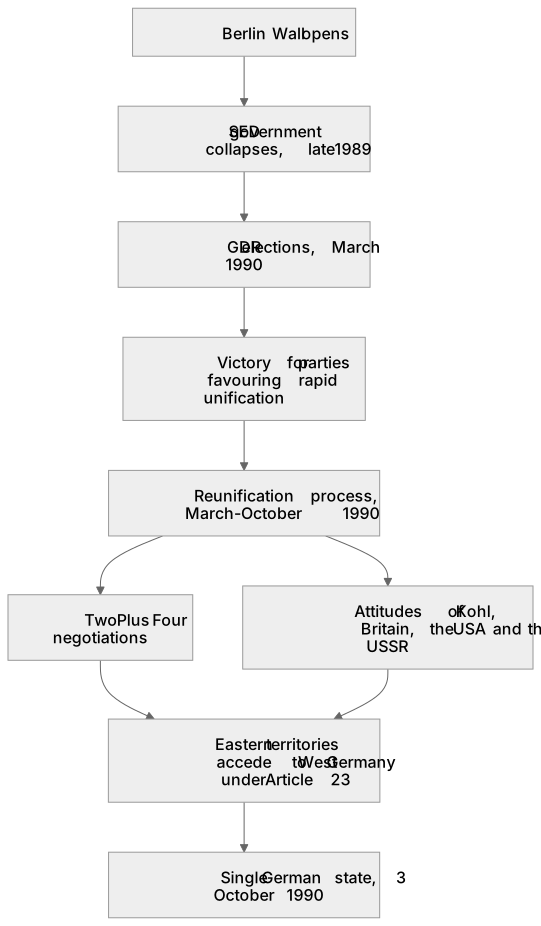
After the Berlin Wall opened, the SED government collapsed in late 1989.
Checked against the Pearson Edexcel 9HI0 specification (opens in a new tab) on .
- Point 4 of 4
- 4 key terms
Study notes
From the checked teaching notes for this specification point.
The idea
After the Berlin Wall opened, the SED government collapsed in late 1989. The March 1990 elections in the GDR produced a victory for parties favouring rapid unification with West Germany. Reunification proceeded between March and October 1990. Key external actors shaped the process: Kohl, the West German Chancellor, pushed for swift unification; Britain, under Thatcher, was cautious about a united Germany; the USA, under Bush, supported unification within NATO; and the USSR, under Gorbachev, eventually accepted a united Germany in NATO. The eastern territories acceded to West Germany under Article 23 of the Basic Law on 3 October 1990, ending the GDR.
What earns the marks
- Explains the collapse of the SED government in 1989 and the transition to free elections in March 1990.
- Analyses the outcome and significance of the March 1990 elections in the GDR.
- Explains the process of reunification between March and October 1990, including the role of the Two Plus Four negotiations.
- Compares the attitudes of Kohl, Britain, the USA and the USSR towards German reunification.
- Explains the accession of the eastern territories to West Germany under Article 23 and the establishment of a single German state on 3 October 1990.
Common mistakes and how to put them right
Assuming all Allied powers opposed reunification.
Put it right by distinguishing Britain’s caution from US support and eventual Soviet acceptance.
Confusing the dates of the March 1990 elections with the date of reunification.
Put it right by keeping the election in March and accession on 3 October 1990.
Overlooking the Two Plus Four process.
Put it right by including it as the diplomatic framework for reunification.
Exam tips
- Create a timeline from November 1989 to October 1990 to show the sequence of collapse, election and accession.
- Use the attitudes of Kohl, Britain, the USA and the USSR to analyse international constraints and opportunities.
- Link the method of accession (Article 23) to the speed and nature of reunification.
Try the lesson
The start of the Growing crises and the collapse of communist rule in the GDR: The end of the GDR, 1989-90: the collapse of the SED government 1989 and the elections of March 1990; the reunification of East and West Germany, March–October 1990; the attitudes of Kohl, Britain, the USA and the USSR; the accession of the eastern territories to West Germany. lesson, made from checked teaching notes for this specification point.
Have a go first
In the free Volkskammer elections of March 1990, which grouping won the largest share of the vote and led the new GDR government?
Listen
After the Berlin Wall opened, the SED government collapsed in late 1989. The March 1990 elections in the GDR produced a victory for parties favouring rapid unification with West Germany. Reunification proceeded between March and October 1990. Key external actors shaped the process: Kohl, the West German Chancellor, pushed for swift unification; Britain, under Thatcher, was cautious about a united Germany; the USA, under Bush, supported unification within NATO; and the USSR, under Gorbachev, eventually accepted a united Germany in NATO. The eastern territories acceded to West Germany under Article 23 of the Basic Law on 3 October 1990, ending the GDR. A strong answer earns marks for these points. Explains the collapse of the SED government in 1989 and the transition to free elections in March 1990. Analyses the outcome and significance of the March 1990 elections in the GDR. Explains the process of reunification between March and October 1990, including the role of the Two Plus Four negotiations. Compares the attitudes of Kohl, Britain, the USA and the USSR towards German reunification. A common slip: Assuming all Allied powers opposed reunification. Instead, distinguishing Britain’s caution from US support and eventual Soviet acceptance. Exam tip: Create a timeline from November 1989 to October 1990 to show the sequence of collapse, election and accession.
See it
Key words
Say what each word means before you turn the card.
SED government
Try answering aloud or in your head before turning the card.
March 1990 elections
Try answering aloud or in your head before turning the card.
Two Plus Four negotiations
Try answering aloud or in your head before turning the card.
Article 23
Try answering aloud or in your head before turning the card.
See every definition
- SED government
- The government that collapsed in late 1989 after the Berlin Wall opened.
- March 1990 elections
- Elections in the GDR that produced a victory for parties favouring rapid unification with West Germany.
- Two Plus Four negotiations
- The diplomatic framework for reunification, which the note says should be included in answers.
- Article 23
- The part of the Basic Law under which the eastern territories acceded to West Germany on 3 October 1990.
Label the diagram
Some boxes have lost their names. Pick the right name for each number.
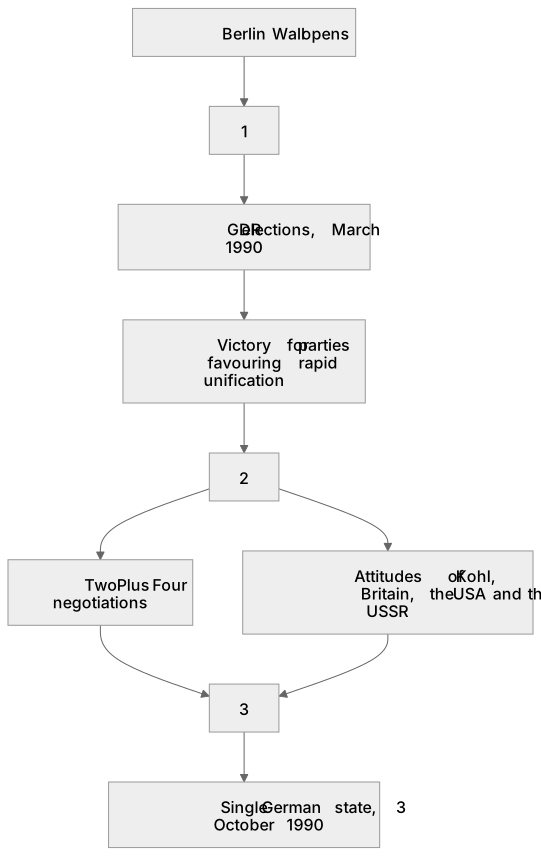
1Box 1
2Box 2
3Box 3
There is more to this lesson
The full lesson goes on to check your understanding and help you earn the marks. Create a free account to carry on, with your progress saved.
A week of Premium from your first lesson · Then the free plan continues · No card, no charge
Test your understanding of Growing crises and the collapse of communist rule in the GDR: The end of the GDR, 1989-90: the collapse of the SED government 1989 and the elections of March 1990; the reunification of East and West Germany, March–October 1990; the attitudes of Kohl, Britain, the USA and the USSR; the accession of the eastern territories to West Germany.
Active recall beats re-reading. Take an instant quiz now to test what you’ve learned and lock it into long-term memory.
A week of Premium from your first lesson · Then the free plan continues · No card, no charge