Pearson Edexcel · A-Level · History
Course version: 9HI0 · Version from Sept 2015
The events of 1989, including the opening of Hungary’s border with…
Full specification wording
Growing crises and the collapse of communist rule in the GDR: The events of 1989, including the opening of Hungary’s border with Austria, emigration from the GDR, Gorbachev’s visit to East Berlin in October, the decline of Honecker’s influence and his dismissal, Krenz and the opening of the Berlin Wall.
In 1989 the GDR’s crisis accelerated through linked events.
Checked against the Pearson Edexcel 9HI0 specification (opens in a new tab) on .
- Point 3 of 4
- 4 key terms
Study notes
From the checked teaching notes for this specification point.
The idea
In 1989 the GDR’s crisis accelerated through linked events. Hungary’s reformist government dismantled its border with Austria, creating an escape route; thousands of GDR citizens left via Hungary, while others occupied West German embassies. This emigration drained the state of workers and exposed its loss of legitimacy. In October, Gorbachev visited East Berlin for the GDR’s 40th anniversary and made clear the USSR would not intervene militarily. Honecker’s influence declined as protests grew and Politburo colleagues withdrew support; he was dismissed in October. His successor, Krenz, promised reforms but failed to stabilise the regime. On 9 November, amid confused border regulations, the Berlin Wall was opened, allowing free movement and symbolising the collapse of communist rule.
What earns the marks
- Explains how Hungary’s opening of its border with Austria provided an exit route for GDR citizens and triggered mass emigration.
- Analyses the impact of emigration on the GDR’s economy, workforce and political legitimacy.
- Assesses the significance of Gorbachev’s October visit to East Berlin in signalling that the USSR would not use force to prop up the SED regime.
- Explains the decline of Honecker’s influence within the Politburo and his dismissal in October 1989.
- Evaluates Krenz’s leadership and his failure to halt the crisis, including the opening of the Berlin Wall on 9 November 1989.
Common mistakes and how to put them right
Treating the opening of the Berlin Wall as a planned reform rather than the result of confused border regulations and public pressure.
Put it right by explaining the sequence of events on 9 November.
Assuming Gorbachev ordered the GDR to open the Wall.
Put it right by distinguishing Soviet non-intervention from GDR decisions.
Confusing the roles of Honecker and Krenz.
Put it right by noting Honecker’s dismissal in October and Krenz’s short-lived leadership thereafter.
Exam tips
- Build a clear chronological framework linking Hungary, emigration, Gorbachev’s visit, Honecker’s fall, Krenz and the Wall.
- Use precise dates and names to support analysis of causation and significance.
- When assessing significance, weigh short-term triggers against long-term structural weaknesses of the GDR.
Try the lesson
The start of the Growing crises and the collapse of communist rule in the GDR: The events of 1989, including the opening of Hungary’s border with Austria, emigration from the GDR, Gorbachev’s visit to East Berlin in October, the decline of Honecker’s influence and his dismissal, Krenz and the opening of the Berlin Wall. lesson, made from checked teaching notes for this specification point.
Have a go first
In May 1989, which country removed its border restrictions with Austria, allowing thousands of GDR citizens to leave the Eastern bloc through its territory?
Listen
In 1989 the GDR’s crisis accelerated through linked events. Hungary’s reformist government dismantled its border with Austria, creating an escape route; thousands of GDR citizens left via Hungary, while others occupied West German embassies. This emigration drained the state of workers and exposed its loss of legitimacy. In October, Gorbachev visited East Berlin for the GDR’s 40th anniversary and made clear the USSR would not intervene militarily. Honecker’s influence declined as protests grew and Politburo colleagues withdrew support; he was dismissed in October. His successor, Krenz, promised reforms but failed to stabilise the regime. On 9 November, amid confused border regulations, the Berlin Wall was opened, allowing free movement and symbolising the collapse of communist rule. A strong answer earns marks for these points. Explains how Hungary’s opening of its border with Austria provided an exit route for GDR citizens and triggered mass emigration. Analyses the impact of emigration on the GDR’s economy, workforce and political legitimacy. Assesses the significance of Gorbachev’s October visit to East Berlin in signalling that the USSR would not use force to prop up the SED regime. Explains the decline of Honecker’s influence within the Politburo and his dismissal in October 1989. A common slip: Treating the opening of the Berlin Wall as a planned reform rather than the result of confused border regulations and public pressure. Instead, explaining the sequence of events on 9 November. Exam tip: Build a clear chronological framework linking Hungary, emigration, Gorbachev’s visit, Honecker’s fall, Krenz and the Wall.
See it
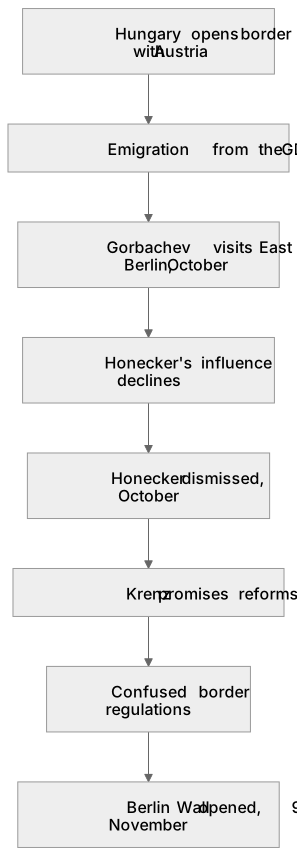
Put it in order
Put these steps in the order they happen.
- 1. Honecker dismissed, October
- 2. Berlin Wall opened, 9 November
- 3. Krenz promises reforms
- 4. Hungary opens border with Austria
- 5. Emigration from the GDR
- 6. Confused border regulations
- 7. Gorbachev visits East Berlin, October
- 8. Honecker's influence declines
Key words
Say what each word means before you turn the card.
Mass emigration
Try answering aloud or in your head before turning the card.
Gorbachev's visit to East Berlin
Try answering aloud or in your head before turning the card.
Honecker's dismissal
Try answering aloud or in your head before turning the card.
Opening of the Berlin Wall
Try answering aloud or in your head before turning the card.
See every definition
- Mass emigration
- The departure of thousands of GDR citizens via Hungary and West German embassies, which drained the state of workers and exposed its loss of legitimacy.
- Gorbachev's visit to East Berlin
- An October visit for the GDR's 40th anniversary that made clear the USSR would not intervene militarily.
- Honecker's dismissal
- The removal in October of the leader whose influence declined as protests grew and Politburo colleagues withdrew support.
- Opening of the Berlin Wall
- The event on 9 November, amid confused border regulations, that allowed free movement and symbolised the collapse of communist rule.
Label the diagram
Some boxes have lost their names. Pick the right name for each number.
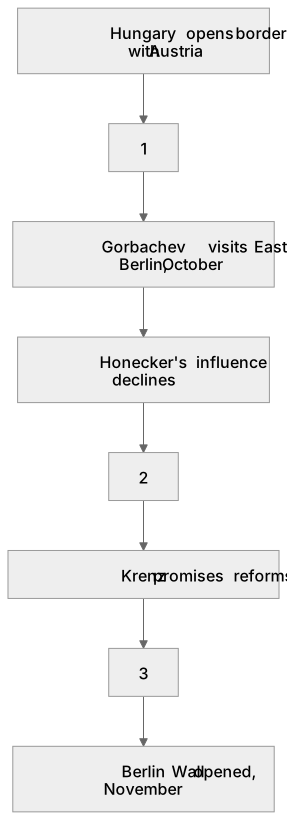
1Box 1
2Box 2
3Box 3
There is more to this lesson
The full lesson goes on to check your understanding and help you earn the marks. Create a free account to carry on, with your progress saved.
A week of Premium from your first lesson · Then the free plan continues · No card, no charge
Test your understanding of Growing crises and the collapse of communist rule in the GDR: The events of 1989, including the opening of Hungary’s border with Austria, emigration from the GDR, Gorbachev’s visit to East Berlin in October, the decline of Honecker’s influence and his dismissal, Krenz and the opening of the Berlin Wall.
Active recall beats re-reading. Take an instant quiz now to test what you’ve learned and lock it into long-term memory.
A week of Premium from your first lesson · Then the free plan continues · No card, no charge