Pearson Edexcel · A-Level · History
Course version: 9HI0 · Version from Sept 2015
Becket and the king, 1162–64: reasons for Becket’s election as Archbishop…
Full specification wording
Henry II and the English church, 1154–74: Becket and the king, 1162–64: reasons for Becket’s election as Archbishop of Canterbury; Henry’s demands for reform; the Constitutions of Clarendon; Becket’s attitude towards reform; conflict between king and archbishop; Becket’s flight into exile.
In 1162 Henry II secured Becket’s election as Archbishop of Canterbury, expecting a loyal ally to advance royal reform.
Checked against the Pearson Edexcel 9HI0 specification (opens in a new tab) on .
- Point 2 of 4
- 4 key terms
Study notes
From the checked teaching notes for this specification point.
The idea
In 1162 Henry II secured Becket’s election as Archbishop of Canterbury, expecting a loyal ally to advance royal reform. Reasons included Becket’s service as chancellor, his administrative skill and his personal friendship with the king. Henry demanded reform to curb church courts, limit appeals to Rome and subject clergy to royal justice. The Constitutions of Clarendon (1164) codified these demands, asserting royal customs over ecclesiastical privileges. Becket initially wavered but then resisted, refusing to accept clauses that reduced papal authority and clerical immunity. Conflict escalated: Becket opposed royal interference, Henry summoned him to trial, and Becket fled into exile in France. This period set the stage for his murder in 1170.
What earns the marks
- Explain the reasons for Becket’s election, including his royal service, administrative experience and Henry’s expectation of loyalty.
- Describe Henry’s demands for reform, such as restricting appeals to Rome, controlling church courts and asserting royal justice over clergy.
- Outline the key provisions of the Constitutions of Clarendon and explain how they challenged church privileges.
- Analyse Becket’s attitude towards reform, showing his initial hesitation and eventual resistance to royal encroachment.
- Narrate the conflict between king and archbishop, including the trial, Becket’s refusal to submit and his flight into exile.
Common mistakes and how to put them right
Assuming Becket was always a fierce opponent of royal reform.
Put it right: Note his initial wavering and the complexity of his position before he resisted.
Treating the Constitutions of Clarendon as a single undifferentiated document.
Put it right: Identify specific clauses that provoked Becket’s opposition, such as appeals to Rome and clerical immunity.
Confusing Becket’s exile with his later murder.
Put it right: Keep the chronology clear—exile occurred in 1164, murder in 1170.
Exam tips
- Use dates accurately: 1162 for Becket’s election, 1164 for the Constitutions of Clarendon and Becket’s flight.
- When explaining Becket’s election, link Henry’s expectations to the king’s wider reform programme.
- For the Constitutions, select two or three clauses and explain their significance rather than listing all sixteen.
Try the lesson
The start of the Henry II and the English church, 1154–74: Becket and the king, 1162–64: reasons for Becket’s election as Archbishop of Canterbury; Henry’s demands for reform; the Constitutions of Clarendon; Becket’s attitude towards reform; conflict between king and archbishop; Becket’s flight into exile. lesson, made from checked teaching notes for this specification point.
Have a go first
Why did Henry II choose Thomas Becket as Archbishop of Canterbury in 1162?
Listen
In 1162 Henry II secured Becket’s election as Archbishop of Canterbury, expecting a loyal ally to advance royal reform. Reasons included Becket’s service as chancellor, his administrative skill and his personal friendship with the king. Henry demanded reform to curb church courts, limit appeals to Rome and subject clergy to royal justice. The Constitutions of Clarendon (1164) codified these demands, asserting royal customs over ecclesiastical privileges. Becket initially wavered but then resisted, refusing to accept clauses that reduced papal authority and clerical immunity. Conflict escalated: Becket opposed royal interference, Henry summoned him to trial, and Becket fled into exile in France. This period set the stage for his murder in 1170. A strong answer earns marks for these points. Explain the reasons for Becket’s election, including his royal service, administrative experience and Henry’s expectation of loyalty. Describe Henry’s demands for reform, such as restricting appeals to Rome, controlling church courts and asserting royal justice over clergy. Outline the key provisions of the Constitutions of Clarendon and explain how they challenged church privileges. Analyse Becket’s attitude towards reform, showing his initial hesitation and eventual resistance to royal encroachment. A common slip: Assuming Becket was always a fierce opponent of royal reform. Instead, note his initial wavering and the complexity of his position before he resisted. Exam tip: Use dates accurately: 1162 for Becket’s election, 1164 for the Constitutions of Clarendon and Becket’s flight.
See it
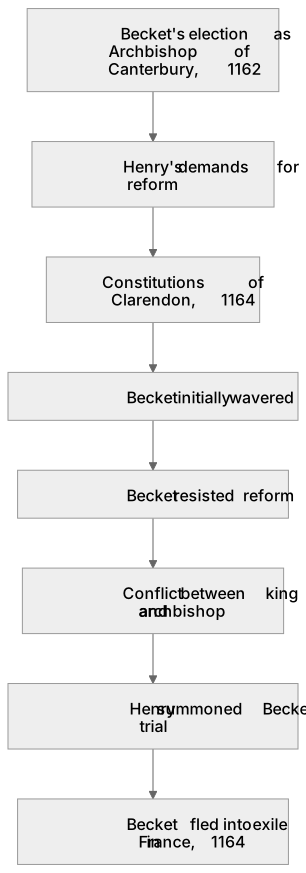
Put it in order
Put these steps in the order they happen.
- 1. Becket resisted reform
- 2. Becket fled into exile in France, 1164
- 3. Conflict between king and archbishop
- 4. Becket's election as Archbishop of Canterbury, 1162
- 5. Henry's demands for reform
- 6. Henry summoned Becket to trial
- 7. Constitutions of Clarendon, 1164
- 8. Becket initially wavered
Key words
Say what each word means before you turn the card.
Royal versus ecclesiastical authority
Try answering aloud or in your head before turning the card.
Personal loyalty and betrayal
Try answering aloud or in your head before turning the card.
Legal reform and custom
Try answering aloud or in your head before turning the card.
Exile and political resistance
Try answering aloud or in your head before turning the card.
See every definition
- Royal versus ecclesiastical authority
- The conflict between king and archbishop over whether royal customs or church privileges should prevail.
- Personal loyalty and betrayal
- Henry expected Becket to be a loyal ally, but Becket resisted royal reform instead.
- Legal reform and custom
- Henry demanded reform to curb church courts, limit appeals to Rome and subject clergy to royal justice, codified as royal customs.
- Exile and political resistance
- Becket opposed royal interference, refused to submit and fled into exile in France.
Label the diagram
Some boxes have lost their names. Pick the right name for each number.
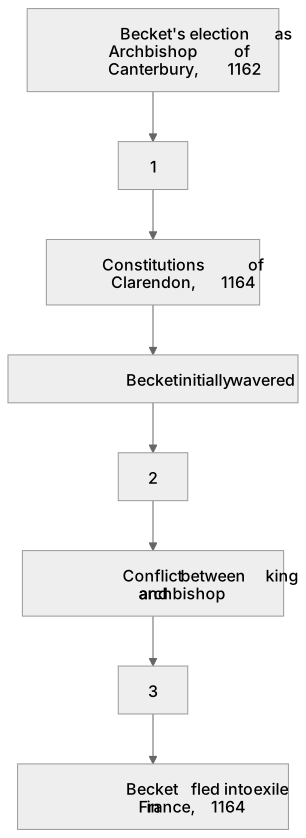
1Box 1
2Box 2
3Box 3
There is more to this lesson
The full lesson goes on to check your understanding and help you earn the marks. Create a free account to carry on, with your progress saved.
A week of Premium from your first lesson · Then the free plan continues · No card, no charge
Test your understanding of Henry II and the English church, 1154–74: Becket and the king, 1162–64: reasons for Becket’s election as Archbishop of Canterbury; Henry’s demands for reform; the Constitutions of Clarendon; Becket’s attitude towards reform; conflict between king and archbishop; Becket’s flight into exile.
Active recall beats re-reading. Take an instant quiz now to test what you’ve learned and lock it into long-term memory.
A week of Premium from your first lesson · Then the free plan continues · No card, no charge