Pearson Edexcel · A-Level · History
Course version: 9HI0 · Version from Sept 2015
The failure to compromise, 1169–70: the failure to reach a settlement; the…
Full specification wording
Henry II and the English church, 1154–74: The failure to compromise, 1169–70: the failure to reach a settlement; the diplomacy of Pope Alexander III; the coronation of the Young King in June 1170; Becket’s return to England, his death and its significance, including its impact on the position of Henry II.
After Becket fled to France in 1164, Henry II and Louis VII attempted mediation, but the failure to compromise in 1169–70 meant the failure to reach a settlement.
Checked against the Pearson Edexcel 9HI0 specification (opens in a new tab) on .
- Point 3 of 4
Study notes
From the checked teaching notes for this specification point.
The idea
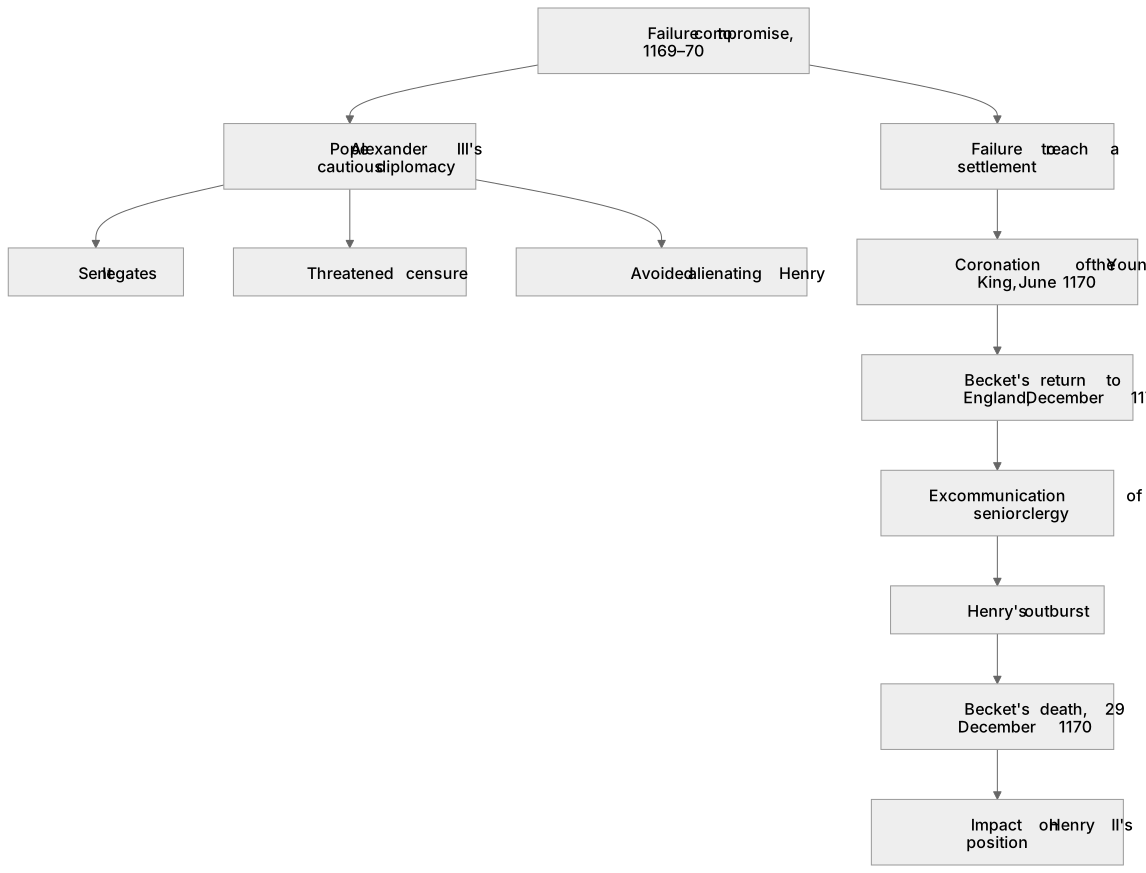
After Becket fled to France in 1164, Henry II and Louis VII attempted mediation, but the failure to compromise in 1169–70 meant the failure to reach a settlement. Pope Alexander III pursued cautious diplomacy: he sent legates and threatened censure but avoided alienating Henry, whose support he needed against Frederick Barbarossa. In June 1170, Henry had his son crowned Young King by the Archbishop of York, usurping Canterbury's privilege and enraging Becket. Becket returned to England in December 1170, but his excommunication of senior clergy, including the Archbishop of York and the Bishops of London and Salisbury, provoked Henry’s outburst. Becket’s death on 29 December and its significance transformed Henry’s position: he faced international outrage, the threat of interdict, and a rebellion in 1173–74, forcing him to submit to papal authority.
What earns the marks
- Explains why the failure to compromise in 1169–70 occurred: neither Henry nor Becket would concede on the principle of royal versus ecclesiastical authority, preventing a settlement.
- Analyses the diplomacy of Pope Alexander III: he balanced pressure on Henry (threats of excommunication) with reluctance to act decisively due to needing Henry’s support against the antipope.
- Assesses the significance of the coronation of the Young King in June 1170: performed by the Archbishop of York, it violated Canterbury’s rights and escalated the conflict.
- Evaluates Becket’s return to England and death: his excommunication of senior clergy (York, London, Salisbury) provoked Henry’s anger, leading to the murder on 29 December 1170.
- Judges the significance and impact on Henry II’s position: the death brought international condemnation, forced Henry to accept papal terms, and contributed to the 1173–74 rebellion.
Common mistakes and how to put them right
Treating the coronation of the Young King as a minor event.
Put it right: It was a major provocation because it usurped Canterbury’s traditional right and was a direct challenge to Becket’s authority.
Assuming Pope Alexander III consistently supported Henry.
Put it right: He was cautious and sought to avoid alienating Henry, but he also threatened spiritual penalties.
Claiming Becket excommunicated royal officials upon his return.
Put it right: He excommunicated senior clergy, specifically the Archbishop of York and the Bishops of London and Salisbury, who had participated in the coronation.
Exam tips
- When discussing the failure to compromise, link specific disagreements to the broader issue of royal versus papal authority.
- For the impact of Becket’s death, consider short-term consequences (excommunication threat, rebellion) and long-term significance (martyrdom, limits on royal power).
Try the lesson
The start of the Henry II and the English church, 1154–74: The failure to compromise, 1169–70: the failure to reach a settlement; the diplomacy of Pope Alexander III; the coronation of the Young King in June 1170; Becket’s return to England, his death and its significance, including its impact on the position of Henry II. lesson, made from checked teaching notes for this specification point.
Have a go first
At which location did Henry II's men murder Thomas Becket in December 1170?
Listen
After Becket fled to France in 1164, Henry II and Louis VII attempted mediation, but the failure to compromise in 1169–70 meant the failure to reach a settlement. Pope Alexander III pursued cautious diplomacy: he sent legates and threatened censure but avoided alienating Henry, whose support he needed against Frederick Barbarossa. In June 1170, Henry had his son crowned Young King by the Archbishop of York, usurping Canterbury's privilege and enraging Becket. Becket returned to England in December 1170, but his excommunication of senior clergy, including the Archbishop of York and the Bishops of London and Salisbury, provoked Henry’s outburst. Becket’s death on 29 December and its significance transformed Henry’s position: he faced international outrage, the threat of interdict, and a rebellion in 1173–74, forcing him to submit to papal authority. A strong answer earns marks for these points. Explains why the failure to compromise in 1169–70 occurred: neither Henry nor Becket would concede on the principle of royal versus ecclesiastical authority, preventing a settlement. Analyses the diplomacy of Pope Alexander III: he balanced pressure on Henry (threats of excommunication) with reluctance to act decisively due to needing Henry’s support against the antipope. Assesses the significance of the coronation of the Young King in June 1170: performed by the Archbishop of York, it violated Canterbury’s rights and escalated the conflict. Evaluates Becket’s return to England and death: his excommunication of senior clergy (York, London, Salisbury) provoked Henry’s anger, leading to the murder on 29 December 1170. A common slip: treating the coronation of the Young King as a minor event. Instead, it was a major provocation because it usurped Canterbury’s traditional right and was a direct challenge to Becket’s authority. Exam tip: When discussing the failure to compromise, link specific disagreements to the broader issue of royal versus papal authority.
See it
Label the diagram
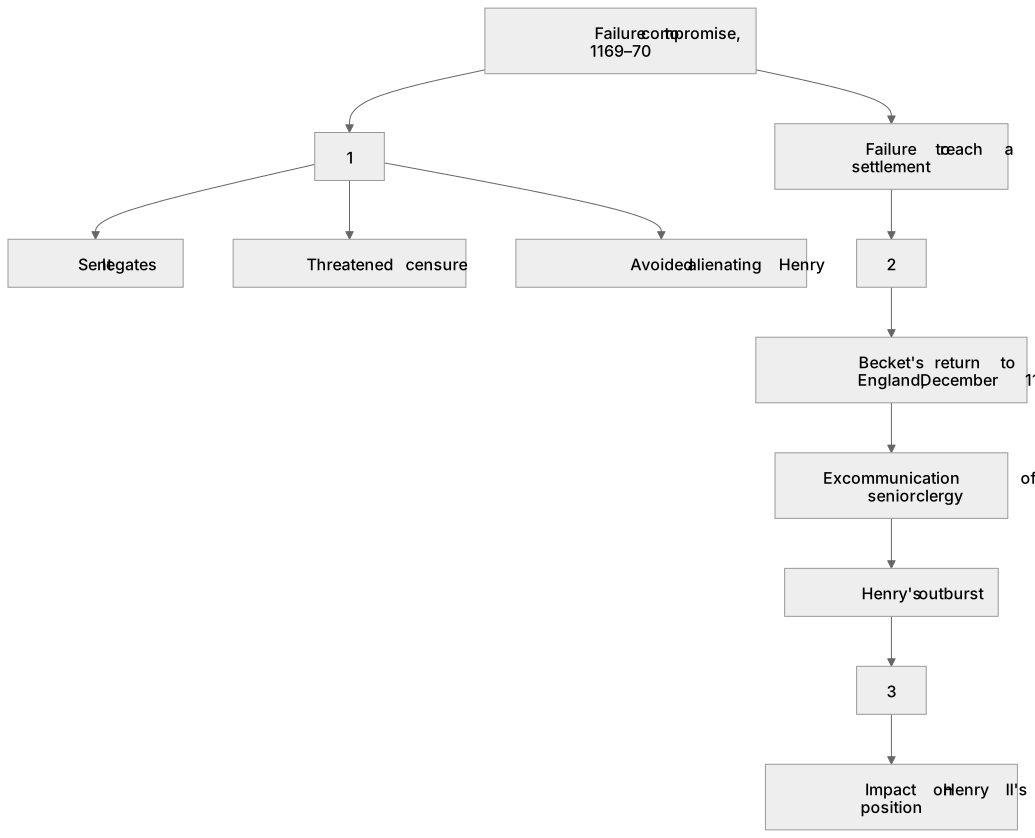
Some boxes have lost their names. Pick the right name for each number.
1Box 1
2Box 2
3Box 3
There is more to this lesson
The full lesson goes on to check your understanding and help you earn the marks. Create a free account to carry on, with your progress saved.
A week of Premium from your first lesson · Then the free plan continues · No card, no charge
Test your understanding of Henry II and the English church, 1154–74: The failure to compromise, 1169–70: the failure to reach a settlement; the diplomacy of Pope Alexander III; the coronation of the Young King in June 1170; Becket’s return to England, his death and its significance, including its impact on the position of Henry II.
Active recall beats re-reading. Take an instant quiz now to test what you’ve learned and lock it into long-term memory.
A week of Premium from your first lesson · Then the free plan continues · No card, no charge