Pearson Edexcel · A-Level · History
Course version: 9HI0 · Version from Sept 2015
The settlements between king and church, 1172–74: the agreement at…
Full specification wording
Henry II and the English church, 1154–74: The settlements between king and church, 1172–74: the agreement at Avranches; relations between Henry and the pope; Henry’s penance at Canterbury in 1174; the extent of Henry’s success.
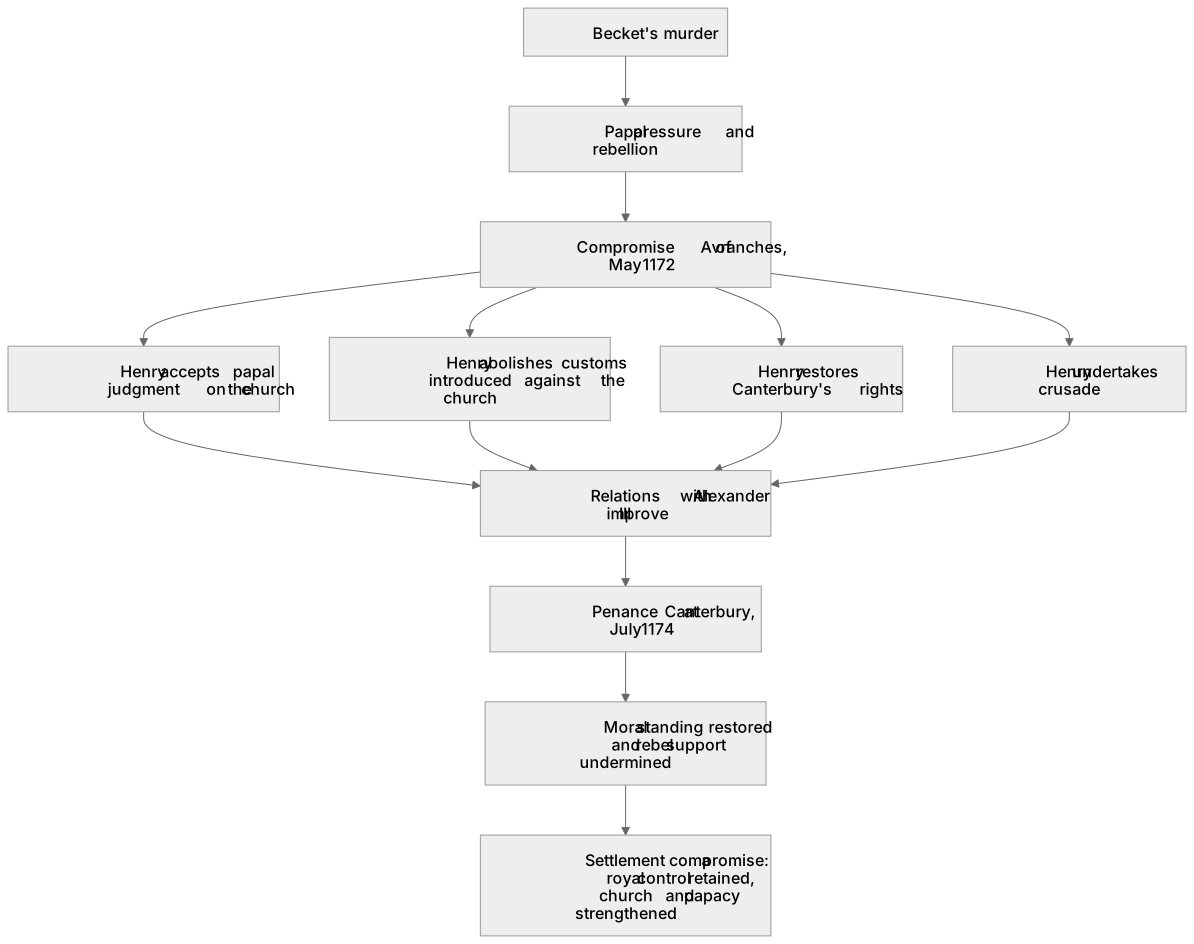
After Becket’s murder, Henry II faced papal pressure and rebellion.
Checked against the Pearson Edexcel 9HI0 specification (opens in a new tab) on .
- Point 4 of 4
- 3 key terms
Study notes
From the checked teaching notes for this specification point.
The idea
After Becket’s murder, Henry II faced papal pressure and rebellion. In May 1172, the Compromise of Avranches was agreed: Henry swore to accept the pope’s judgment on the church, to abolish any customs introduced against the church, to restore Canterbury’s rights, and to undertake a crusade. Relations with Pope Alexander III improved as Henry conceded on key points, though he avoided full capitulation. In July 1174, Henry performed penance at Canterbury, walking barefoot and being scourged by monks, which helped restore his moral standing and undermined rebel support. The extent of Henry’s success is debated: he retained royal control over many church matters, but the church gained greater independence and the papacy’s authority was strengthened. The settlements marked a compromise rather than a clear victory for either side.
What earns the marks
- Analyses relations between Henry and the pope after Avranches: Henry’s concessions improved relations with Alexander III, who lifted the threat of excommunication and interdict, but the papacy maintained its authority.
- Assesses the significance of Henry’s penance at Canterbury in 1174: it was a public act of contrition that restored his moral position, reduced the threat of rebellion, and was carefully staged to limit political damage.
- Judges the overall impact of the settlements on king–church relations: they established a framework for future coexistence, but tensions over jurisdiction and authority persisted.
Common mistakes and how to put them right
Claiming Henry completely capitulated at Avranches.
Put it right: He made significant concessions but retained royal authority over many church matters and avoided accepting all the Constitutions of Clarendon.
Viewing the penance at Canterbury as purely humiliating.
Put it right: It was a calculated political act that helped restore Henry’s reputation and weakened his enemies.
Assuming the settlements fully resolved the conflict.
Put it right: They reduced immediate tensions but did not settle the fundamental question of royal versus ecclesiastical authority.
Exam tips
- When discussing Avranches, specify the key terms and explain how they represented a compromise rather than a clear win for either side.
- Use the penance at Canterbury as evidence of Henry’s political skill in turning a ritual humiliation into a means of restoring authority.
- For the extent of Henry’s success, weigh his retained royal powers against the church’s gains and the papacy’s enhanced role.
Try the lesson
The start of the Henry II and the English church, 1154–74: The settlements between king and church, 1172–74: the agreement at Avranches; relations between Henry and the pope; Henry’s penance at Canterbury in 1174; the extent of Henry’s success. lesson, made from checked teaching notes for this specification point.
Have a go first
In which year did Henry II perform his public penance at Canterbury for Becket's death?
Listen
After Becket’s murder, Henry II faced papal pressure and rebellion. In May 1172, the Compromise of Avranches was agreed: Henry swore to accept the pope’s judgment on the church, to abolish any customs introduced against the church, to restore Canterbury’s rights, and to undertake a crusade. Relations with Pope Alexander III improved as Henry conceded on key points, though he avoided full capitulation. In July 1174, Henry performed penance at Canterbury, walking barefoot and being scourged by monks, which helped restore his moral standing and undermined rebel support. The extent of Henry’s success is debated: he retained royal control over many church matters, but the church gained greater independence and the papacy’s authority was strengthened. The settlements marked a compromise rather than a clear victory for either side. A strong answer earns marks for these points. Explains the terms of the agreement at Avranches (1172): Henry accepted papal judgment, promised to restore Canterbury’s rights, and agreed to go on crusade, but avoided accepting the Constitutions of Clarendon wholesale. Analyses relations between Henry and the pope after Avranches: Henry’s concessions improved relations with Alexander III, who lifted the threat of excommunication and interdict, but the papacy maintained its authority. Assesses the significance of Henry’s penance at Canterbury in 1174: it was a public act of contrition that restored his moral position, reduced the threat of rebellion, and was carefully staged to limit political damage. Evaluates the extent of Henry’s success: he preserved royal authority in many areas, but the church gained greater freedom and the pope’s role as arbiter was enhanced; the settlement was a compromise, not a total victory. A common slip: claiming Henry completely capitulated at Avranches. Instead, he made significant concessions but retained royal authority over many church matters and avoided accepting all the Constitutions of Clarendon. Exam tip: When discussing Avranches, specify the key terms and explain how they represented a compromise rather than a clear win for either side.
See it
Key words
Say what each word means before you turn the card.
The political use of penance and ritual
Try answering aloud or in your head before turning the card.
The papacy as an arbiter in national disputes
Try answering aloud or in your head before turning the card.
The limits of royal authority over the church
Try answering aloud or in your head before turning the card.
See every definition
- The political use of penance and ritual
- Henry's penance at Canterbury was a public act of contrition, carefully staged to limit political damage, which restored his moral standing and undermined rebel support.
- The papacy as an arbiter in national disputes
- Henry swore to accept the pope's judgment on the church, and the papacy's authority was strengthened, with the pope's role as arbiter enhanced.
- The limits of royal authority over the church
- Henry retained royal control over many church matters but the church gained greater independence, and tensions over jurisdiction and authority persisted.
Label the diagram
Some boxes have lost their names. Pick the right name for each number.
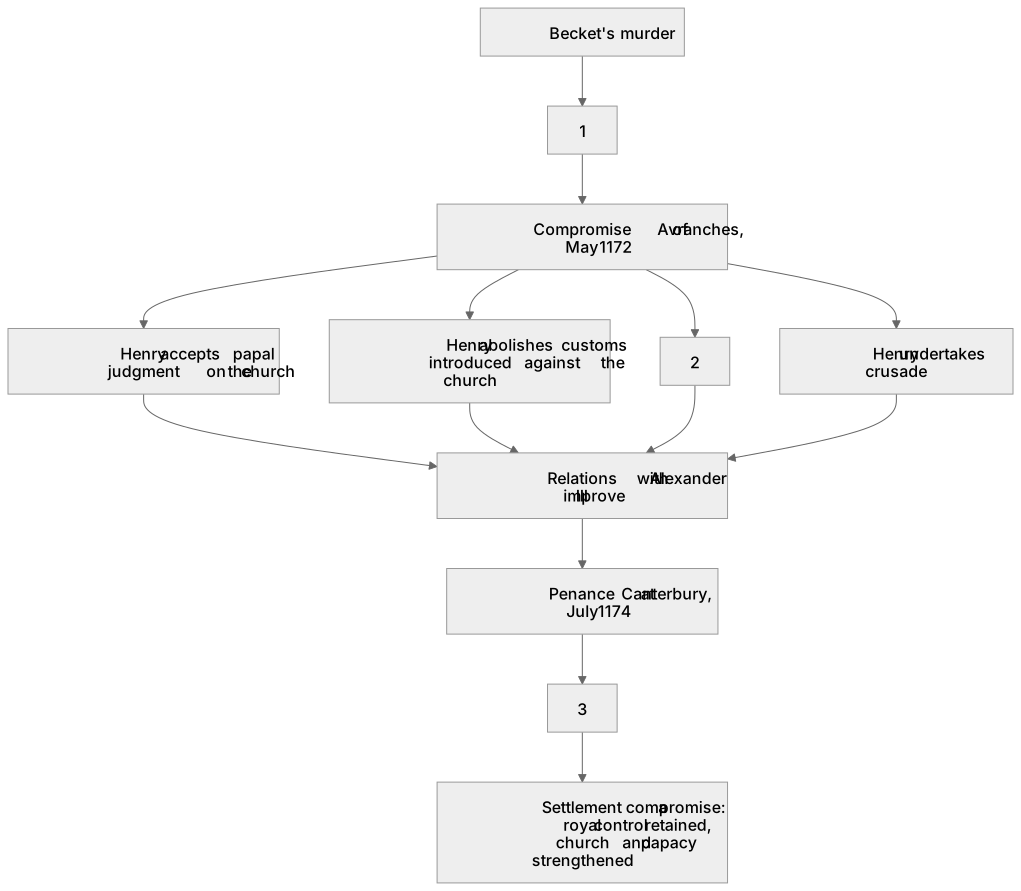
1Box 1
2Box 2
3Box 3
There is more to this lesson
The full lesson goes on to check your understanding and help you earn the marks. Create a free account to carry on, with your progress saved.
A week of Premium from your first lesson · Then the free plan continues · No card, no charge
Test your understanding of Henry II and the English church, 1154–74: The settlements between king and church, 1172–74: the agreement at Avranches; relations between Henry and the pope; Henry’s penance at Canterbury in 1174; the extent of Henry’s success.
Active recall beats re-reading. Take an instant quiz now to test what you’ve learned and lock it into long-term memory.
A week of Premium from your first lesson · Then the free plan continues · No card, no charge