Pearson Edexcel · A-Level · History
Course version: 9HI0 · Version from Sept 2015
The importance of William III’s wars in the development of a financial…
Full specification wording
How revolutionary, in the years to 1701, was the Glorious Revolution of 1688–89?: The importance of William III’s wars in the development of a financial revolution.
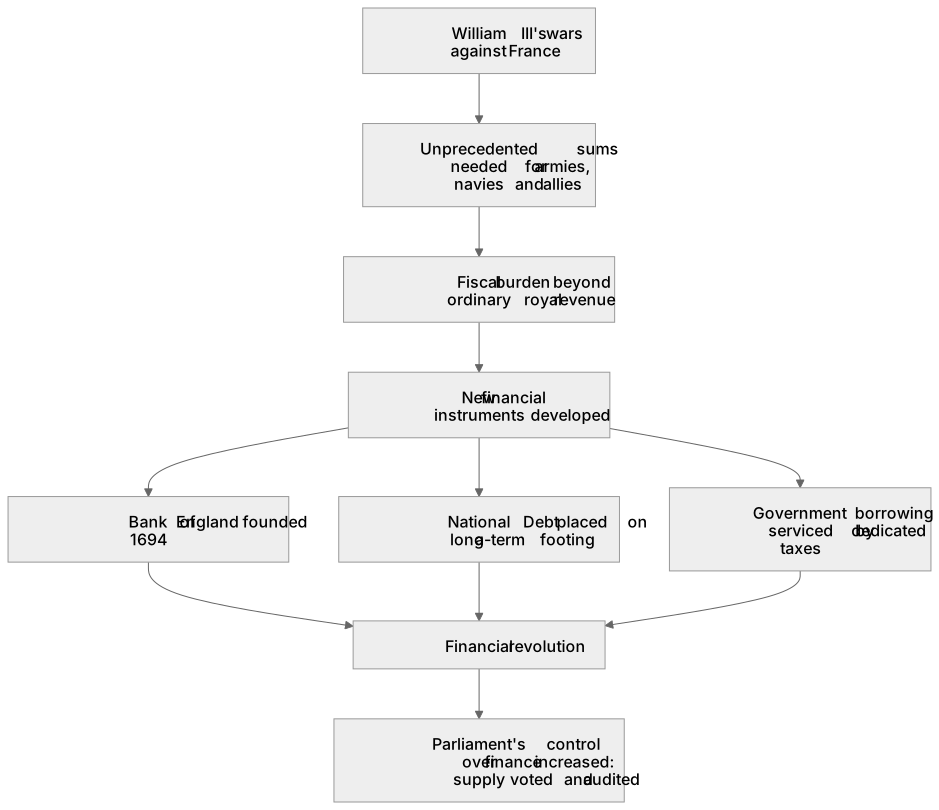
William III's wars against France, primarily the Nine Years' War (1688–1697), demanded unprecedented sums for armies, navies, and allies.
Checked against the Pearson Edexcel 9HI0 specification (opens in a new tab) on .
- Point 4 of 4
- 4 key terms
Study notes
From the checked teaching notes for this specification point.
The idea
William III's wars against France, primarily the Nine Years' War (1688–1697), demanded unprecedented sums for armies, navies, and allies. To fund this massive military expenditure, the Crown and Parliament developed new financial instruments, sparking the development of a financial revolution. The Bank of England was founded in 1694, the National Debt was placed on a long-term footing, and government borrowing was serviced by dedicated taxes. These measures increased Parliament's control over finance because supply had to be voted and audited. The financial revolution also depended on credible repayment.
What earns the marks
- Explains how the scale and duration of William III's wars (such as the Nine Years' War) created a fiscal burden far beyond ordinary royal revenue.
- Identifies key financial innovations in the development of a financial revolution: the Bank of England (1694), the National Debt, and Exchequer bills.
- Links war finance to parliamentary power, because Parliament voted supply, authorised new taxes, and scrutinised expenditure.
- Assesses the importance of William III's wars by comparing them with other causes of the financial revolution, such as overseas trade, London's financial markets, and Dutch financial techniques.
- Uses evidence of change, such as the rise in government borrowing or the establishment of the Bank of England, to support a judgement about how far war drove the revolution.
Common mistakes and how to put them right
Including the War of the Spanish Succession (1702–1713) as one of William III's wars.
Put it right: William III died in 1702, so focus on the Nine Years' War (1688–1697) when discussing his conflicts.
Treating the development of a financial revolution as solely caused by war.
Put it right: War was a major catalyst, but commercial wealth, credible parliamentary institutions, and foreign expertise also mattered.
Confusing the National Debt with a single loan.
Put it right: It was a permanent, funded debt on which interest was paid from taxation, not a one-off sum.
Exam tips
- Use precise financial terms correctly, such as funded debt, Exchequer bills, and interest payments, to demonstrate understanding.
- Connect each financial innovation to the war effort, for example by explaining how the Bank of England helped to raise loans for William III's wars.
Try the lesson
The start of the How revolutionary, in the years to 1701, was the Glorious Revolution of 1688–89?: The importance of William III’s wars in the development of a financial revolution. lesson, made from checked teaching notes for this specification point.
Have a go first
Which institution was founded in 1694 to help fund William III's wars against France?
Listen
William III's wars against France, primarily the Nine Years' War (1688–1697), demanded unprecedented sums for armies, navies, and allies. To fund this massive military expenditure, the Crown and Parliament developed new financial instruments, sparking the development of a financial revolution. The Bank of England was founded in 1694, the National Debt was placed on a long-term footing, and government borrowing was serviced by dedicated taxes. These measures increased Parliament's control over finance because supply had to be voted and audited. The financial revolution also depended on credible repayment. A strong answer earns marks for these points. Explains how the scale and duration of William III's wars (such as the Nine Years' War) created a fiscal burden far beyond ordinary royal revenue. Identifies key financial innovations in the development of a financial revolution: the Bank of England (1694), the National Debt, and Exchequer bills. Links war finance to parliamentary power, because Parliament voted supply, authorised new taxes, and scrutinised expenditure. Assesses the importance of William III's wars by comparing them with other causes of the financial revolution, such as overseas trade, London's financial markets, and Dutch financial techniques. A common slip: Including the War of the Spanish Succession (1702–1713) as one of William III's wars. Instead, William III died in 1702, so focus on the Nine Years' War (1688–1697) when discussing his conflicts. Exam tip: Use precise financial terms correctly, such as funded debt, Exchequer bills, and interest payments, to demonstrate understanding.
See it
Put the events in order
Put these events in the order they happened, earliest first.
- 1. Nine Years' War began, creating a fiscal burden
- 2. William III died
- 3. The Bank of England was founded
Key words
Say what each word means before you turn the card.
Financial revolution
Try answering aloud or in your head before turning the card.
Bank of England
Try answering aloud or in your head before turning the card.
National Debt
Try answering aloud or in your head before turning the card.
Parliamentary control of finance
Try answering aloud or in your head before turning the card.
See every definition
- Financial revolution
- A development sparked by new financial instruments created by the Crown and Parliament to fund massive military expenditure.
- Bank of England
- Founded in 1694, it helped to raise loans for William III's wars.
- National Debt
- A permanent, funded debt placed on a long-term footing, on which interest was paid from taxation.
- Parliamentary control of finance
- Increased because supply had to be voted and audited, with Parliament voting supply, authorising new taxes, and scrutinising expenditure.
Label the diagram
Some boxes have lost their names. Pick the right name for each number.
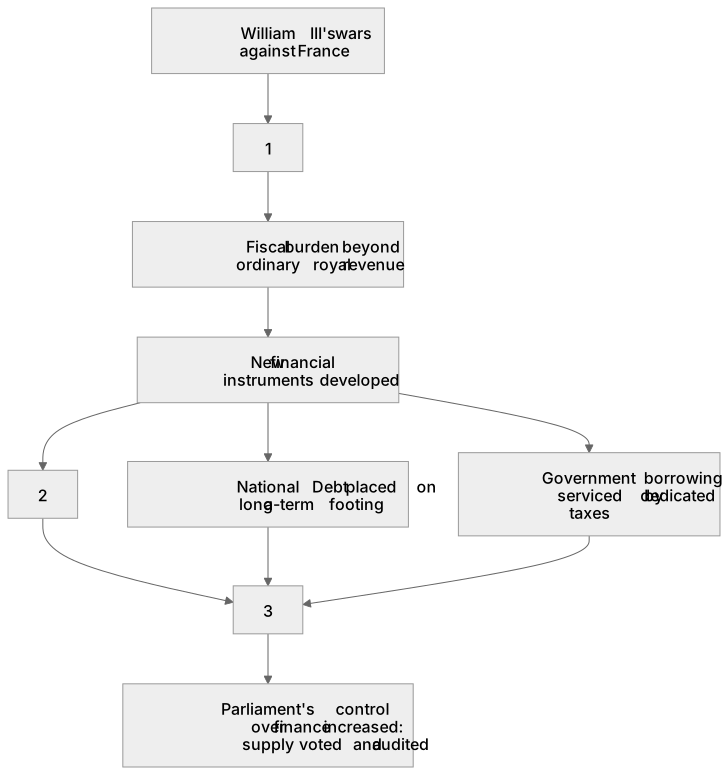
1Box 1
2Box 2
3Box 3
There is more to this lesson
The full lesson goes on to check your understanding and help you earn the marks. Create a free account to carry on, with your progress saved.
A week of Premium from your first lesson · Then the free plan continues · No card, no charge
Test your understanding of How revolutionary, in the years to 1701, was the Glorious Revolution of 1688–89?: The importance of William III’s wars in the development of a financial revolution.
Active recall beats re-reading. Take an instant quiz now to test what you’ve learned and lock it into long-term memory.
A week of Premium from your first lesson · Then the free plan continues · No card, no charge