Pearson Edexcel · A-Level · History
Course version: 9HI0 · Version from Sept 2015
The significance of the Triennial Act 1694 and the growth of parliamentary…
Full specification wording
How revolutionary, in the years to 1701, was the Glorious Revolution of 1688–89?: The significance of the Triennial Act 1694 and the growth of parliamentary power.
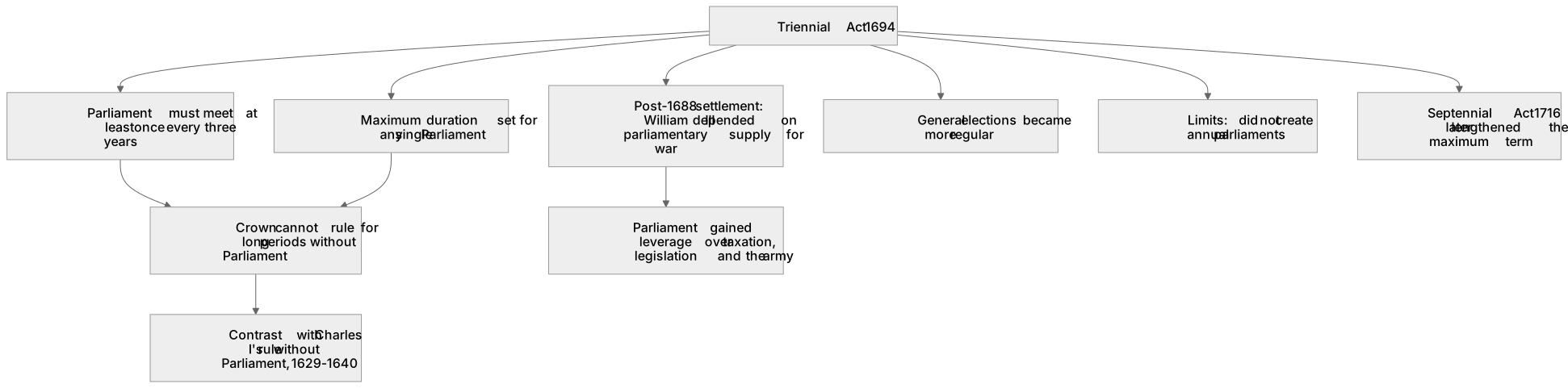
The Triennial Act 1694 required Parliament to meet at least once every three years and set a maximum duration for any single Parliament.
Checked against the Pearson Edexcel 9HI0 specification (opens in a new tab) on .
- Point 3 of 4
- 4 key terms
Study notes
From the checked teaching notes for this specification point.
The idea
The Triennial Act 1694 required Parliament to meet at least once every three years and set a maximum duration for any single Parliament. It mattered because it removed the Crown's ability to rule for long periods without Parliament, as Charles I had done between 1629 and 1640. It also reflected the post-1688 settlement, in which William III depended on parliamentary supply for war, so Parliament gained leverage over taxation, legislation and the army. Its limits should also be noted: it did not create annual parliaments, and the Septennial Act 1716 later lengthened the maximum term, showing that parliamentary power grew unevenly.
What earns the marks
- Explains the Act's two core provisions: Parliament must meet at least once every three years, and no Parliament could last beyond three years without a general election.
- Links the Act to the constitutional context after 1688, when William III's need for war finance gave Parliament greater bargaining power.
- Assesses significance by contrast with the Personal Rule of 1629–1640, when Charles I governed without Parliament and raised revenue through prerogative means.
- Recognises limits: the Act did not guarantee frequent sittings in practice, and the Septennial Act 1716 extended the maximum duration to seven years.
- Uses specific evidence, such as the frequency of elections after 1694 or the Crown's continued ability to manage Parliament through patronage, to support a judgement.
Common mistakes and how to put them right
Treating the Triennial Act as creating annual parliaments.
Put it right: It set a three-year maximum gap between meetings and a three-year maximum duration, not annual elections.
Assuming the Act alone caused the growth of parliamentary power.
Put it right: It was one part of a wider post-1688 settlement including the Bill of Rights 1689 and financial dependence of the Crown on Parliament.
Confusing the 1694 Act with the 1641 Triennial Act.
Put it right: The 1641 Act was passed during the early Stuart crisis and lacked the same post-revolution context, while the 1694 Act operated within the Williamite settlement.
Exam tips
- Anchor each paragraph to a clear criterion of significance, such as legal change, practical effect on elections, or limitation on royal prerogative.
- Use precise dates and names, for example 1694, William III, the Personal Rule 1629–1640, and the Septennial Act 1716, to show secure contextual knowledge.
- Reach a substantiated overall judgement about how far the Act transformed parliamentary power rather than listing its terms.
Try the lesson
The start of the How revolutionary, in the years to 1701, was the Glorious Revolution of 1688–89?: The significance of the Triennial Act 1694 and the growth of parliamentary power. lesson, made from checked teaching notes for this specification point.
Have a go first
Under the Triennial Act of 1694, how often was a new Parliament required to meet?
Listen
The Triennial Act 1694 required Parliament to meet at least once every three years and set a maximum duration for any single Parliament. It mattered because it removed the Crown's ability to rule for long periods without Parliament, as Charles I had done between 1629 and 1640. It also reflected the post-1688 settlement, in which William III depended on parliamentary supply for war, so Parliament gained leverage over taxation, legislation and the army. Its limits should also be noted: it did not create annual parliaments, and the Septennial Act 1716 later lengthened the maximum term, showing that parliamentary power grew unevenly. A strong answer earns marks for these points. Explains the Act's two core provisions: Parliament must meet at least once every three years, and no Parliament could last beyond three years without a general election. Links the Act to the constitutional context after 1688, when William III's need for war finance gave Parliament greater bargaining power. Assesses significance by contrast with the Personal Rule of 1629–1640, when Charles I governed without Parliament and raised revenue through prerogative means. Recognises limits: the Act did not guarantee frequent sittings in practice, and the Septennial Act 1716 extended the maximum duration to seven years. A common slip: Treating the Triennial Act as creating annual parliaments. Instead, it set a three-year maximum gap between meetings and a three-year maximum duration, not annual elections. Exam tip: Anchor each paragraph to a clear criterion of significance, such as legal change, practical effect on elections, or limitation on royal prerogative.
See it
Put the events in order
Put these events in the order they happened, earliest first.
- 1. The Septennial Act lengthens the maximum term
- 2. Charles I begins the Personal Rule without Parliament
- 3. The Triennial Act is passed
- 4. The Bill of Rights is passed
Key words
Say what each word means before you turn the card.
Triennial Act 1694
Try answering aloud or in your head before turning the card.
Personal Rule of 1629–1640
Try answering aloud or in your head before turning the card.
Septennial Act 1716
Try answering aloud or in your head before turning the card.
parliamentary supply
Try answering aloud or in your head before turning the card.
See every definition
- Triennial Act 1694
- Required Parliament to meet at least once every three years and set a maximum duration for any single Parliament.
- Personal Rule of 1629–1640
- Period when Charles I governed without Parliament and raised revenue through prerogative means.
- Septennial Act 1716
- Later lengthened the maximum term, showing that parliamentary power grew unevenly.
- parliamentary supply
- War finance that William III depended on after 1688, giving Parliament leverage over taxation, legislation and the army.
Label the diagram
Some boxes have lost their names. Pick the right name for each number.
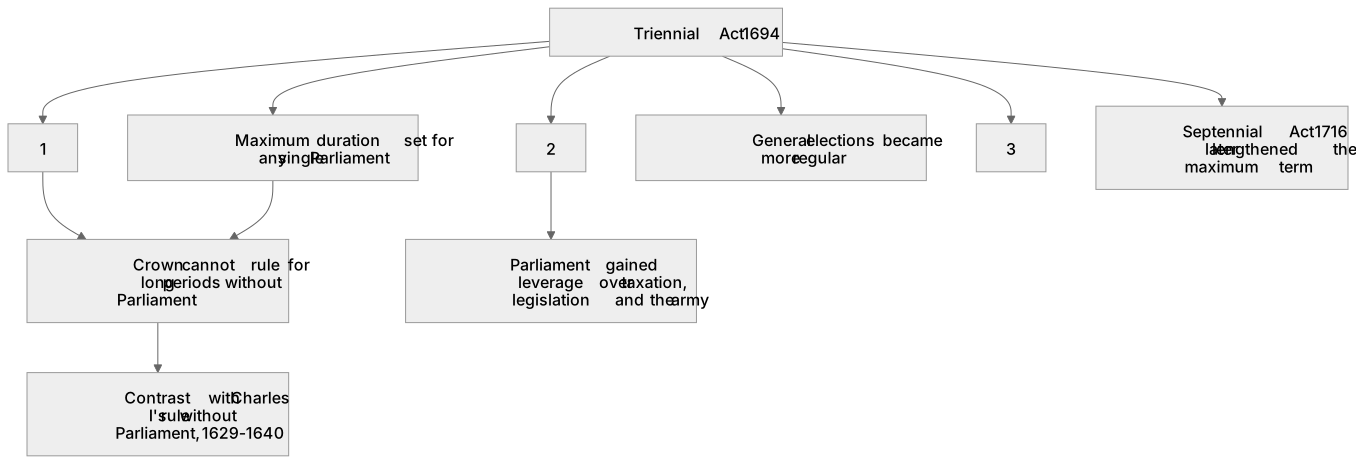
1Box 1
2Box 2
3Box 3
There is more to this lesson
The full lesson goes on to check your understanding and help you earn the marks. Create a free account to carry on, with your progress saved.
A week of Premium from your first lesson · Then the free plan continues · No card, no charge
Test your understanding of How revolutionary, in the years to 1701, was the Glorious Revolution of 1688–89?: The significance of the Triennial Act 1694 and the growth of parliamentary power.
Active recall beats re-reading. Take an instant quiz now to test what you’ve learned and lock it into long-term memory.
A week of Premium from your first lesson · Then the free plan continues · No card, no charge