Pearson Edexcel · A-Level · History
Course version: 9HI0 · Version from Sept 2015
The house of Godwin: Harold Godwinson’s succession as Earl of Wessex; the…
Full specification wording
Late Anglo- Saxon England, c1053–66: The house of Godwin: Harold Godwinson’s succession as Earl of Wessex; the power of the Godwin siblings; the campaign against the Welsh; Harold Godwinson’s embassy to Normandy; the rising against Tostig and his exile.
The house of Godwin dominated late Anglo-Saxon politics.
Checked against the Pearson Edexcel 9HI0 specification (opens in a new tab) on .
- Point 3 of 4
- 4 key terms
Study notes
From the checked teaching notes for this specification point.
The idea
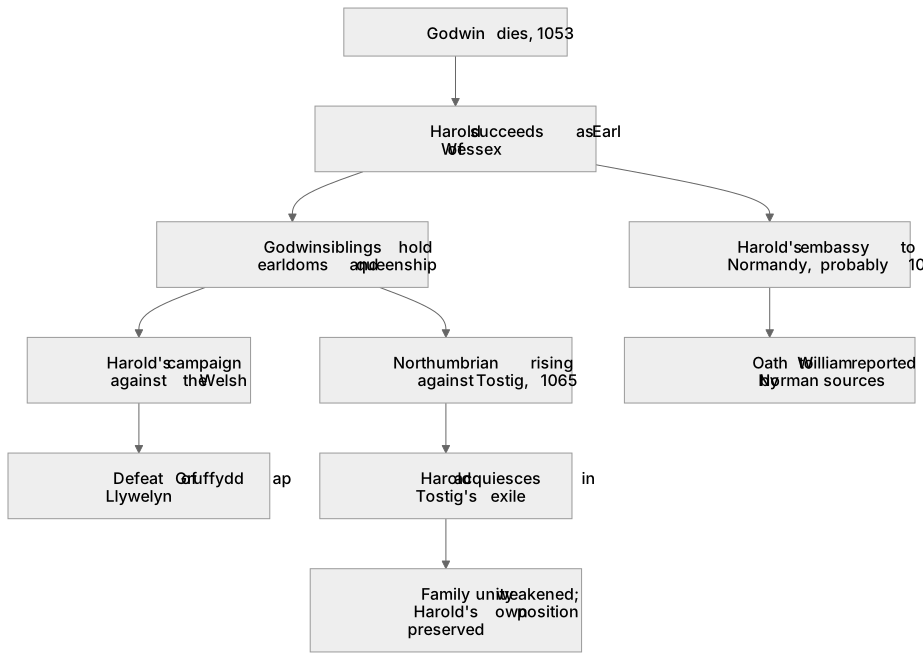
The house of Godwin dominated late Anglo-Saxon politics. When Earl Godwin died in 1053, Harold succeeded him as Earl of Wessex, taking control of the richest earldom and becoming the king’s leading magnate. His siblings held earldoms: Tostig in Northumbria, Gyrth in East Anglia, Leofwine in the south-east, and Edith was Edward’s queen. This network gave the family military, judicial and economic power. In the early 1060s Harold led a successful campaign against the Welsh, defeating Gruffydd ap Llywelyn and winning prestige. He also went on an embassy to Normandy, probably in 1064, where he swore an oath to William according to Norman sources. In 1065 Northumbrian rebels rose against Tostig, and Harold acquiesced in his exile, weakening the family’s unity but preserving his own position.
What earns the marks
- Explains how Harold became Earl of Wessex in 1053 after Godwin’s death, and why this earldom was the wealthiest and most strategically important.
- Analyses the power of the Godwin siblings: Tostig, Gyrth, Leofwine and Edith, and how their positions extended family influence over crown, church and localities.
- Describes Harold’s Welsh campaign, including the defeat of Gruffydd ap Llywelyn and the political and military gains for Harold and Edward.
- Explains the purpose and consequences of Harold’s embassy to Normandy, including the disputed oath to William and its use in Norman propaganda.
- Examines the causes and course of the rising against Tostig in 1065, and the significance of Harold’s role in Tostig’s exile for Godwin family cohesion and royal authority.
Common mistakes and how to put them right
Treating Harold’s succession as Earl of Wessex as automatic.
Put it right: It followed Godwin’s death in 1053 and depended on royal approval and family influence.
Assuming all Godwin siblings held earldoms.
Put it right: Edith was queen, not an earl, and the brothers held different earldoms at different times.
Presenting Harold’s Welsh campaign as a minor raid.
Put it right: It was a major royal-backed campaign that removed Gruffydd ap Llywelyn and enhanced Harold’s reputation.
Stating the Norman oath as undisputed fact.
Put it right: The oath is reported by Norman sources and its exact terms and circumstances are debated.
Claiming Harold supported Tostig in 1065.
Put it right: Harold allowed Tostig’s exile to avoid civil war and protect his own succession prospects.
Exam tips
- Use the specification wording to structure your answer: succession, siblings, Wales, Normandy, Tostig.
- Support each point with specific dates, names and places, such as 1053, 1063, 1064 and 1065.
- When discussing the oath, compare Norman and English evidence and explain why the difference matters.
- Link the rising against Tostig to the wider theme of royal authority and the succession crisis of 1066.
Try the lesson
The start of the Late Anglo- Saxon England, c1053–66: The house of Godwin: Harold Godwinson’s succession as Earl of Wessex; the power of the Godwin siblings; the campaign against the Welsh; Harold Godwinson’s embassy to Normandy; the rising against Tostig and his exile. lesson, made from checked teaching notes for this specification point.
Have a go first
Which earldom did Harold Godwinson hold after his father Godwin died in 1053?
Listen
The house of Godwin dominated late Anglo-Saxon politics. When Earl Godwin died in 1053, Harold succeeded him as Earl of Wessex, taking control of the richest earldom and becoming the king’s leading magnate. His siblings held earldoms: Tostig in Northumbria, Gyrth in East Anglia, Leofwine in the south-east, and Edith was Edward’s queen. This network gave the family military, judicial and economic power. In the early 1060s Harold led a successful campaign against the Welsh, defeating Gruffydd ap Llywelyn and winning prestige. He also went on an embassy to Normandy, probably in 1064, where he swore an oath to William according to Norman sources. In 1065 Northumbrian rebels rose against Tostig, and Harold acquiesced in his exile, weakening the family’s unity but preserving his own position. A strong answer earns marks for these points. Explains how Harold became Earl of Wessex in 1053 after Godwin’s death, and why this earldom was the wealthiest and most strategically important. Analyses the power of the Godwin siblings: Tostig, Gyrth, Leofwine and Edith, and how their positions extended family influence over crown, church and localities. Describes Harold’s Welsh campaign, including the defeat of Gruffydd ap Llywelyn and the political and military gains for Harold and Edward. Explains the purpose and consequences of Harold’s embassy to Normandy, including the disputed oath to William and its use in Norman propaganda. A common slip: treating Harold’s succession as Earl of Wessex as automatic. Instead, it followed Godwin’s death in 1053 and depended on royal approval and family influence. Exam tip: Use the specification wording to structure your answer: succession, siblings, Wales, Normandy, Tostig.
See it
Put the events in order
Put these events in the order they happened, earliest first.
- 1. Northumbrian rebels rose against Tostig
- 2. Harold Godwinson succeeded as Earl of Wessex after Godwin's death
- 3. Harold went on an embassy to Normandy
- 4. Harold led a successful campaign against the Welsh
Key words
Say what each word means before you turn the card.
Power and authority
Try answering aloud or in your head before turning the card.
Family and succession
Try answering aloud or in your head before turning the card.
Kingship and nobility
Try answering aloud or in your head before turning the card.
Military campaigns and diplomacy
Try answering aloud or in your head before turning the card.
See every definition
- Power and authority
- The family network gave the Godwins military, judicial and economic power, extending their influence over crown, church and localities.
- Family and succession
- Harold succeeded Godwin as Earl of Wessex in 1053, depending on royal approval and family influence rather than being automatic.
- Kingship and nobility
- Harold became the king's leading magnate, while his siblings held earldoms and Edith was Edward's queen.
- Military campaigns and diplomacy
- Harold led a royal-backed campaign against the Welsh and went on an embassy to Normandy, where he swore an oath to William according to Norman sources.
Label the diagram
Some boxes have lost their names. Pick the right name for each number.
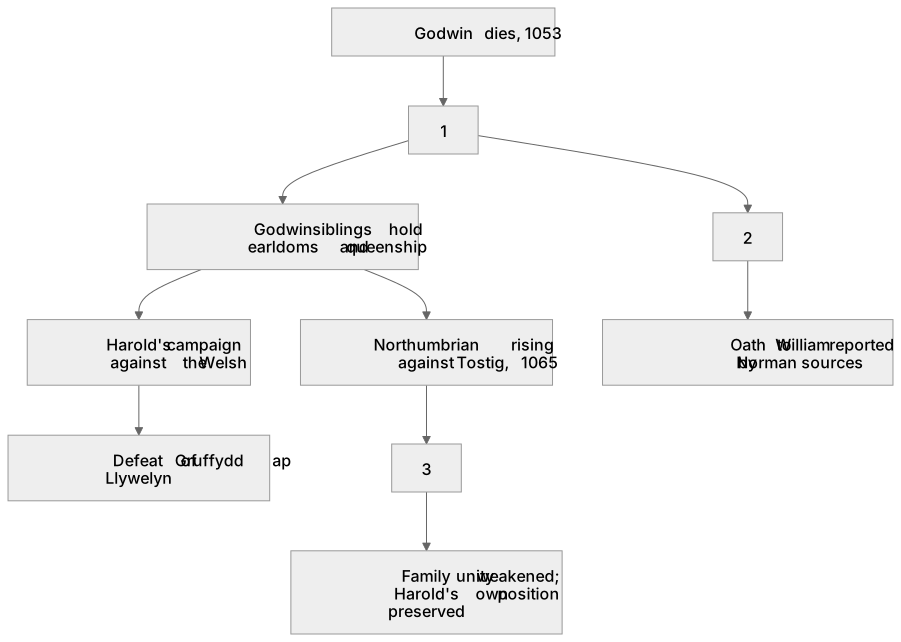
1Box 1
2Box 2
3Box 3
There is more to this lesson
The full lesson goes on to check your understanding and help you earn the marks. Create a free account to carry on, with your progress saved.
A week of Premium from your first lesson · Then the free plan continues · No card, no charge
Test your understanding of Late Anglo- Saxon England, c1053–66: The house of Godwin: Harold Godwinson’s succession as Earl of Wessex; the power of the Godwin siblings; the campaign against the Welsh; Harold Godwinson’s embassy to Normandy; the rising against Tostig and his exile.
Active recall beats re-reading. Take an instant quiz now to test what you’ve learned and lock it into long-term memory.
A week of Premium from your first lesson · Then the free plan continues · No card, no charge