Pearson Edexcel · A-Level · History
Course version: 9HI0 · Version from Sept 2015
Louis VII, Conrad III and the Second Crusade: personal and political…
Full specification wording
Leadership of the crusades, 1095–1192: Louis VII, Conrad III and the Second Crusade: personal and political rivalries and tensions; their relationship with Manuel I; the failure to consult the leaders of the crusader states; failure at Damascus 1148 and the end of the crusade.
The Second Crusade (1147–1149) was led by Louis VII and Conrad III, whose personal and political rivalries undermined the campaign.
Checked against the Pearson Edexcel 9HI0 specification (opens in a new tab) on .
- Point 2 of 3
- 4 key terms
Study notes
From the checked teaching notes for this specification point.
The idea
The Second Crusade (1147–1149) was led by Louis VII and Conrad III, whose personal and political rivalries undermined the campaign. They travelled separately, and their relationship with Manuel I was tense: Conrad allied with Manuel, while Louis distrusted Byzantine motives. Crucially, the kings failed to consult the leaders of the crusader states effectively, ignoring Raymond of Antioch's advice to attack Aleppo. This poor coordination culminated in the disastrous failure at Damascus in 1148, where the crusaders withdrew after four days. The end of the crusade damaged Christian prestige and prompted bitter recriminations. Understanding these factors explains why the campaign achieved so little.
What earns the marks
- Explains how personal and political rivalries between Louis VII and Conrad III, including separate routes and competing priorities, weakened unified command.
- Analyses the relationship with Manuel I, such as the Byzantine desire to control crusader gains and the lack of trust between Latin and Greek leaders.
- Assesses the failure to consult the leaders of the crusader states, such as alienating Raymond of Antioch, and how this led to poor strategic decisions.
- Evaluates the failure at Damascus in 1148, including the swift withdrawal and its consequences for the crusade's collapse.
- Discusses the end of the crusade and its impact on the reputation of the leaders and the wider crusading movement.
Common mistakes and how to put them right
Treating the Second Crusade as a single unified campaign.
Put it right: Recognise that Louis and Conrad operated separately and often at cross-purposes due to personal and political rivalries.
Ignoring the relationship with Manuel I and Byzantine-crusader relations.
Put it right: Include how Manuel's diplomacy and the lack of trust affected the campaign.
Assuming the failure at Damascus was solely due to military weakness.
Put it right: Consider the failure to consult the leaders of the crusader states effectively, leading to strategic errors.
Exam tips
- Use specific examples, such as the separate routes taken by Louis and Conrad, to illustrate personal and political rivalries.
- Link the failure to consult the leaders of the crusader states, like Raymond of Antioch, to the disastrous decision to attack Damascus.
- When discussing the end of the crusade, consider both immediate and long-term consequences for the Latin East.
Try the lesson
The start of the Leadership of the crusades, 1095–1192: Louis VII, Conrad III and the Second Crusade: personal and political rivalries and tensions; their relationship with Manuel I; the failure to consult the leaders of the crusader states; failure at Damascus 1148 and the end of the crusade. lesson, made from checked teaching notes for this specification point.
Have a go first
Which city was the target of the Second Crusade's attack in July 1148 that ended in failure?
Listen
The Second Crusade (1147–1149) was led by Louis VII and Conrad III, whose personal and political rivalries undermined the campaign. They travelled separately, and their relationship with Manuel I was tense: Conrad allied with Manuel, while Louis distrusted Byzantine motives. Crucially, the kings failed to consult the leaders of the crusader states effectively, ignoring Raymond of Antioch's advice to attack Aleppo. This poor coordination culminated in the disastrous failure at Damascus in 1148, where the crusaders withdrew after four days. The end of the crusade damaged Christian prestige and prompted bitter recriminations. Understanding these factors explains why the campaign achieved so little. A strong answer earns marks for these points. Explains how personal and political rivalries between Louis VII and Conrad III, including separate routes and competing priorities, weakened unified command. Analyses the relationship with Manuel I, such as the Byzantine desire to control crusader gains and the lack of trust between Latin and Greek leaders. Assesses the failure to consult the leaders of the crusader states, such as alienating Raymond of Antioch, and how this led to poor strategic decisions. Evaluates the failure at Damascus in 1148, including the swift withdrawal and its consequences for the crusade's collapse. A common slip: Treating the Second Crusade as a single unified campaign. Instead, Recognise that Louis and Conrad operated separately and often at cross-purposes due to personal and political rivalries. Exam tip: Use specific examples, such as the separate routes taken by Louis and Conrad, to illustrate personal and political rivalries.
See it
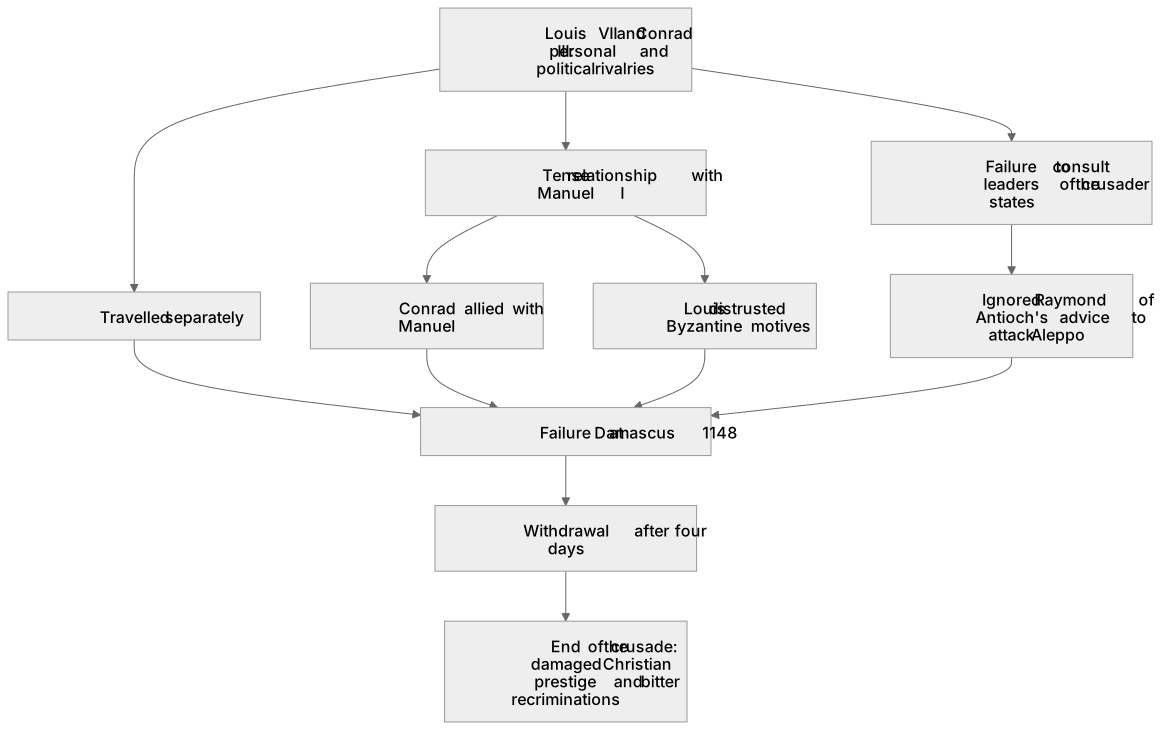
Put the events in order
Put these events in the order they happened, earliest first.
- 1. Louis VII and Conrad III lead the Second Crusade
- 2. The Second Crusade comes to an end
- 3. Crusaders fail at Damascus and withdraw
Key words
Say what each word means before you turn the card.
Leadership and command
Try answering aloud or in your head before turning the card.
Cross-cultural relations
Try answering aloud or in your head before turning the card.
Strategic decision-making
Try answering aloud or in your head before turning the card.
Consequences of failure
Try answering aloud or in your head before turning the card.
See every definition
- Leadership and command
- Personal and political rivalries between Louis VII and Conrad III, including separate routes and competing priorities, weakened unified command.
- Cross-cultural relations
- The relationship with Manuel I involved Byzantine desire to control crusader gains and a lack of trust between Latin and Greek leaders.
- Strategic decision-making
- The failure to consult the leaders of the crusader states, such as alienating Raymond of Antioch, led to poor strategic decisions.
- Consequences of failure
- The failure at Damascus in 1148, including the swift withdrawal, contributed to the crusade's collapse and damaged Christian prestige.
Label the diagram
Some boxes have lost their names. Pick the right name for each number.
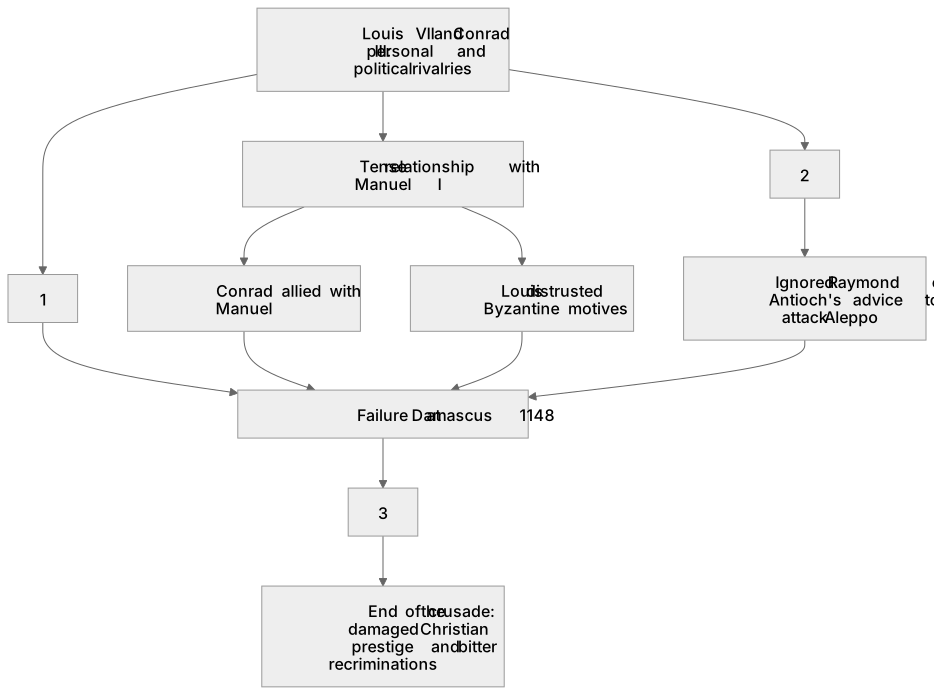
1Box 1
2Box 2
3Box 3
There is more to this lesson
The full lesson goes on to check your understanding and help you earn the marks. Create a free account to carry on, with your progress saved.
A week of Premium from your first lesson · Then the free plan continues · No card, no charge
Test your understanding of Leadership of the crusades, 1095–1192: Louis VII, Conrad III and the Second Crusade: personal and political rivalries and tensions; their relationship with Manuel I; the failure to consult the leaders of the crusader states; failure at Damascus 1148 and the end of the crusade.
Active recall beats re-reading. Take an instant quiz now to test what you’ve learned and lock it into long-term memory.
A week of Premium from your first lesson · Then the free plan continues · No card, no charge