Pearson Edexcel · A-Level · History
Course version: 9HI0 · Version from Sept 2015
The First Crusade: the eight princes and their changing priorities;…
Full specification wording
Leadership of the crusades, 1095–1192: The First Crusade: the eight princes and their changing priorities; Baldwin’s conquest of Edessa 1097; Bohemund’s seizure of Antioch 1098; emergence of Godfrey of Bouillon as leader and the capture of Jerusalem 1099.
The First Crusade was led by eight princes: Raymond of Toulouse, Bohemund of Taranto, Godfrey of Bouillon, Baldwin of Boulogne, Hugh of Vermandois, Robert of Normandy, Robert of Flanders, and…
Checked against the Pearson Edexcel 9HI0 specification (opens in a new tab) on .
- Point 1 of 3
- 3 key terms
Study notes
From the checked teaching notes for this specification point.
The idea
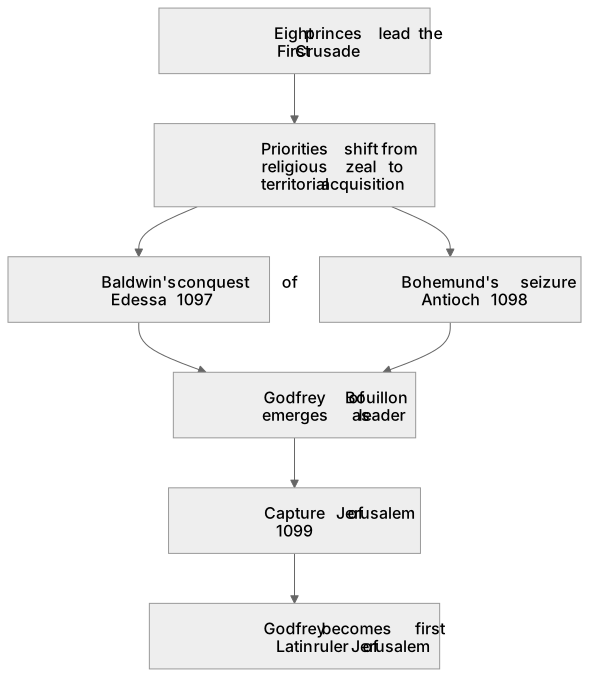
The First Crusade was led by eight princes: Raymond of Toulouse, Bohemund of Taranto, Godfrey of Bouillon, Baldwin of Boulogne, Hugh of Vermandois, Robert of Normandy, Robert of Flanders, and Stephen of Blois. Their priorities shifted from religious zeal to territorial acquisition. Baldwin secured the County of Edessa (noted in the specification as 1097, though historically finalised in 1098). Bohemund seized Antioch in 1098 after a gruelling siege, keeping it for himself. Godfrey of Bouillon emerged as the primary leader, culminating in the capture of Jerusalem in 1099, after which he became its first Latin ruler. These events highlight the evolution from pilgrimage to conquest.
What earns the marks
- Identifies the eight princes and explains how their priorities changed from religious pilgrimage to political and territorial ambitions.
- Describes Baldwin's conquest of Edessa (specification date 1097) and its significance as the first crusader state.
- Explains Bohemund's seizure of Antioch in 1098, including the role of the siege and internal crusader politics.
- Analyses Godfrey of Bouillon's emergence as leader and the capture of Jerusalem in 1099, and the impact of these events on the crusade's outcome.
Common mistakes and how to put them right
Assuming the eight princes acted in perfect unity.
Put it right: Emphasise the factionalism and shifting priorities among the leaders.
Confusing the sequence of events, such as placing the capture of Jerusalem before the seizure of Antioch.
Put it right: Maintain a strict chronological timeline of the campaign.
Taking the specification date of 1097 for Edessa's conquest as absolute.
Put it right: Acknowledge the specification date of 1097, but demonstrate historical awareness that Baldwin's control was solidified in early 1098.
Exam tips
- Use a chronological framework to show how priorities changed over time, from the initial gathering to the capture of Jerusalem.
- Support your arguments with specific names of the eight princes and key events like Bohemund's capture of Antioch in 1098.
Try the lesson
The start of the Leadership of the crusades, 1095–1192: The First Crusade: the eight princes and their changing priorities; Baldwin’s conquest of Edessa 1097; Bohemund’s seizure of Antioch 1098; emergence of Godfrey of Bouillon as leader and the capture of Jerusalem 1099. lesson, made from checked teaching notes for this specification point.
Have a go first
Which city was captured by the crusaders under Godfrey of Bouillon in 1099?
Listen
The First Crusade was led by eight princes: Raymond of Toulouse, Bohemund of Taranto, Godfrey of Bouillon, Baldwin of Boulogne, Hugh of Vermandois, Robert of Normandy, Robert of Flanders, and Stephen of Blois. Their priorities shifted from religious zeal to territorial acquisition. Baldwin secured the County of Edessa (noted in the specification as 1097, though historically finalised in 1098). Bohemund seized Antioch in 1098 after a gruelling siege, keeping it for himself. Godfrey of Bouillon emerged as the primary leader, culminating in the capture of Jerusalem in 1099, after which he became its first Latin ruler. These events highlight the evolution from pilgrimage to conquest. A strong answer earns marks for these points. Identifies the eight princes and explains how their priorities changed from religious pilgrimage to political and territorial ambitions. Describes Baldwin's conquest of Edessa (specification date 1097) and its significance as the first crusader state. Explains Bohemund's seizure of Antioch in 1098, including the role of the siege and internal crusader politics. Analyses Godfrey of Bouillon's emergence as leader and the capture of Jerusalem in 1099, and the impact of these events on the crusade's outcome. A common slip: Assuming the eight princes acted in perfect unity; in reality, they often had competing interests and rivalries. Instead, Emphasise the factionalism and shifting priorities among the leaders. Exam tip: Use a chronological framework to show how priorities changed over time, from the initial gathering to the capture of Jerusalem.
See it
Put the events in order
Put these events in the order they happened, earliest first.
- 1. Baldwin's conquest of Edessa
- 2. Capture of Jerusalem and Godfrey's emergence as leader
- 3. Bohemund's seizure of Antioch
Key words
Say what each word means before you turn the card.
Leadership and command
Try answering aloud or in your head before turning the card.
Crusader states and settlement
Try answering aloud or in your head before turning the card.
Religious vs secular motives
Try answering aloud or in your head before turning the card.
See every definition
- Leadership and command
- The eight princes led the First Crusade, but they often had competing interests and rivalries rather than acting in perfect unity.
- Crusader states and settlement
- Baldwin's conquest of Edessa was significant as the first crusader state, showing priorities shifting from religious zeal to territorial acquisition.
- Religious vs secular motives
- Priorities shifted from religious zeal and pilgrimage to political and territorial ambitions, highlighting an evolution from pilgrimage to conquest.
Label the diagram
Some boxes have lost their names. Pick the right name for each number.
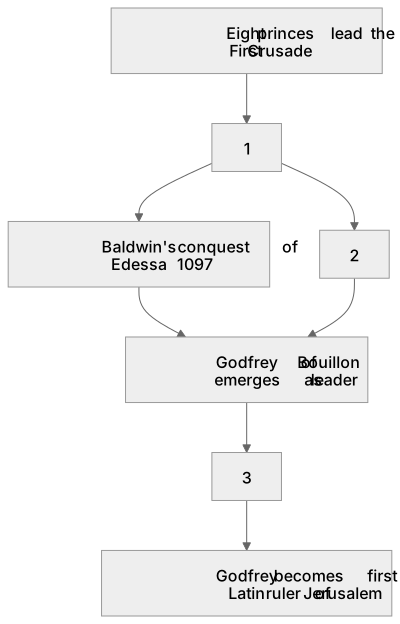
1Box 1
2Box 2
3Box 3
There is more to this lesson
The full lesson goes on to check your understanding and help you earn the marks. Create a free account to carry on, with your progress saved.
A week of Premium from your first lesson · Then the free plan continues · No card, no charge
Test your understanding of Leadership of the crusades, 1095–1192: The First Crusade: the eight princes and their changing priorities; Baldwin’s conquest of Edessa 1097; Bohemund’s seizure of Antioch 1098; emergence of Godfrey of Bouillon as leader and the capture of Jerusalem 1099.
Active recall beats re-reading. Take an instant quiz now to test what you’ve learned and lock it into long-term memory.
A week of Premium from your first lesson · Then the free plan continues · No card, no charge