Pearson Edexcel · A-Level · History
Course version: 9HI0 · Version from Sept 2015
The SED and the Protestant church: attacks on religious beliefs and…
Full specification wording
Life in East Germany, 1949–85: The SED and the Protestant church: attacks on religious beliefs and practices; education and Protestant youth groups; the establishment of a dialogue between church and state.
The SED sought to weaken Protestant influence by promoting atheism and restricting church activities.
Checked against the Pearson Edexcel 9HI0 specification (opens in a new tab) on .
- Point 3 of 4
- 4 key terms
Study notes
From the checked teaching notes for this specification point.
The idea
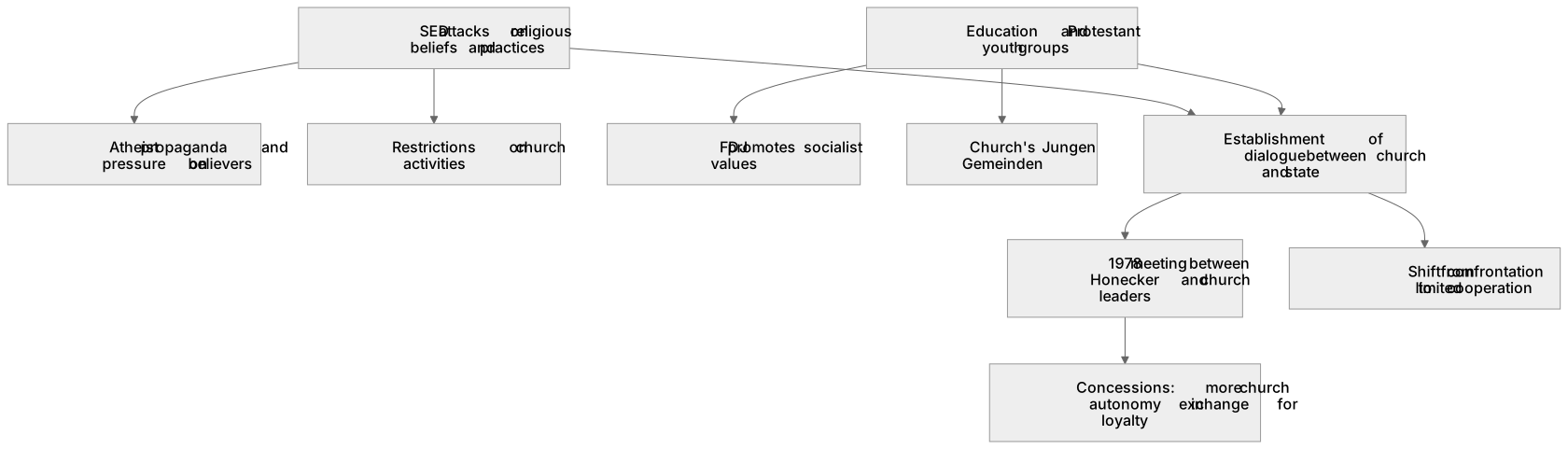
The SED sought to weaken Protestant influence by promoting atheism and restricting church activities. It attacked religious beliefs through propaganda and pressured believers, while education and youth groups like the FDJ promoted socialist values. Yet by the 1970s, the state opened a dialogue with the church, recognising its influence. For example, the 1978 meeting between Honecker and church leaders led to concessions, allowing more church autonomy in exchange for loyalty. This shift shows how the SED balanced repression with pragmatic engagement, aiming to integrate Christians into socialist society while limiting dissent.
What earns the marks
- Explains SED attacks on religious beliefs and practices, such as atheist propaganda, restrictions on church activities, and harassment of believers.
- Describes the role of education and Protestant youth groups, including the FDJ and the church's Jungen Gemeinden, in shaping youth.
- Analyses the establishment of dialogue between church and state, e.g., the 1978 meeting between Honecker and church leaders.
- Evaluates the extent to which SED policies towards the Protestant church changed over time, from confrontation to limited cooperation.
Common mistakes and how to put them right
Assuming the SED consistently persecuted the church without recognising periods of dialogue.
Put it right by noting the 1978 agreement and its motivations.
Confusing Protestant youth groups with state youth organisations like the FDJ.
Put it right by distinguishing their separate aims and memberships.
Overlooking the church's role as a space for dissent.
Put it right by acknowledging that some churches sheltered opposition groups.
Exam tips
- Use specific examples such as the 1978 meeting or the 'Junge Gemeinde' to support arguments.
- Compare different phases of SED policy to show change over time.
- Link church-state relations to broader themes of control and opposition in the GDR.
Try the lesson
The start of the Life in East Germany, 1949–85: The SED and the Protestant church: attacks on religious beliefs and practices; education and Protestant youth groups; the establishment of a dialogue between church and state. lesson, made from checked teaching notes for this specification point.
Have a go first
In the early 1950s the SED promoted the Jugendweihe as an alternative to which religious ceremony traditionally celebrated by Protestant families in the GDR?
Listen
The SED sought to weaken Protestant influence by promoting atheism and restricting church activities. It attacked religious beliefs through propaganda and pressured believers, while education and youth groups like the FDJ promoted socialist values. Yet by the 1970s, the state opened a dialogue with the church, recognising its influence. For example, the 1978 meeting between Honecker and church leaders led to concessions, allowing more church autonomy in exchange for loyalty. This shift shows how the SED balanced repression with pragmatic engagement, aiming to integrate Christians into socialist society while limiting dissent. A strong answer earns marks for these points. Explains SED attacks on religious beliefs and practices, such as atheist propaganda, restrictions on church activities, and harassment of believers. Describes the role of education and Protestant youth groups, including the FDJ and the church's Jungen Gemeinden, in shaping youth. Analyses the establishment of dialogue between church and state, e.g., the 1978 meeting between Honecker and church leaders. Evaluates the extent to which SED policies towards the Protestant church changed over time, from confrontation to limited cooperation. A common slip: Assuming the SED consistently persecuted the church without recognising periods of dialogue. Instead, noting the 1978 agreement and its motivations. Exam tip: Use specific examples such as the 1978 meeting or the 'Junge Gemeinde' to support arguments.
See it
Key words
Say what each word means before you turn the card.
State control and repression
Try answering aloud or in your head before turning the card.
Religion and ideology
Try answering aloud or in your head before turning the card.
Youth and education
Try answering aloud or in your head before turning the card.
Negotiation and compromise
Try answering aloud or in your head before turning the card.
See every definition
- State control and repression
- The SED attacked religious beliefs and practices through atheist propaganda, restrictions on church activities and harassment of believers.
- Religion and ideology
- The SED promoted atheism and socialist values in an attempt to weaken Protestant influence in East Germany.
- Youth and education
- Education and youth groups, including the FDJ and the church's Jungen Gemeinden, shaped young people in the GDR.
- Negotiation and compromise
- By the 1970s the state opened a dialogue with the church, and the 1978 meeting between Honecker and church leaders led to concessions.
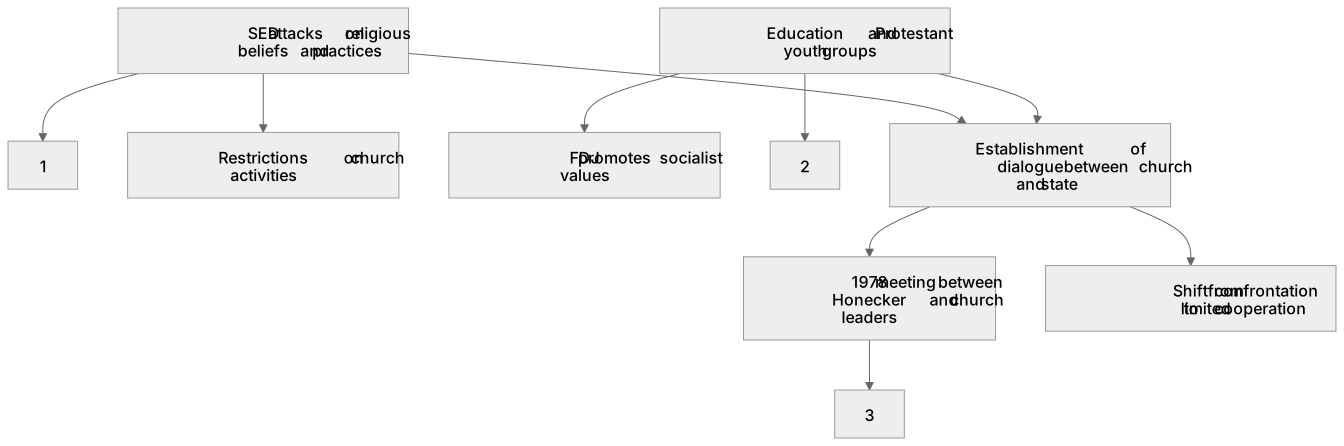
Label the diagram
Some boxes have lost their names. Pick the right name for each number.
1Box 1
2Box 2
3Box 3
There is more to this lesson
The full lesson goes on to check your understanding and help you earn the marks. Create a free account to carry on, with your progress saved.
A week of Premium from your first lesson · Then the free plan continues · No card, no charge
Test your understanding of Life in East Germany, 1949–85: The SED and the Protestant church: attacks on religious beliefs and practices; education and Protestant youth groups; the establishment of a dialogue between church and state.
Active recall beats re-reading. Take an instant quiz now to test what you’ve learned and lock it into long-term memory.
A week of Premium from your first lesson · Then the free plan continues · No card, no charge