Pearson Edexcel · A-Level · History
Course version: 9HI0 · Version from Sept 2015
Luther’s excommunication 1520: Luther’s tower experience and his…
Full specification wording
Luther’s early challenge to the Catholic Church, 1517–20: Luther’s excommunication 1520: Luther’s tower experience and his acceptance of justification by faith alone; the 1520 pamphlets addressed to the clergy, nobility and the German people; the burning of the Bull of Excommunication in 1520.
Luther's excommunication in 1520 marked a pivotal moment in the Reformation.
Checked against the Pearson Edexcel 9HI0 specification (opens in a new tab) on .
- Point 4 of 4
- 4 key terms
Study notes
From the checked teaching notes for this specification point.
The idea
Luther's excommunication in 1520 marked a pivotal moment in the Reformation. Central to this was Luther's 'tower experience', where he formulated his acceptance of justification by faith alone, challenging Catholic doctrines on salvation. In 1520, Luther published three highly influential pamphlets addressed to the clergy, nobility and the German people. These works expanded his critique of papal authority and sacramental theology, rallying widespread support. The sequence culminated in December 1520 with Luther's public burning of the Bull of Excommunication in Wittenberg. This dramatic act symbolised a total rejection of papal authority, cementing the schism and making reconciliation with the Catholic Church impossible.
What earns the marks
- Explains the theological significance of Luther's tower experience and how his acceptance of justification by faith alone undermined the Catholic Church's teachings on salvation and indulgences.
- Analyses the impact of the 1520 pamphlets addressed to the clergy, nobility and the German people in broadening Luther's appeal and challenging the spiritual and temporal authority of the papacy.
- Evaluates the symbolic and practical importance of the burning of the Bull of Excommunication in 1520 as a definitive break from Rome.
- Assesses the interplay between Luther's developing theology and his increasingly radical public actions leading up to his formal excommunication.
Common mistakes and how to put them right
Confusing the chronological order of events in 1520, such as stating the pamphlets were written after his formal excommunication.
Put it right: Note that the initial Bull (Exsurge Domine) threatened excommunication, prompting the 1520 pamphlets, before the actual excommunication bull in 1521.
Treating the three 1520 pamphlets as having the same audience and message.
Put it right: Distinguish between the pamphlets, noting that 'To the Christian Nobility' appealed to secular leaders, while 'On the Freedom of a Christian' addressed the German people and clergy.
Underestimating the theological shift of the tower experience.
Put it right: Emphasise that the acceptance of justification by faith alone was not just a minor reform but a fundamental rejection of the Catholic penitential system.
Exam tips
- When discussing Luther's excommunication, explicitly link his theological breakthrough (justification by faith alone) to his practical defiance (burning the Bull) to demonstrate a comprehensive understanding of his motives.
- Use the specific audiences of the 1520 pamphlets (clergy, nobility, German people) to explain how Luther successfully built a broad coalition of support against the papacy.
Try the lesson
The start of the Luther’s early challenge to the Catholic Church, 1517–20: Luther’s excommunication 1520: Luther’s tower experience and his acceptance of justification by faith alone; the 1520 pamphlets addressed to the clergy, nobility and the German people; the burning of the Bull of Excommunication in 1520. lesson, made from checked teaching notes for this specification point.
Have a go first
Which doctrine, central to Luther's tower experience, did he come to accept as the basis of salvation?
Listen
Luther's excommunication in 1520 marked a pivotal moment in the Reformation. Central to this was Luther's 'tower experience', where he formulated his acceptance of justification by faith alone, challenging Catholic doctrines on salvation. In 1520, Luther published three highly influential pamphlets addressed to the clergy, nobility and the German people. These works expanded his critique of papal authority and sacramental theology, rallying widespread support. The sequence culminated in December 1520 with Luther's public burning of the Bull of Excommunication in Wittenberg. This dramatic act symbolised a total rejection of papal authority, cementing the schism and making reconciliation with the Catholic Church impossible. A strong answer earns marks for these points. Explains the theological significance of Luther's tower experience and how his acceptance of justification by faith alone undermined the Catholic Church's teachings on salvation and indulgences. Analyses the impact of the 1520 pamphlets addressed to the clergy, nobility and the German people in broadening Luther's appeal and challenging the spiritual and temporal authority of the papacy. Evaluates the symbolic and practical importance of the burning of the Bull of Excommunication in 1520 as a definitive break from Rome. Assesses the interplay between Luther's developing theology and his increasingly radical public actions leading up to his formal excommunication. A common slip: Confusing the chronological order of events in 1520, such as stating the pamphlets were written after his formal excommunication. Instead, note that the initial Bull (Exsurge Domine) threatened excommunication, prompting the 1520 pamphlets, before the actual excommunication bull in 1521. Exam tip: When discussing Luther's excommunication, explicitly link his theological breakthrough (justification by faith alone) to his practical defiance (burning the Bull) to demonstrate a comprehensive understanding of his motives.
See it
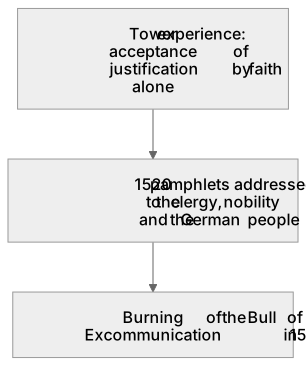
Put it in order
Put these steps in the order they happen.
- 1. 1520 pamphlets addressed to the clergy, nobility and the German people
- 2. Burning of the Bull of Excommunication in 1520
- 3. Tower experience: acceptance of justification by faith alone
Key words
Say what each word means before you turn the card.
justification by faith alone
Try answering aloud or in your head before turning the card.
tower experience
Try answering aloud or in your head before turning the card.
1520 pamphlets
Try answering aloud or in your head before turning the card.
burning of the Bull of Excommunication
Try answering aloud or in your head before turning the card.
See every definition
- justification by faith alone
- The doctrine Luther accepted at his tower experience, challenging Catholic teachings on salvation and indulgences.
- tower experience
- The moment when Luther formulated his acceptance of justification by faith alone, undermining Catholic doctrines on salvation.
- 1520 pamphlets
- Three influential works addressed to the clergy, nobility and the German people, expanding Luther's critique of papal authority and sacramental theology.
- burning of the Bull of Excommunication
- Luther's public act in Wittenberg in December 1520, symbolising total rejection of papal authority and cementing the schism.
Label the diagram
Some boxes have lost their names. Pick the right name for each number.
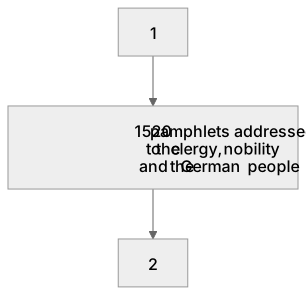
1Box 1
2Box 2
There is more to this lesson
The full lesson goes on to check your understanding and help you earn the marks. Create a free account to carry on, with your progress saved.
A week of Premium from your first lesson · Then the free plan continues · No card, no charge
Test your understanding of Luther’s early challenge to the Catholic Church, 1517–20: Luther’s excommunication 1520: Luther’s tower experience and his acceptance of justification by faith alone; the 1520 pamphlets addressed to the clergy, nobility and the German people; the burning of the Bull of Excommunication in 1520.
Active recall beats re-reading. Take an instant quiz now to test what you’ve learned and lock it into long-term memory.
A week of Premium from your first lesson · Then the free plan continues · No card, no charge