Pearson Edexcel · A-Level · History
Course version: 9HI0 · Version from Sept 2015
The shaping of Luther’s beliefs: his protest to Albert of Mainz; the…
Full specification wording
Luther’s early challenge to the Catholic Church, 1517–20: The shaping of Luther’s beliefs: his protest to Albert of Mainz; the response of Leo X to Luther’s early challenge; the debate with Cajetan in 1518; significance of the debate with Eck in 1519.
Luther's beliefs radicalised from protesting indulgences to rejecting papal authority.
Checked against the Pearson Edexcel 9HI0 specification (opens in a new tab) on .
- Point 3 of 4
- 3 key terms
Study notes
From the checked teaching notes for this specification point.
The idea
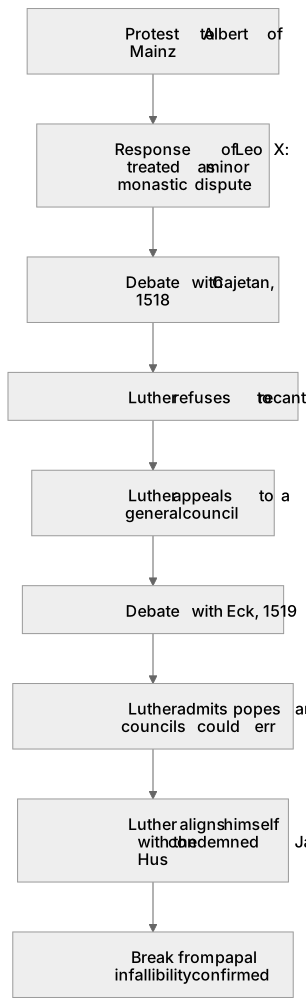
Luther's beliefs radicalised from protesting indulgences to rejecting papal authority. His protest to Albert of Mainz challenged indulgences. The response of Leo X to Luther's early challenge initially treated it as a minor monastic dispute. In the debate with Cajetan in 1518, Luther refused to recant, appealing to a general council. The significance of the debate with Eck in 1519 is that Luther was forced to admit that popes and councils could err, aligning himself with the condemned Jan Hus. This confirmed his break from papal infallibility.
For example: By publicly defending Hus at Leipzig, Luther crossed the line from reformer to heretic, making his excommunication inevitable.
What earns the marks
- Explains the shaping of Luther's beliefs, tracing his ideological journey from the protest to Albert of Mainz to his break with papal authority.
- Analyses the response of Leo X to Luther's early challenge, noting the initial underestimation of the threat and the subsequent escalation.
- Evaluates the debate with Cajetan in 1518, highlighting Luther's refusal to recant and his appeal to a general council.
- Assesses the significance of the debate with Eck in 1519, specifically Luther's admission that popes and councils could err, which aligned him with Jan Hus.
Common mistakes and how to put them right
Misdating Luther's assertion that popes and councils can err to the 1518 Cajetan debate.
Put it right: Place this crucial development in the 1519 debate with Eck.
Assuming Leo X immediately recognised Luther as a major threat.
Put it right: Note that Leo X initially dismissed the issue as a minor monastic squabble.
Confusing the outcomes of the debates with Cajetan and Eck.
Put it right: Cajetan focused on getting Luther to recant, while Eck pushed Luther to publicly deny papal infallibility.
Exam tips
- Distinguish the debate with Cajetan in 1518 from the significance of the debate with Eck in 1519 to accurately trace the shaping of Luther's beliefs.
- Use the protest to Albert of Mainz as the starting point to demonstrate how Luther's early challenge evolved over time.
Try the lesson
The start of the Luther’s early challenge to the Catholic Church, 1517–20: The shaping of Luther’s beliefs: his protest to Albert of Mainz; the response of Leo X to Luther’s early challenge; the debate with Cajetan in 1518; significance of the debate with Eck in 1519. lesson, made from checked teaching notes for this specification point.
Have a go first
In 1517 Luther sent his protest about the sale of indulgences to which church leader?
Listen
Luther's beliefs radicalised from protesting indulgences to rejecting papal authority. His protest to Albert of Mainz challenged indulgences. The response of Leo X to Luther's early challenge initially treated it as a minor monastic dispute. In the debate with Cajetan in 1518, Luther refused to recant, appealing to a general council. The significance of the debate with Eck in 1519 is that Luther was forced to admit that popes and councils could err, aligning himself with the condemned Jan Hus. This confirmed his break from papal infallibility. For example, by publicly defending Hus at Leipzig, Luther crossed the line from reformer to heretic, making his excommunication inevitable. A strong answer earns marks for these points. Explains the shaping of Luther's beliefs, tracing his ideological journey from the protest to Albert of Mainz to his break with papal authority. Analyses the response of Leo X to Luther's early challenge, noting the initial underestimation of the threat and the subsequent escalation. Evaluates the debate with Cajetan in 1518, highlighting Luther's refusal to recant and his appeal to a general council. Assesses the significance of the debate with Eck in 1519, specifically Luther's admission that popes and councils could err, which aligned him with Jan Hus. A common slip: Misdating Luther's assertion that popes and councils can err to the 1518 Cajetan debate. Instead, Place this crucial development in the 1519 debate with Eck. Exam tip: Distinguish the debate with Cajetan in 1518 from the significance of the debate with Eck in 1519 to accurately trace the shaping of Luther's beliefs.
See it
Key words
Say what each word means before you turn the card.
The shaping of Luther's beliefs and theology
Try answering aloud or in your head before turning the card.
Papal responses and the escalation of the conflict
Try answering aloud or in your head before turning the card.
The role of public debates in radicalising reform movements
Try answering aloud or in your head before turning the card.
See every definition
- The shaping of Luther's beliefs and theology
- Luther's beliefs radicalised from protesting indulgences to rejecting papal authority, a journey traced from his protest to Albert of Mainz to his break with papal authority.
- Papal responses and the escalation of the conflict
- Leo X initially treated Luther's early challenge as a minor monastic dispute, underestimating the threat before the conflict subsequently escalated.
- The role of public debates in radicalising reform movements
- In the debate with Cajetan in 1518 Luther refused to recant, appealing to a general council, and in the debate with Eck in 1519 he admitted that popes and councils could err.
Label the diagram
Some boxes have lost their names. Pick the right name for each number.
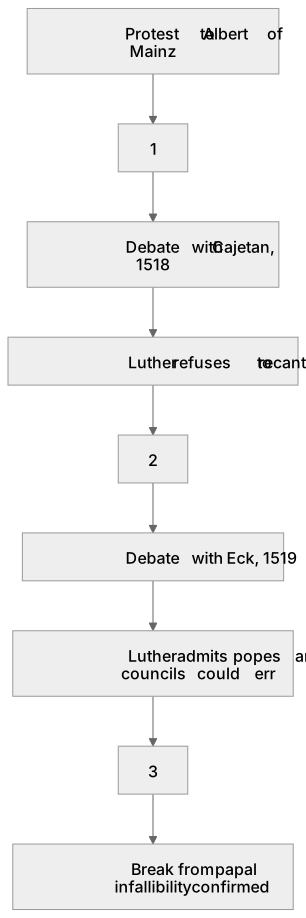
1Box 1
2Box 2
3Box 3
There is more to this lesson
The full lesson goes on to check your understanding and help you earn the marks. Create a free account to carry on, with your progress saved.
A week of Premium from your first lesson · Then the free plan continues · No card, no charge
Test your understanding of Luther’s early challenge to the Catholic Church, 1517–20: The shaping of Luther’s beliefs: his protest to Albert of Mainz; the response of Leo X to Luther’s early challenge; the debate with Cajetan in 1518; significance of the debate with Eck in 1519.
Active recall beats re-reading. Take an instant quiz now to test what you’ve learned and lock it into long-term memory.
A week of Premium from your first lesson · Then the free plan continues · No card, no charge