Pearson Edexcel · A-Level · History
Course version: 9HI0 · Version from Sept 2015
Problems in Normandy, 1066–87: conflict in Maine, 1069–73; William’s…
Full specification wording
Normandy, 1066–1106: Problems in Normandy, 1066–87: conflict in Maine, 1069–73; William’s defeat at the siege of Dol; resisting the demands of Robert Curthose, 1078–83; the division of the Anglo-Norman territories after William’s death.
After 1066, William faced persistent problems in Normandy.
Checked against the Pearson Edexcel 9HI0 specification (opens in a new tab) on .
- Point 2 of 4
- 4 key terms
Study notes
From the checked teaching notes for this specification point.
The idea
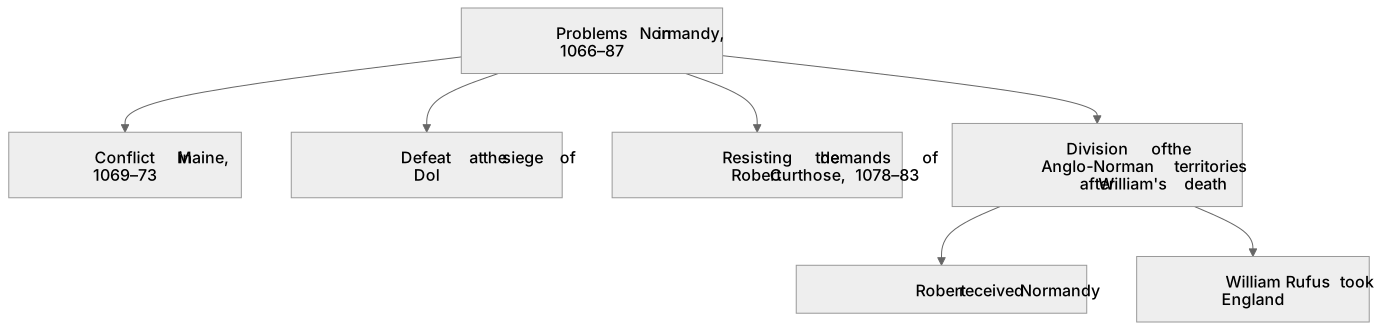
After 1066, William faced persistent problems in Normandy. Conflict in Maine from 1069 to 1073 saw local lords and the counts of Anjou challenge Norman control, requiring William to campaign repeatedly. At the siege of Dol, likely in 1076, William was defeated by a coalition including Anjou and Brittany, damaging his prestige. From 1078 to 1083, his eldest son Robert Curthose rebelled, demanding recognition and territory, which led to fighting and a temporary exile. Finally, after William’s death in 1087, the Anglo-Norman territories were divided: Robert received Normandy, while William Rufus took England, creating a rift that would shape future conflict. These problems show that conquest did not end William’s troubles.
What earns the marks
- Explains the nature of the conflict in Maine, including the role of local lords and Angevin interference, and how William responded.
- Describes William’s defeat at the siege of Dol, identifying the opposing coalition and the consequences for his authority.
- Analyses the demands of Robert Curthose and the significance of his rebellion for William’s control over Normandy and England.
- Assesses the impact of the division of the Anglo-Norman territories after 1087, including the succession dispute between Robert and William Rufus.
- Evaluates how these problems weakened or tested William’s rule, and how he managed them.
Common mistakes and how to put them right
Confusing the dates or sequence of events.
Put it right: Create a clear timeline to keep the order correct.
Assuming Robert Curthose’s rebellion was solely about personal ambition.
Put it right: Consider wider baronial discontent and the question of succession.
Treating the division of 1087 as a simple inheritance.
Put it right: Explain that it was a deliberate act by William I that created political instability.
Exam tips
- Structure your answer around the four problems listed, giving each appropriate weight.
- Use specific evidence, such as the role of Fulk le Rechin of Anjou or the terms of the division, to support your analysis.
- Link the problems to the broader theme of maintaining control in a cross-Channel empire.
Try the lesson
The start of the Normandy, 1066–1106: Problems in Normandy, 1066–87: conflict in Maine, 1069–73; William’s defeat at the siege of Dol; resisting the demands of Robert Curthose, 1078–83; the division of the Anglo-Norman territories after William’s death. lesson, made from checked teaching notes for this specification point.
Have a go first
Which region was the site of a major conflict between 1069 and 1073 that created significant problems for William I?
Listen
After 1066, William faced persistent problems in Normandy. Conflict in Maine from 1069 to 1073 saw local lords and the counts of Anjou challenge Norman control, requiring William to campaign repeatedly. At the siege of Dol, likely in 1076, William was defeated by a coalition including Anjou and Brittany, damaging his prestige. From 1078 to 1083, his eldest son Robert Curthose rebelled, demanding recognition and territory, which led to fighting and a temporary exile. Finally, after William’s death in 1087, the Anglo-Norman territories were divided: Robert received Normandy, while William Rufus took England, creating a rift that would shape future conflict. These problems show that conquest did not end William’s troubles. A strong answer earns marks for these points. Explains the nature of the conflict in Maine, including the role of local lords and Angevin interference, and how William responded. Describes William’s defeat at the siege of Dol, identifying the opposing coalition and the consequences for his authority. Analyses the demands of Robert Curthose and the significance of his rebellion for William’s control over Normandy and England. Assesses the impact of the division of the Anglo-Norman territories after 1087, including the succession dispute between Robert and William Rufus. A common slip: Confusing the dates or sequence of events. Instead, create a clear timeline to keep the order correct. Exam tip: Structure your answer around the four problems listed, giving each appropriate weight.
See it
Key words
Say what each word means before you turn the card.
Rebellion and succession
Try answering aloud or in your head before turning the card.
Frontier warfare
Try answering aloud or in your head before turning the card.
Anglo-Norman politics
Try answering aloud or in your head before turning the card.
Kingship and authority
Try answering aloud or in your head before turning the card.
See every definition
- Rebellion and succession
- Robert Curthose rebelled from 1078 to 1083, demanding recognition and territory, and after William's death the Anglo-Norman territories were divided between Robert and William Rufus.
- Frontier warfare
- Conflict in Maine from 1069 to 1073 saw local lords and the counts of Anjou challenge Norman control, requiring William to campaign repeatedly.
- Anglo-Norman politics
- After 1087 the Anglo-Norman territories were divided, with Robert receiving Normandy and William Rufus taking England, creating a rift that would shape future conflict.
- Kingship and authority
- William's defeat at the siege of Dol damaged his prestige, and Robert Curthose's demands led to fighting and a temporary exile.
Label the diagram
Some boxes have lost their names. Pick the right name for each number.
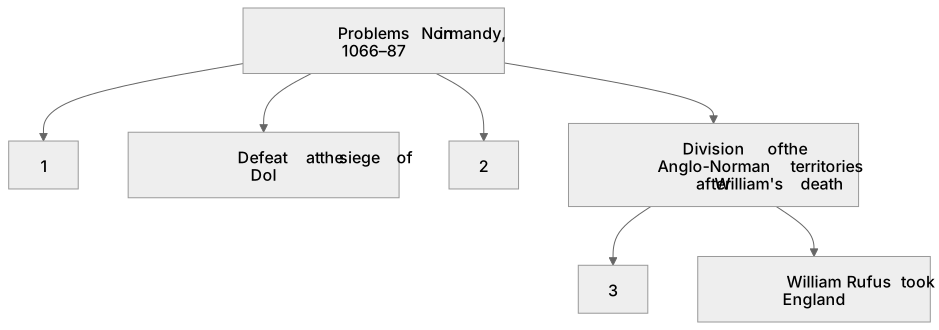
1Box 1
2Box 2
3Box 3
There is more to this lesson
The full lesson goes on to check your understanding and help you earn the marks. Create a free account to carry on, with your progress saved.
A week of Premium from your first lesson · Then the free plan continues · No card, no charge
Test your understanding of Normandy, 1066–1106: Problems in Normandy, 1066–87: conflict in Maine, 1069–73; William’s defeat at the siege of Dol; resisting the demands of Robert Curthose, 1078–83; the division of the Anglo-Norman territories after William’s death.
Active recall beats re-reading. Take an instant quiz now to test what you’ve learned and lock it into long-term memory.
A week of Premium from your first lesson · Then the free plan continues · No card, no charge