Pearson Edexcel · A-Level · History
Course version: 9HI0 · Version from Sept 2015
Reasons for William of Normandy’s decision to invade England in 1066: his…
Full specification wording
Normandy, 1066–1106: Reasons for William of Normandy’s decision to invade England in 1066: his claim to the throne; the military power of Normandy; papal support for William’s claim.
William of Normandy’s decision to invade England in 1066 rested on three interlocking factors.
Checked against the Pearson Edexcel 9HI0 specification (opens in a new tab) on .
- Point 1 of 4
- 4 key terms
Study notes
From the checked teaching notes for this specification point.
The idea
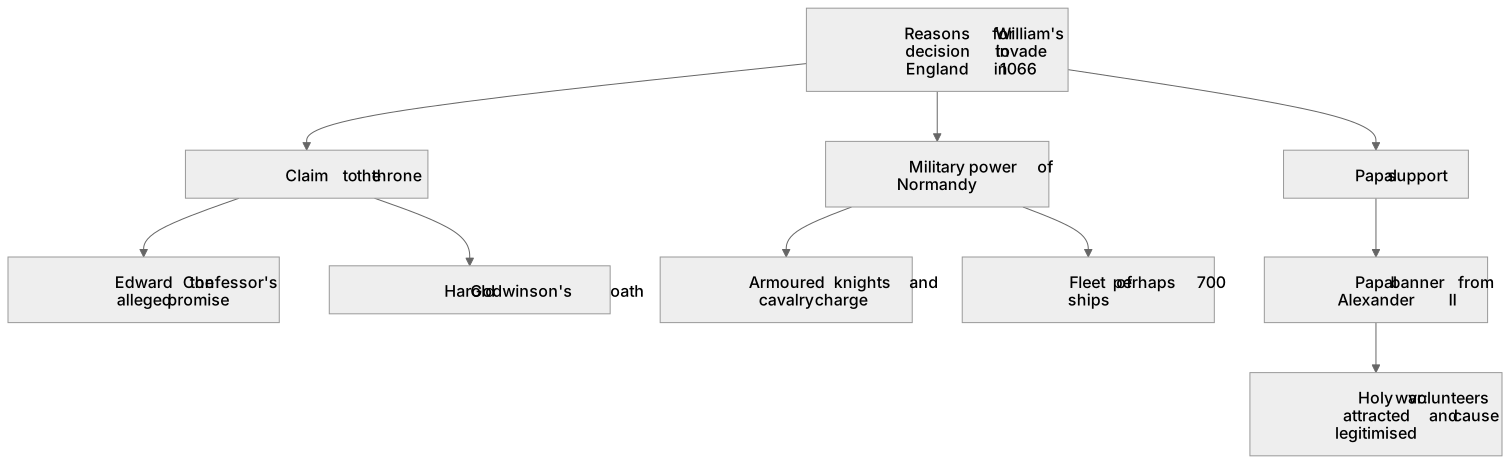
William of Normandy’s decision to invade England in 1066 rested on three interlocking factors. First, his claim to the throne: he asserted that Edward the Confessor had promised him the crown and that Harold Godwinson had sworn an oath to support him, perhaps on relics at Bayeux or Bonneville. Second, the military power of Normandy: William could call on armoured knights, a formidable cavalry charge, and a fleet of perhaps 700 ships, giving him the means to project force across the Channel. Third, papal support: William secured a papal banner from Alexander II, which turned the invasion into a holy war, attracting volunteers and legitimising his cause. Together, these reasons made invasion feasible and justifiable, though each is debated by historians.
What earns the marks
- Explains William’s claim to the throne through Edward the Confessor’s alleged promise and Harold’s oath, showing how these gave him a legal and moral case.
- Analyses the military power of Normandy, including knights, cavalry, and shipbuilding capacity, as the practical means of invasion.
- Assesses the role of papal support in providing legitimacy, recruits, and spiritual rewards, and how it strengthened William’s position.
- Evaluates the relative importance of the three reasons, considering whether any one was decisive or whether they worked together.
- Uses specific evidence, such as the Bayeux Tapestry’s depiction of Harold’s oath or the papal banner, to support arguments.
Common mistakes and how to put them right
Treating the three reasons as separate and unconnected.
Put it right: Show how they reinforced each other, for example papal support made it easier to recruit knights.
Assuming Harold’s oath is undisputed fact.
Put it right: Acknowledge that the sources are partisan and historians debate what was promised.
Overstating the size or quality of William’s army without considering logistical challenges.
Put it right: Discuss the difficulty of maintaining a fleet and supplying troops across the Channel.
Exam tips
- Plan your answer around the three stated reasons, ensuring each is explained and linked to William’s decision.
- Use precise evidence, such as the date of Harold’s oath or the role of Hildebrand, to support your points.
- Consider counterarguments or alternative interpretations, for example that William’s claim was a pretext for expansion, to reach higher levels.
Try the lesson
The start of the Normandy, 1066–1106: Reasons for William of Normandy’s decision to invade England in 1066: his claim to the throne; the military power of Normandy; papal support for William’s claim. lesson, made from checked teaching notes for this specification point.
Have a go first
What was the primary dynastic justification for William of Normandy’s decision to invade England in 1066?
Listen
William of Normandy’s decision to invade England in 1066 rested on three interlocking factors. First, his claim to the throne: he asserted that Edward the Confessor had promised him the crown and that Harold Godwinson had sworn an oath to support him, perhaps on relics at Bayeux or Bonneville. Second, the military power of Normandy: William could call on armoured knights, a formidable cavalry charge, and a fleet of perhaps 700 ships, giving him the means to project force across the Channel. Third, papal support: William secured a papal banner from Alexander II, which turned the invasion into a holy war, attracting volunteers and legitimising his cause. Together, these reasons made invasion feasible and justifiable, though each is debated by historians. A strong answer earns marks for these points. Explains William’s claim to the throne through Edward the Confessor’s alleged promise and Harold’s oath, showing how these gave him a legal and moral case. Analyses the military power of Normandy, including knights, cavalry, and shipbuilding capacity, as the practical means of invasion. Assesses the role of papal support in providing legitimacy, recruits, and spiritual rewards, and how it strengthened William’s position. Evaluates the relative importance of the three reasons, considering whether any one was decisive or whether they worked together. A common slip: Treating the three reasons as separate and unconnected. Instead, show how they reinforced each other, for example papal support made it easier to recruit knights. Exam tip: Plan your answer around the three stated reasons, ensuring each is explained and linked to William’s decision.
See it
Key words
Say what each word means before you turn the card.
Legitimacy and succession
Try answering aloud or in your head before turning the card.
Military technology and logistics
Try answering aloud or in your head before turning the card.
Religion and papal authority
Try answering aloud or in your head before turning the card.
Political calculation and risk
Try answering aloud or in your head before turning the card.
See every definition
- Legitimacy and succession
- William asserted that Edward the Confessor had promised him the crown and that Harold Godwinson had sworn an oath to support him, giving him a legal and moral case.
- Military technology and logistics
- William could call on armoured knights, a formidable cavalry charge and a fleet of perhaps 700 ships, giving him the means to project force across the Channel.
- Religion and papal authority
- William secured a papal banner from Alexander II, which turned the invasion into a holy war, attracting volunteers and legitimising his cause.
- Political calculation and risk
- The three reasons made invasion feasible and justifiable, though each is debated by historians, and they reinforced each other rather than standing alone.
Label the diagram
Some boxes have lost their names. Pick the right name for each number.
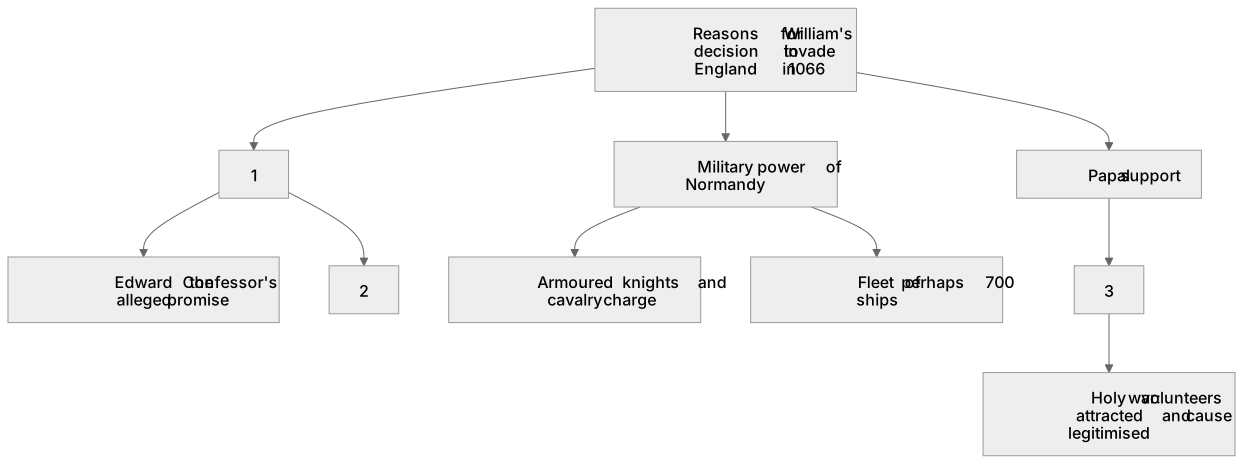
1Box 1
2Box 2
3Box 3
There is more to this lesson
The full lesson goes on to check your understanding and help you earn the marks. Create a free account to carry on, with your progress saved.
A week of Premium from your first lesson · Then the free plan continues · No card, no charge
Test your understanding of Normandy, 1066–1106: Reasons for William of Normandy’s decision to invade England in 1066: his claim to the throne; the military power of Normandy; papal support for William’s claim.
Active recall beats re-reading. Take an instant quiz now to test what you’ve learned and lock it into long-term memory.
A week of Premium from your first lesson · Then the free plan continues · No card, no charge