Pearson Edexcel · A-Level · History
Course version: 9HI0 · Version from Sept 2015
The situation c1563: Philip II’s policy towards the Netherlands and the…
Full specification wording
Origins of the Dutch Revolt, c1563–67: The situation c1563: Philip II’s policy towards the Netherlands and the lack of regard for established traditions; the regency of Margaret of Parma; the influence of Granvelle.
By 1563, Philip II's policies in the Netherlands showed little respect for established traditions.
Checked against the Pearson Edexcel 9HI0 specification (opens in a new tab) on .
- Point 2 of 4
- 4 key terms
Study notes
From the checked teaching notes for this specification point.
The idea
By 1563, Philip II's policies in the Netherlands showed little respect for established traditions. He centralised authority, increased taxes and promoted loyal officials, ignoring provincial privileges. Margaret of Parma, his half-sister, became regent in 1559, but her authority was limited by Philip's direct control and by factional rivalry. Cardinal Granvelle, her chief adviser, was resented by the grandees for his influence and his foreign origin. The grandees, led by Orange, Egmont and Horn, demanded his removal and greater respect for traditional rights. This tension set the stage for the Dutch Revolt.
For example: Granvelle's attempt to reorganise the bishoprics and his role in policy-making provoked noble opposition, leading to the grandees' 1563 letter demanding his dismissal.
What earns the marks
- Outlines Philip II's centralising policies, such as appointing loyal officials and increasing taxation, and how they disregarded established traditions.
- Explains the role of Margaret of Parma as regent, including the limits on her power and her dependence on Philip's instructions.
- Describes Granvelle's influence as chief adviser and the reasons for noble resentment, such as his foreign birth and policy role.
- Shows how the grandees' opposition to Granvelle and Philip's policies contributed to growing unrest.
- Uses specific examples, such as the new bishoprics scheme or the grandees' 1563 letter to Philip II, to illustrate the situation in c1563.
Common mistakes and how to put them right
Assuming Margaret of Parma had full independent authority.
Put it right: She was constrained by Philip II's directives and by the grandees' opposition.
Underestimating Granvelle's influence; correction: he was a key policy-maker whose actions provoked significant noble resistance.
Confusing Philip II's policies with those of his father Charles V.
Put it right: Philip's approach was more centralising and less sensitive to local traditions.
Exam tips
- When discussing Philip II's policy, give concrete examples like the new bishoprics scheme or the increase in taxes.
- Explain how Margaret's regency was weakened by the conflict between Granvelle and the grandees.
Try the lesson
The start of the Origins of the Dutch Revolt, c1563–67: The situation c1563: Philip II’s policy towards the Netherlands and the lack of regard for established traditions; the regency of Margaret of Parma; the influence of Granvelle. lesson, made from checked teaching notes for this specification point.
Have a go first
Who served as regent of the Netherlands for Philip II in the early 1560s?
Listen
By 1563, Philip II's policies in the Netherlands showed little respect for established traditions. He centralised authority, increased taxes and promoted loyal officials, ignoring provincial privileges. Margaret of Parma, his half-sister, became regent in 1559, but her authority was limited by Philip's direct control and by factional rivalry. Cardinal Granvelle, her chief adviser, was resented by the grandees for his influence and his foreign origin. The grandees, led by Orange, Egmont and Horn, demanded his removal and greater respect for traditional rights. This tension set the stage for the Dutch Revolt. For example, Granvelle's attempt to reorganise the bishoprics and his role in policy-making provoked noble opposition, leading to the grandees' 1563 letter demanding his dismissal. A strong answer earns marks for these points. Outlines Philip II's centralising policies, such as appointing loyal officials and increasing taxation, and how they disregarded established traditions. Explains the role of Margaret of Parma as regent, including the limits on her power and her dependence on Philip's instructions. Describes Granvelle's influence as chief adviser and the reasons for noble resentment, such as his foreign birth and policy role. Shows how the grandees' opposition to Granvelle and Philip's policies contributed to growing unrest. A common slip: Assuming Margaret of Parma had full independent authority. Instead, she was constrained by Philip II's directives and by the grandees' opposition. Exam tip: When discussing Philip II's policy, give concrete examples like the new bishoprics scheme or the increase in taxes.
See it
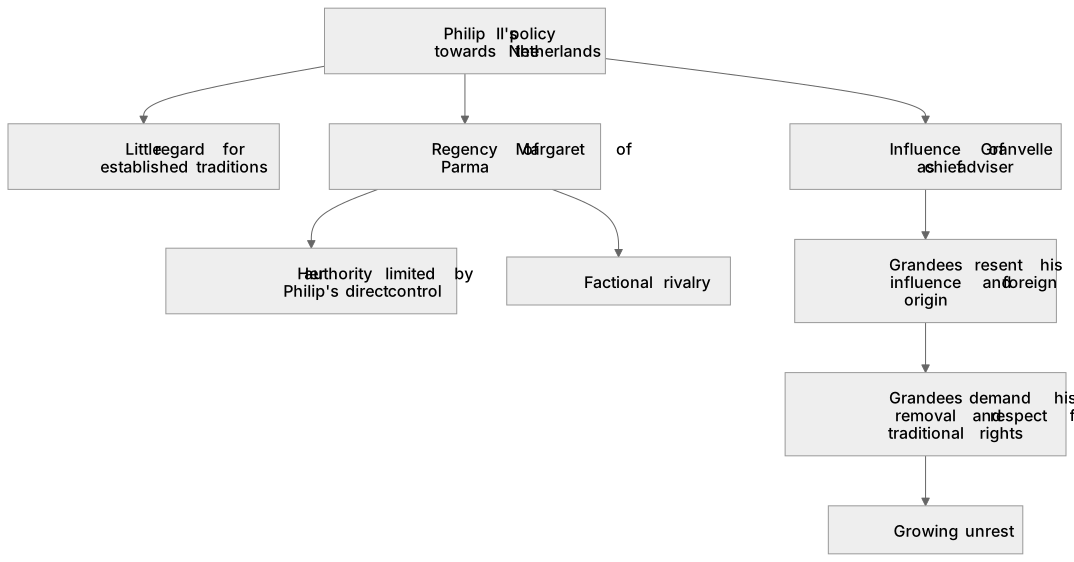
Key words
Say what each word means before you turn the card.
Centralisation versus local privilege
Try answering aloud or in your head before turning the card.
The role of royal favourites and factional politics
Try answering aloud or in your head before turning the card.
The limits of female regency in the sixteenth century
Try answering aloud or in your head before turning the card.
The defence of traditional rights by the nobility
Try answering aloud or in your head before turning the card.
See every definition
- Centralisation versus local privilege
- Philip II's policies showed little respect for established traditions, as he centralised authority, increased taxes and promoted loyal officials while ignoring provincial privileges.
- The role of royal favourites and factional politics
- Cardinal Granvelle, chief adviser to the regent, was resented by the grandees for his influence and his foreign origin, and factional rivalry limited her authority.
- The limits of female regency in the sixteenth century
- Margaret of Parma became regent in 1559, but her authority was limited by Philip's direct control and by factional rivalry.
- The defence of traditional rights by the nobility
- The grandees, led by Orange, Egmont and Horn, demanded Granvelle's removal and greater respect for traditional rights.
Label the diagram
Some boxes have lost their names. Pick the right name for each number.
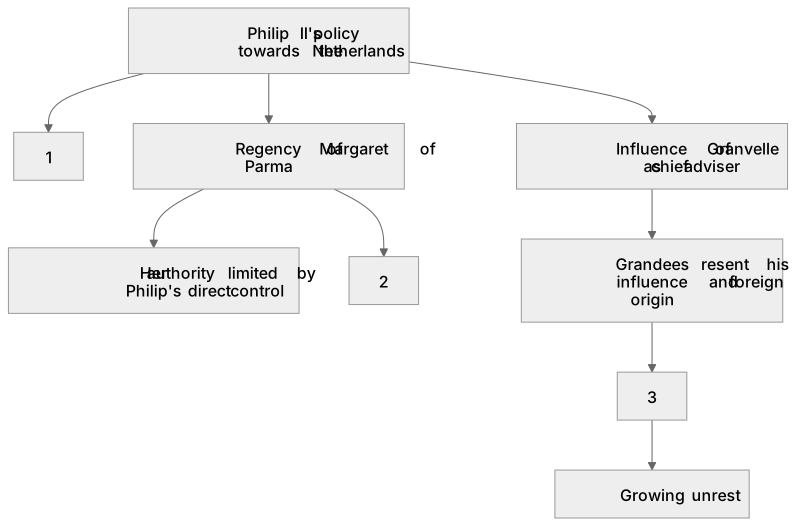
1Box 1
2Box 2
3Box 3
There is more to this lesson
The full lesson goes on to check your understanding and help you earn the marks. Create a free account to carry on, with your progress saved.
A week of Premium from your first lesson · Then the free plan continues · No card, no charge
Test your understanding of Origins of the Dutch Revolt, c1563–67: The situation c1563: Philip II’s policy towards the Netherlands and the lack of regard for established traditions; the regency of Margaret of Parma; the influence of Granvelle.
Active recall beats re-reading. Take an instant quiz now to test what you’ve learned and lock it into long-term memory.
A week of Premium from your first lesson · Then the free plan continues · No card, no charge