Pearson Edexcel · A-Level · History
Course version: 9HI0 · Version from Sept 2015
Britain, c1785–c1870: democracy, protest and reform - 2 Industrialis-…
Full specification wording
Paper 1, Option 1D: Britain, c1785–c1870: democracy, protest and reform - 2 Industrialis- ation and protest, c1785–c1870: The impact of industrialisation: the growth of banking, investment and a new industrial middle class; the diversity of economic regions; the growth of industrial towns and cities. Government attitudes towards industrial development.
Industrialisation transformed Britain's economy and society between c1785 and c1870.
Checked against the Pearson Edexcel 9HI0 specification (opens in a new tab) on .
- Point 1 of 3
- 4 key terms
Study notes
From the checked teaching notes for this specification point.
The idea
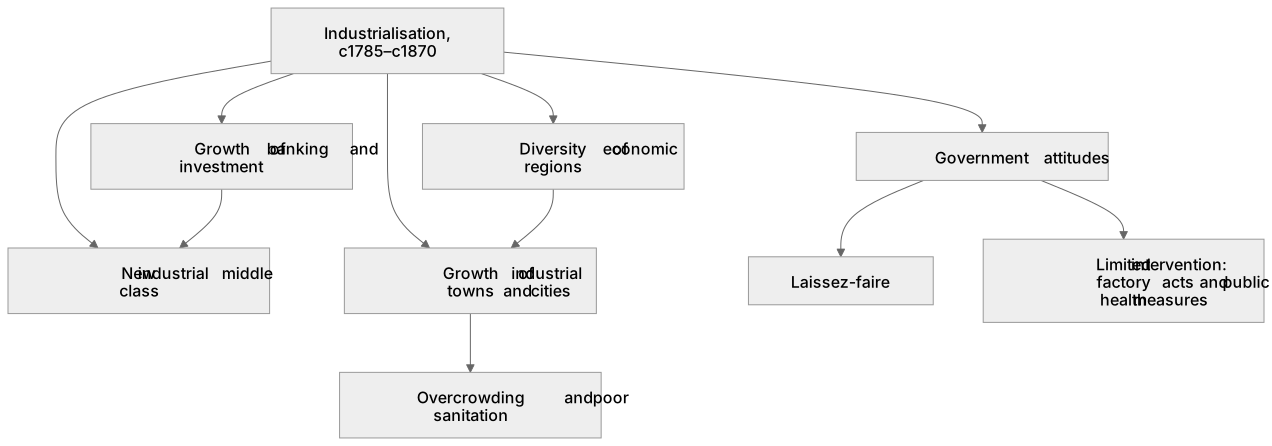
Industrialisation transformed Britain's economy and society between c1785 and c1870. Banking and investment grew to finance railways, factories and trade, creating a new industrial middle class of manufacturers, merchants and financiers. Economic regions diversified: Lancashire specialised in cotton, Yorkshire in wool, the Midlands in metalworking, and London in finance and commerce. Industrial towns and cities expanded rapidly, with Manchester's population rising from about 25,000 in 1772 to over 300,000 by 1851, bringing overcrowding and poor sanitation. Government attitudes shifted from laissez-faire to limited intervention, with factory acts and public health measures.
What earns the marks
- Explains the growth of banking and investment, including the role of country banks, joint-stock banks and railway investment.
- Describes the emergence of a new industrial middle class, including manufacturers, merchants and professionals, and their increasing wealth and influence.
- Analyses the diversity of economic regions, giving examples such as cotton in Lancashire, wool in Yorkshire, and metalworking in the Midlands.
- Explains the growth of industrial towns and cities, including population growth, urbanisation and associated social problems.
- Assesses government attitudes towards industrial development, including laissez-faire, factory legislation and public health reforms.
Common mistakes and how to put them right
Assuming that government adopted a completely hands-off approach.
Put it right: It intervened through factory acts and poor law reforms.
Treating industrialisation as uniform across Britain.
Put it right: Regions developed different specialisms and experienced different rates of growth.
Ignoring the social costs of urbanisation, such as overcrowding and disease, when discussing economic growth.
Confusing the industrial middle class with the working class.
Put it right: The former owned or managed enterprises, while the latter provided labour.
Exam tips
- Use specific regional examples, such as the Lancashire cotton industry or the South Wales ironworks, to illustrate diversity.
- Quantify urban growth with approximate figures, for example Manchester's population increase, to show the scale of change.
- Link government attitudes to specific legislation, such as the 1833 Factory Act or the 1848 Public Health Act.
- Consider both economic benefits and social costs when assessing the impact of industrialisation.
Try the lesson
The start of the Paper 1, Option 1D: Britain, c1785–c1870: democracy, protest and reform - 2 Industrialis- ation and protest, c1785–c1870: The impact of industrialisation: the growth of banking, investment and a new industrial middle class; the diversity of economic regions; the growth of industrial towns and cities. Government attitudes towards industrial development. lesson, made from checked teaching notes for this specification point.
Have a go first
Which group grew in numbers and influence in Britain as a result of industrialisation in the period c1785–c1870?
Listen
Industrialisation transformed Britain's economy and society between c1785 and c1870. Banking and investment grew to finance railways, factories and trade, creating a new industrial middle class of manufacturers, merchants and financiers. Economic regions diversified: Lancashire specialised in cotton, Yorkshire in wool, the Midlands in metalworking, and London in finance and commerce. Industrial towns and cities expanded rapidly, with Manchester's population rising from about 25,000 in 1772 to over 300,000 by 1851, bringing overcrowding and poor sanitation. Government attitudes shifted from laissez-faire to limited intervention, with factory acts and public health measures. A strong answer earns marks for these points. Explains the growth of banking and investment, including the role of country banks, joint-stock banks and railway investment. Describes the emergence of a new industrial middle class, including manufacturers, merchants and professionals, and their increasing wealth and influence. Analyses the diversity of economic regions, giving examples such as cotton in Lancashire, wool in Yorkshire, and metalworking in the Midlands. Explains the growth of industrial towns and cities, including population growth, urbanisation and associated social problems. Exam tip: Use specific regional examples, such as the Lancashire cotton industry or the South Wales ironworks, to illustrate diversity.
See it
Key words
Say what each word means before you turn the card.
Economic growth and financial innovation
Try answering aloud or in your head before turning the card.
Social class formation and the middle class
Try answering aloud or in your head before turning the card.
Regional economic diversity and specialisation
Try answering aloud or in your head before turning the card.
Urbanisation and its consequences
Try answering aloud or in your head before turning the card.
See every definition
- Economic growth and financial innovation
- Banking and investment grew to finance railways, factories and trade, including the role of country banks, joint-stock banks and railway investment.
- Social class formation and the middle class
- A new industrial middle class of manufacturers, merchants and financiers emerged, owning or managing enterprises and gaining increasing wealth and influence.
- Regional economic diversity and specialisation
- Economic regions diversified, with Lancashire specialising in cotton, Yorkshire in wool, the Midlands in metalworking, and London in finance and commerce.
- Urbanisation and its consequences
- Industrial towns and cities expanded rapidly, bringing overcrowding and poor sanitation as populations grew.
Label the diagram
Some boxes have lost their names. Pick the right name for each number.
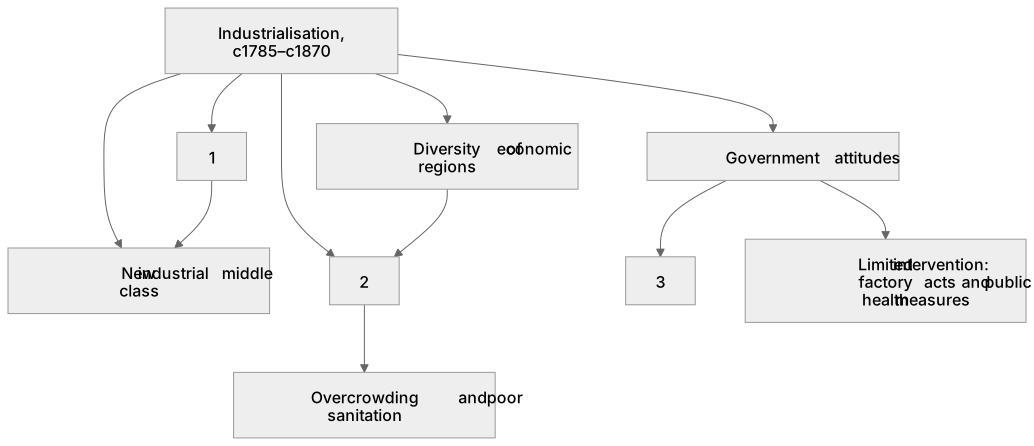
1Box 1
2Box 2
3Box 3
There is more to this lesson
The full lesson goes on to check your understanding and help you earn the marks. Create a free account to carry on, with your progress saved.
A week of Premium from your first lesson · Then the free plan continues · No card, no charge
Test your understanding of Paper 1, Option 1D: Britain, c1785–c1870: democracy, protest and reform - 2 Industrialis- ation and protest, c1785–c1870: The impact of industrialisation: the growth of banking, investment and a new industrial middle class; the diversity of economic regions; the growth of industrial towns and cities. Government attitudes towards industrial development.
Active recall beats re-reading. Take an instant quiz now to test what you’ve learned and lock it into long-term memory.
A week of Premium from your first lesson · Then the free plan continues · No card, no charge