Pearson Edexcel · A-Level · History
Course version: 9HI0 · Version from Sept 2015
Anglo-Saxon England and the Anglo-Norman Kingdom, c1053–1106 - 2 The…
Full specification wording
Paper 2, Option 2A.1: Anglo-Saxon England and the Anglo-Norman Kingdom, c1053–1106 - 2 The Norman conquest of England and extension of control in Wales and Scotland, 1066–93: The founding of a military state: the operation of the feudal system, tenants-in-chief and knights; the nature of land tenure; the building of castles and their impact on Norman control and royal power.
After 1066, William I built a military state resting on feudal obligations.
Checked against the Pearson Edexcel 9HI0 specification (opens in a new tab) on .
- Point 4 of 4
- 4 key terms
Study notes
From the checked teaching notes for this specification point.
The idea
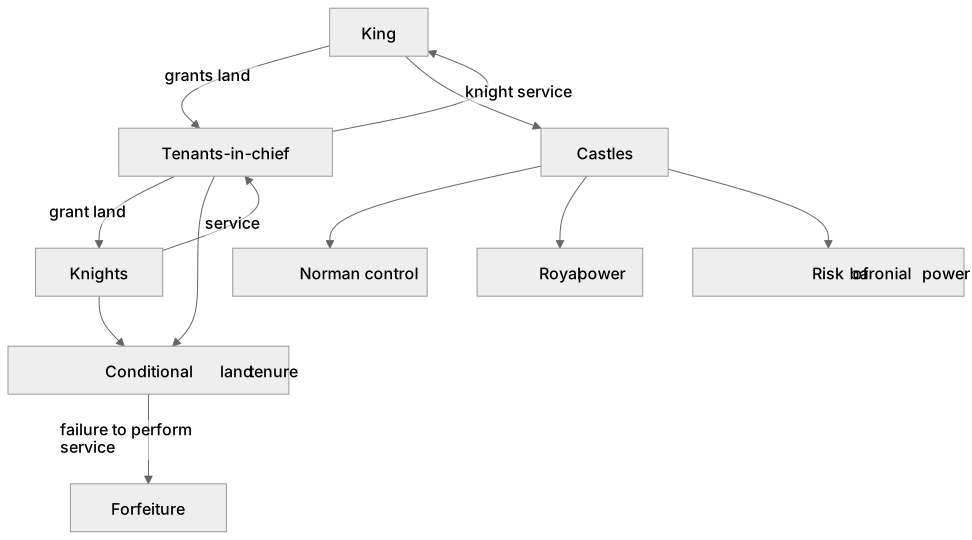
After 1066, William I built a military state resting on feudal obligations. Tenants-in-chief held land directly from the king in return for knight service, and they in turn granted land to knights. Land tenure was conditional, not absolute: failure to perform service could lead to forfeiture. Castles were the physical expression of this system, acting as garrisons, administrative centres and symbols of royal authority. They enabled a small Norman elite to control a large English population, but also created risks of baronial power. Together, feudalism, tenure and castles underpinned Norman control and strengthened royal power.
What earns the marks
- Explains how the feudal system operated, including the relationship between the king, tenants-in-chief and knights.
- Analyses the nature of land tenure, including conditional holding and the obligations attached to land.
- Assesses the role of castles in enforcing Norman control and projecting royal power.
- Evaluates the extent to which the military state strengthened royal authority while creating potential challenges.
- Uses specific examples of castles or landholding arrangements to support arguments.
Common mistakes and how to put them right
Describing feudalism as a single rigid system.
Put it right: It was a set of evolving customs and obligations.
Assuming all land was held directly from the king.
Put it right: Most was held indirectly through tenants-in-chief.
Treating castles solely as military structures.
Put it right: They also served administrative and symbolic functions.
Exam tips
- Define key terms such as tenant-in-chief and knight service precisely in your answers.
- Use castles as concrete evidence when discussing control and royal power.
- Balance the benefits and risks of the feudal system to show analytical depth.
Try the lesson
The start of the Paper 2, Option 2A.1: Anglo-Saxon England and the Anglo-Norman Kingdom, c1053–1106 - 2 The Norman conquest of England and extension of control in Wales and Scotland, 1066–93: The founding of a military state: the operation of the feudal system, tenants-in-chief and knights; the nature of land tenure; the building of castles and their impact on Norman control and royal power. lesson, made from checked teaching notes for this specification point.
Have a go first
In the Norman feudal system, what was a tenant-in-chief expected to provide for the king?
Listen
After 1066, William I built a military state resting on feudal obligations. Tenants-in-chief held land directly from the king in return for knight service, and they in turn granted land to knights. Land tenure was conditional, not absolute: failure to perform service could lead to forfeiture. Castles were the physical expression of this system, acting as garrisons, administrative centres and symbols of royal authority. They enabled a small Norman elite to control a large English population, but also created risks of baronial power. Together, feudalism, tenure and castles underpinned Norman control and strengthened royal power. A strong answer earns marks for these points. Explains how the feudal system operated, including the relationship between the king, tenants-in-chief and knights. Analyses the nature of land tenure, including conditional holding and the obligations attached to land. Assesses the role of castles in enforcing Norman control and projecting royal power. Evaluates the extent to which the military state strengthened royal authority while creating potential challenges. Exam tip: Define key terms such as tenant-in-chief and knight service precisely in your answers.
See it
Key words
Say what each word means before you turn the card.
Feudalism and land tenure
Try answering aloud or in your head before turning the card.
Tenants-in-chief
Try answering aloud or in your head before turning the card.
Castles and control
Try answering aloud or in your head before turning the card.
Royal authority
Try answering aloud or in your head before turning the card.
See every definition
- Feudalism and land tenure
- A set of evolving customs and obligations in which land was held conditionally, not absolutely, and failure to perform service could lead to forfeiture.
- Tenants-in-chief
- Those who held land directly from the king in return for knight service and who in turn granted land to knights.
- Castles and control
- Physical expressions of the system, acting as garrisons, administrative centres and symbols of royal authority, enabling a small Norman elite to control a large English population.
- Royal authority
- Royal power strengthened by feudalism, tenure and castles, though baronial power created potential challenges.
Label the diagram
Some boxes have lost their names. Pick the right name for each number.
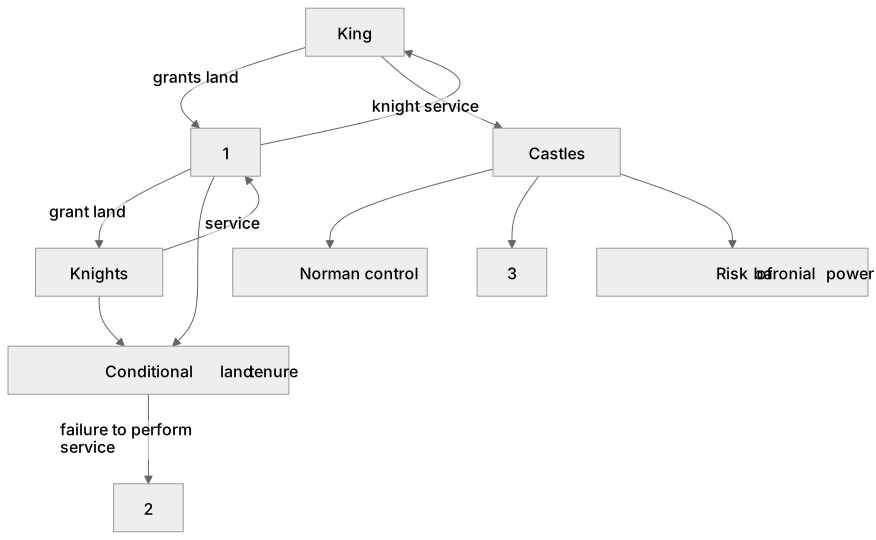
1Box 1
2Box 2
3Box 3
There is more to this lesson
The full lesson goes on to check your understanding and help you earn the marks. Create a free account to carry on, with your progress saved.
A week of Premium from your first lesson · Then the free plan continues · No card, no charge
Test your understanding of Paper 2, Option 2A.1: Anglo-Saxon England and the Anglo-Norman Kingdom, c1053–1106 - 2 The Norman conquest of England and extension of control in Wales and Scotland, 1066–93: The founding of a military state: the operation of the feudal system, tenants-in-chief and knights; the nature of land tenure; the building of castles and their impact on Norman control and royal power.
Active recall beats re-reading. Take an instant quiz now to test what you’ve learned and lock it into long-term memory.
A week of Premium from your first lesson · Then the free plan continues · No card, no charge