Pearson Edexcel · A-Level · History
Course version: 9HI0 · Version from Sept 2015
Anglo-Saxon England and the Anglo-Norman Kingdom, c1053–1106 - 2 The…
Full specification wording
Paper 2, Option 2A.1: Anglo-Saxon England and the Anglo-Norman Kingdom, c1053–1106 - 2 The Norman conquest of England and extension of control in Wales and Scotland, 1066–93: Wales and Scotland: the rising of Eadric the Wild; imposing Norman control in Wales, 1067–93; Malcolm III and the Northern Rebellion; William II and Scotland, 1091–93.
This topic covers how the Normans extended control beyond England's borders.
Checked against the Pearson Edexcel 9HI0 specification (opens in a new tab) on .
- Point 3 of 4
- 4 key terms
Study notes
From the checked teaching notes for this specification point.
The idea
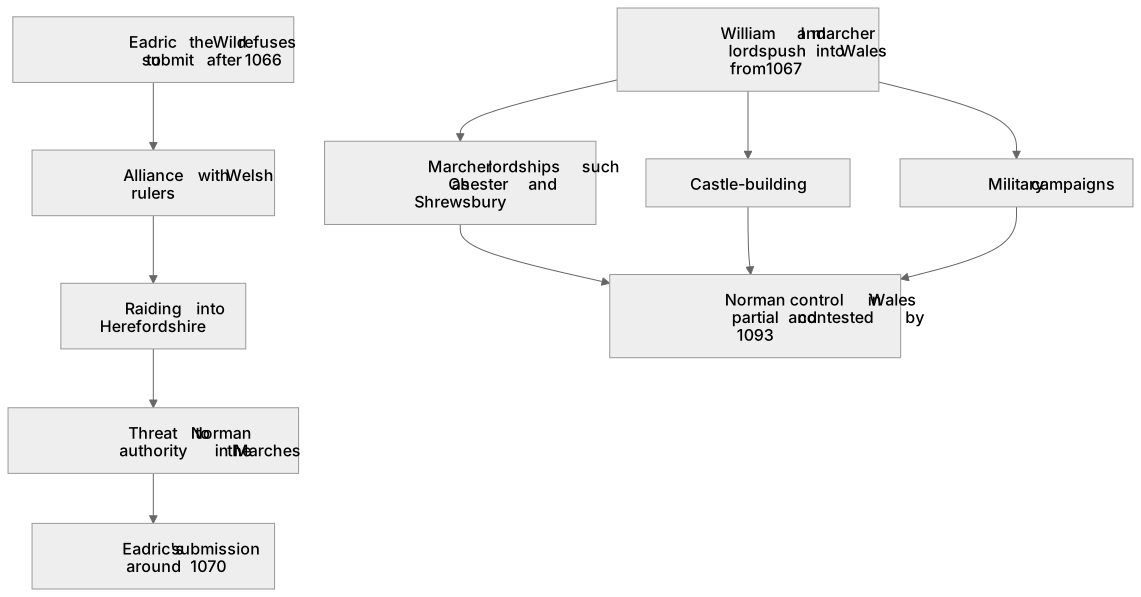
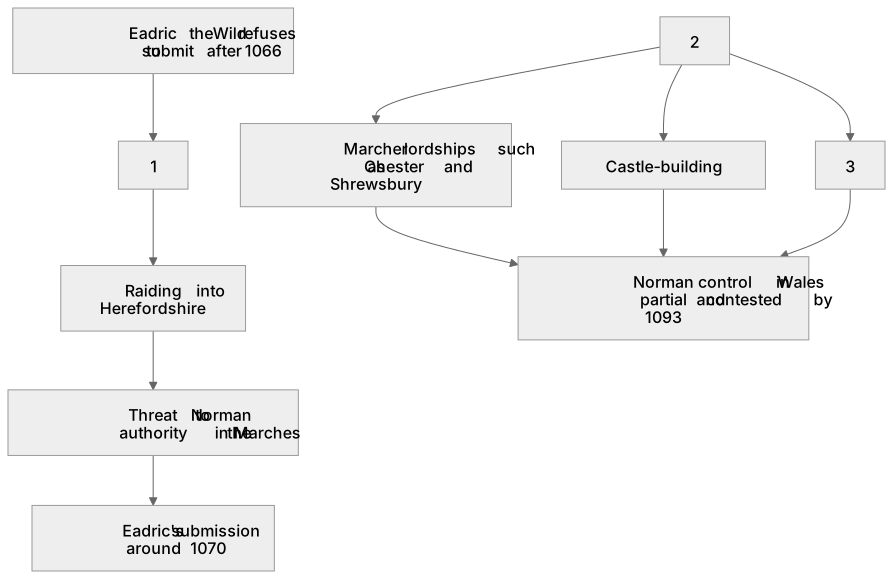
This topic covers how the Normans extended control beyond England's borders. Eadric the Wild, a Shropshire thegn, refused to submit after 1066 and joined forces with Welsh rulers, raiding into Herefordshire until his submission around 1070. From 1067, William I and his marcher lords pushed into Wales through castle-building and lordships such as Chester and Shrewsbury, though full conquest was never achieved. In the north, Malcolm III of Scotland exploited English instability, supporting the Northern Rebellion of 1068–70 and later invading. William II faced further Scottish pressure, leading to the settlement of 1091–93, which temporarily secured Norman overlordship.
What earns the marks
- Explains Eadric the Wild's resistance after 1066, including his alliance with Welsh princes and the threat this posed to Norman authority in the Marches.
- Analyses the methods used to impose Norman control in Wales between 1067 and 1093, such as marcher lordships, castle-building and military campaigns.
- Assesses the role of Malcolm III in supporting the Northern Rebellion and his wider challenge to Norman rule in northern England.
- Evaluates William II's dealings with Scotland in 1091–93, including the treaty and its limits in securing lasting control.
- Demonstrates understanding of the chronology and geographical scope of Norman expansion into Wales and Scotland.
Common mistakes and how to put them right
Treating Eadric the Wild as a purely Welsh figure.
Put it right: He was an English thegn whose rebellion drew on Welsh support.
Assuming Norman control in Wales was complete by 1093.
Put it right: In reality it remained partial and contested.
Confusing Malcolm III's role with that of later Scottish kings.
Put it right: His interventions were tied to specific English political crises.
Exam tips
- Use precise dates and names to anchor arguments about the sequence of events.
- Link each example of resistance or control to the broader theme of Norman consolidation.
- Compare the effectiveness of different methods of control in Wales and Scotland rather than listing events.
Try the lesson
The start of the Paper 2, Option 2A.1: Anglo-Saxon England and the Anglo-Norman Kingdom, c1053–1106 - 2 The Norman conquest of England and extension of control in Wales and Scotland, 1066–93: Wales and Scotland: the rising of Eadric the Wild; imposing Norman control in Wales, 1067–93; Malcolm III and the Northern Rebellion; William II and Scotland, 1091–93. lesson, made from checked teaching notes for this specification point.
Have a go first
Which English thegn led a rising against Norman rule in the Welsh borderlands shortly after 1066?
Listen
This topic covers how the Normans extended control beyond England's borders. Eadric the Wild, a Shropshire thegn, refused to submit after 1066 and joined forces with Welsh rulers, raiding into Herefordshire until his submission around 1070. From 1067, William I and his marcher lords pushed into Wales through castle-building and lordships such as Chester and Shrewsbury, though full conquest was never achieved. In the north, Malcolm III of Scotland exploited English instability, supporting the Northern Rebellion of 1068–70 and later invading. William II faced further Scottish pressure, leading to the settlement of 1091–93, which temporarily secured Norman overlordship. A strong answer earns marks for these points. Explains Eadric the Wild's resistance after 1066, including his alliance with Welsh princes and the threat this posed to Norman authority in the Marches. Analyses the methods used to impose Norman control in Wales between 1067 and 1093, such as marcher lordships, castle-building and military campaigns. Assesses the role of Malcolm III in supporting the Northern Rebellion and his wider challenge to Norman rule in northern England. Evaluates William II's dealings with Scotland in 1091–93, including the treaty and its limits in securing lasting control. Exam tip: Use precise dates and names to anchor arguments about the sequence of events.
See it
Key words
Say what each word means before you turn the card.
Resistance and rebellion
Try answering aloud or in your head before turning the card.
Norman expansion and frontier control
Try answering aloud or in your head before turning the card.
Anglo-Scottish relations
Try answering aloud or in your head before turning the card.
Kingship and overlordship
Try answering aloud or in your head before turning the card.
See every definition
- Resistance and rebellion
- Refusal to submit after 1066, as when Eadric the Wild joined forces with Welsh rulers and raided into Herefordshire until his submission around 1070.
- Norman expansion and frontier control
- Pushing into Wales from 1067 through castle-building and lordships such as Chester and Shrewsbury, though full conquest was never achieved.
- Anglo-Scottish relations
- Malcolm III exploited English instability, supporting the Northern Rebellion of 1068–70 and later invading, while William II faced further Scottish pressure.
- Kingship and overlordship
- The settlement of 1091–93 temporarily secured Norman overlordship, though its limits lay in securing lasting control.
Label the diagram
Some boxes have lost their names. Pick the right name for each number.
1Box 1
2Box 2
3Box 3
There is more to this lesson
The full lesson goes on to check your understanding and help you earn the marks. Create a free account to carry on, with your progress saved.
A week of Premium from your first lesson · Then the free plan continues · No card, no charge
Test your understanding of Paper 2, Option 2A.1: Anglo-Saxon England and the Anglo-Norman Kingdom, c1053–1106 - 2 The Norman conquest of England and extension of control in Wales and Scotland, 1066–93: Wales and Scotland: the rising of Eadric the Wild; imposing Norman control in Wales, 1067–93; Malcolm III and the Northern Rebellion; William II and Scotland, 1091–93.
Active recall beats re-reading. Take an instant quiz now to test what you’ve learned and lock it into long-term memory.
A week of Premium from your first lesson · Then the free plan continues · No card, no charge