Pearson Edexcel · A-Level · History
Course version: 9HI0 · Version from Sept 2015
The unification of Italy, c1830–70 - 1 Challenges to the restored order…
Full specification wording
Paper 2, Option 2D.1: The unification of Italy, c1830–70 - 1 Challenges to the restored order and the failure of revolution, c1830–49: Nationalist influences, 1830–47; Mazzini and Young Italy; Balbo and the rule of Charles Albert in Piedmont; Gioberti and the reforms of Pope Pius IX.
Between 1830 and 1847, nationalist influences multiplied across the peninsula.
Checked against the Pearson Edexcel 9HI0 specification (opens in a new tab) on .
- Point 2 of 4
- 4 key terms
Study notes
From the checked teaching notes for this specification point.
The idea
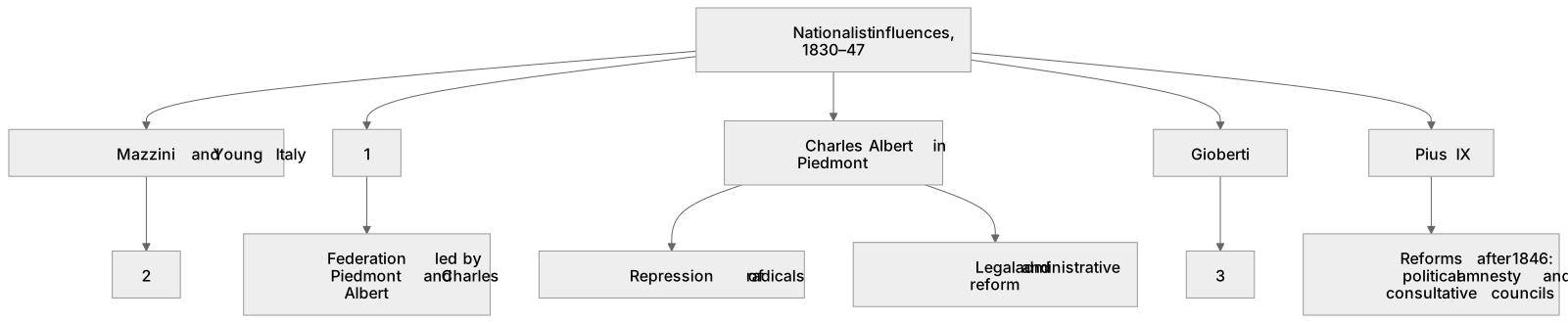
Between 1830 and 1847, nationalist influences multiplied across the peninsula. Mazzini founded Young Italy in 1831, advocating a democratic republic through insurrection and education; his risings failed but his ideas spread. Balbo, a Piedmontese conservative, argued for a federation led by Piedmont and Charles Albert, offering a moderate alternative to revolution. Charles Albert's rule in Piedmont combined repression of radicals with legal and administrative reform, keeping Piedmont as a possible leader. Gioberti, a priest, proposed a neo-Guelph federation of Italian princes under the pope. Pius IX's reforms after 1846, including political amnesty and consultative councils, raised hopes of papal leadership, though he later resisted war with Austria.
What earns the marks
- Explains Mazzini's aims and methods: Young Italy, republicanism, insurrection, education and propaganda.
- Contrasts Balbo's Piedmont-led federalist vision with Mazzini's democratic republicanism.
- Assesses Charles Albert's rule in Piedmont: repression of radicals alongside legal and administrative reform.
- Explains Gioberti's neo-Guelph federalism and its appeal to moderate Catholics.
- Evaluates Pius IX's reforms and their impact on nationalist expectations up to 1847.
Common mistakes and how to put them right
Treating Mazzini as a successful revolutionary.
Put it right: His risings failed, but his ideas influenced later nationalists.
Assuming Charles Albert was consistently liberal.
Put it right: He repressed radicals while reforming administration.
Confusing Balbo's Piedmont-led federation with Gioberti's papal federation.
Put it right: Balbo looked to Charles Albert, while Gioberti wanted a confederation under the pope.
Exam tips
- Compare Mazzini, Balbo and Gioberti directly to show understanding of competing visions.
- Use specific dates and events, such as the founding of Young Italy in 1831 and Pius IX's amnesty in 1846.
Try the lesson
The start of the Paper 2, Option 2D.1: The unification of Italy, c1830–70 - 1 Challenges to the restored order and the failure of revolution, c1830–49: Nationalist influences, 1830–47; Mazzini and Young Italy; Balbo and the rule of Charles Albert in Piedmont; Gioberti and the reforms of Pope Pius IX. lesson, made from checked teaching notes for this specification point.
Have a go first
Which organisation did Giuseppe Mazzini found in 1831 to promote Italian nationalism?
Listen
Between 1830 and 1847, nationalist influences multiplied across the peninsula. Mazzini founded Young Italy in 1831, advocating a democratic republic through insurrection and education; his risings failed but his ideas spread. Balbo, a Piedmontese conservative, argued for a federation led by Piedmont and Charles Albert, offering a moderate alternative to revolution. Charles Albert's rule in Piedmont combined repression of radicals with legal and administrative reform, keeping Piedmont as a possible leader. Gioberti, a priest, proposed a neo-Guelph federation of Italian princes under the pope. Pius IX's reforms after 1846, including political amnesty and consultative councils, raised hopes of papal leadership, though he later resisted war with Austria. A strong answer earns marks for these points. Explains Mazzini's aims and methods: Young Italy, republicanism, insurrection, education and propaganda. Contrasts Balbo's Piedmont-led federalist vision with Mazzini's democratic republicanism. Assesses Charles Albert's rule in Piedmont: repression of radicals alongside legal and administrative reform. Explains Gioberti's neo-Guelph federalism and its appeal to moderate Catholics. A common slip: Treating Mazzini as a successful revolutionary. Instead, his risings failed, but his ideas influenced later nationalists. Exam tip: Compare Mazzini, Balbo and Gioberti directly to show understanding of competing visions.
See it

Key words
Say what each word means before you turn the card.
Young Italy
Try answering aloud or in your head before turning the card.
Balbo
Try answering aloud or in your head before turning the card.
Gioberti
Try answering aloud or in your head before turning the card.
Pius IX
Try answering aloud or in your head before turning the card.
See every definition
- Young Italy
- Founded by Mazzini in 1831, it advocated a democratic republic through insurrection and education, and his risings failed but his ideas spread.
- Balbo
- A Piedmontese conservative who argued for a federation led by Piedmont and Charles Albert, offering a moderate alternative to revolution.
- Gioberti
- A priest who proposed a neo-Guelph federation of Italian princes under the pope.
- Pius IX
- His reforms after 1846, including political amnesty and consultative councils, raised hopes of papal leadership, though he later resisted war with Austria.
Label the diagram
Some boxes have lost their names. Pick the right name for each number.
1Box 1
2Box 2
3Box 3
There is more to this lesson
The full lesson goes on to check your understanding and help you earn the marks. Create a free account to carry on, with your progress saved.
A week of Premium from your first lesson · Then the free plan continues · No card, no charge
Test your understanding of Paper 2, Option 2D.1: The unification of Italy, c1830–70 - 1 Challenges to the restored order and the failure of revolution, c1830–49: Nationalist influences, 1830–47; Mazzini and Young Italy; Balbo and the rule of Charles Albert in Piedmont; Gioberti and the reforms of Pope Pius IX.
Active recall beats re-reading. Take an instant quiz now to test what you’ve learned and lock it into long-term memory.
A week of Premium from your first lesson · Then the free plan continues · No card, no charge