Pearson Edexcel · A-Level · History
Course version: 9HI0 · Version from Sept 2015
The unification of Italy, c1830–70 - 1 Challenges to the restored order…
Full specification wording
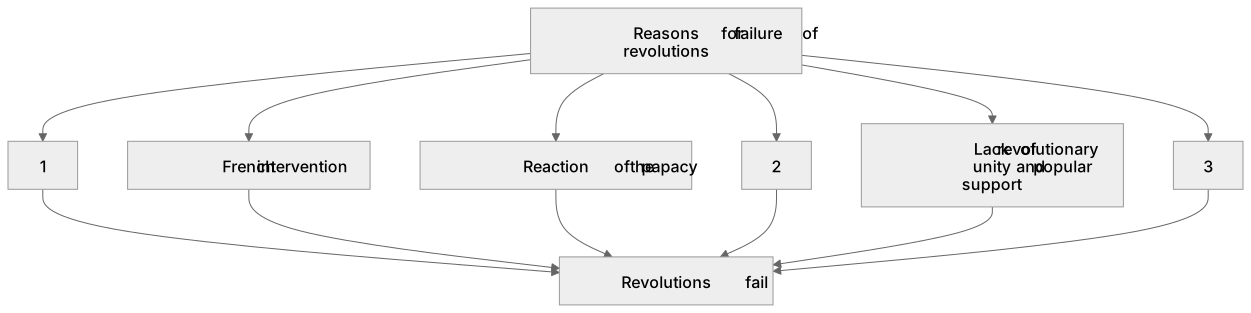
Paper 2, Option 2D.1: The unification of Italy, c1830–70 - 1 Challenges to the restored order and the failure of revolution, c1830–49: Reasons for failure of revolutions: Austrian and French intervention; reaction of the papacy; Piedmont’s weaknesses; lack of revolutionary unity and popular support; lack of international support.
The revolutions of 1848–49 failed for interconnected reasons.
Checked against the Pearson Edexcel 9HI0 specification (opens in a new tab) on .
- Point 4 of 4
- 4 key terms
Study notes
From the checked teaching notes for this specification point.
The idea
The revolutions of 1848–49 failed for interconnected reasons. Austrian military intervention, led by Radetzky, defeated Piedmont at Custoza and Novara and restored Austrian control in Lombardy-Venetia. French intervention crushed the Roman Republic in 1849, while the papacy, initially sympathetic, condemned the war against Austria and withdrew support, undermining the nationalist cause. Piedmont was militarily weak, lacked allies, and its defeat at Novara forced Charles Albert’s abdication. Revolutionaries were divided between moderates and radicals, and between nationalists and those with local grievances, while popular support was limited, especially among peasants. International support was absent: no major power backed Italian unification, and Britain and France pursued their own interests. These factors together ensured the revolutions’ failure.
What earns the marks
- Austrian intervention under Radetzky was decisive: Austrian forces defeated Piedmont at Custoza (July 1848) and Novara (March 1849), restoring Austrian control in Lombardy and Venetia.
- French intervention in 1849 overthrew the Roman Republic, ending Mazzini’s experiment and demonstrating the willingness of foreign powers to suppress Italian revolutions.
- The papacy’s reaction, including Pius IX’s withdrawal of support for the war against Austria and his condemnation of nationalism, deprived the revolution of moral and political leadership.
- Piedmont’s weaknesses included military defeats, lack of reliable allies, and Charles Albert’s abdication after Novara, which left Piedmont isolated and weakened.
- Lack of revolutionary unity and popular support: divisions between moderates and radicals, and between nationalists and peasants with local grievances, prevented a coordinated movement.
- Lack of international support: no major power actively backed Italian unification, and Britain and France prioritised their own strategic interests.
Common mistakes and how to put them right
Overstating popular support for the revolutions.
Put it right: Support was often limited to urban elites and students, while many peasants remained indifferent or hostile.
Assuming the papacy consistently opposed Italian nationalism from the start.
Put it right: Pius IX initially appeared sympathetic but withdrew support after the outbreak of war with Austria.
Treating the failure as solely due to Austrian military strength.
Put it right: French intervention, papal opposition, Piedmontese weakness, and revolutionary disunity were also crucial.
Exam tips
- Structure answers around the named reasons, using specific evidence for each and explaining how they interacted.
- Avoid listing reasons without analysis; show how factors such as foreign intervention and internal division reinforced each other.
- Use precise dates and names, such as Radetzky, Custoza, Novara, Pius IX, and the French siege of Rome, to support arguments.
Try the lesson
The start of the Paper 2, Option 2D.1: The unification of Italy, c1830–70 - 1 Challenges to the restored order and the failure of revolution, c1830–49: Reasons for failure of revolutions: Austrian and French intervention; reaction of the papacy; Piedmont’s weaknesses; lack of revolutionary unity and popular support; lack of international support. lesson, made from checked teaching notes for this specification point.
Have a go first
Which foreign power defeated Piedmontese forces at the Battle of Novara in March 1849, ending the First Italian War of Independence?
Listen
The revolutions of 1848–49 failed for interconnected reasons. Austrian military intervention, led by Radetzky, defeated Piedmont at Custoza and Novara and restored Austrian control in Lombardy-Venetia. French intervention crushed the Roman Republic in 1849, while the papacy, initially sympathetic, condemned the war against Austria and withdrew support, undermining the nationalist cause. Piedmont was militarily weak, lacked allies, and its defeat at Novara forced Charles Albert’s abdication. Revolutionaries were divided between moderates and radicals, and between nationalists and those with local grievances, while popular support was limited, especially among peasants. International support was absent: no major power backed Italian unification, and Britain and France pursued their own interests. These factors together ensured the revolutions’ failure. A strong answer earns marks for these points. Austrian intervention under Radetzky was decisive: Austrian forces defeated Piedmont at Custoza (July 1848) and Novara (March 1849), restoring Austrian control in Lombardy and Venetia. French intervention in 1849 overthrew the Roman Republic, ending Mazzini’s experiment and demonstrating the willingness of foreign powers to suppress Italian revolutions. The papacy’s reaction, including Pius IX’s withdrawal of support for the war against Austria and his condemnation of nationalism, deprived the revolution of moral and political leadership. Piedmont’s weaknesses included military defeats, lack of reliable allies, and Charles Albert’s abdication after Novara, which left Piedmont isolated and weakened. A common slip: Overstating popular support for the revolutions. Instead, support was often limited to urban elites and students, while many peasants remained indifferent or hostile. Exam tip: Structure answers around the named reasons, using specific evidence for each and explaining how they interacted.
See it

Key words
Say what each word means before you turn the card.
Foreign intervention and great-power politics
Try answering aloud or in your head before turning the card.
The role of the papacy
Try answering aloud or in your head before turning the card.
Military and political weaknesses of Piedmont
Try answering aloud or in your head before turning the card.
Revolutionary disunity and limited popular support
Try answering aloud or in your head before turning the card.
See every definition
- Foreign intervention and great-power politics
- Austrian military intervention under Radetzky defeated Piedmont at Custoza and Novara, and French intervention in 1849 crushed the Roman Republic, while no major power backed Italian unification.
- The role of the papacy
- The papacy, initially sympathetic, condemned the war against Austria and withdrew support, depriving the revolution of moral and political leadership.
- Military and political weaknesses of Piedmont
- Piedmont was militarily weak, lacked reliable allies, and its defeat at Novara forced Charles Albert's abdication, leaving it isolated and weakened.
- Revolutionary disunity and limited popular support
- Revolutionaries were divided between moderates and radicals and between nationalists and those with local grievances, while popular support was limited, especially among peasants.
Label the diagram
Some boxes have lost their names. Pick the right name for each number.
1Box 1
2Box 2
3Box 3
There is more to this lesson
The full lesson goes on to check your understanding and help you earn the marks. Create a free account to carry on, with your progress saved.
A week of Premium from your first lesson · Then the free plan continues · No card, no charge
Test your understanding of Paper 2, Option 2D.1: The unification of Italy, c1830–70 - 1 Challenges to the restored order and the failure of revolution, c1830–49: Reasons for failure of revolutions: Austrian and French intervention; reaction of the papacy; Piedmont’s weaknesses; lack of revolutionary unity and popular support; lack of international support.
Active recall beats re-reading. Take an instant quiz now to test what you’ve learned and lock it into long-term memory.
A week of Premium from your first lesson · Then the free plan continues · No card, no charge