Pearson Edexcel · A-Level · History
Course version: 9HI0 · Version from Sept 2015
The unification of Italy, c1830–70 - 4 Consolidating the Kingdom of Italy,…
Full specification wording
Paper 2, Option 2D.1: The unification of Italy, c1830–70 - 4 Consolidating the Kingdom of Italy, 1861–70: Obstacles to unity after 1861: Austrian and French influence; the papacy; the reaction to ‘Piedmontisation’, including the ‘Brigands’ war’, 1861–65; the economic and social impact of the north-south divide.
After 1861 the new Kingdom of Italy faced serious obstacles.
Checked against the Pearson Edexcel 9HI0 specification (opens in a new tab) on .
- Point 1 of 4
- 3 key terms
Study notes
From the checked teaching notes for this specification point.
The idea
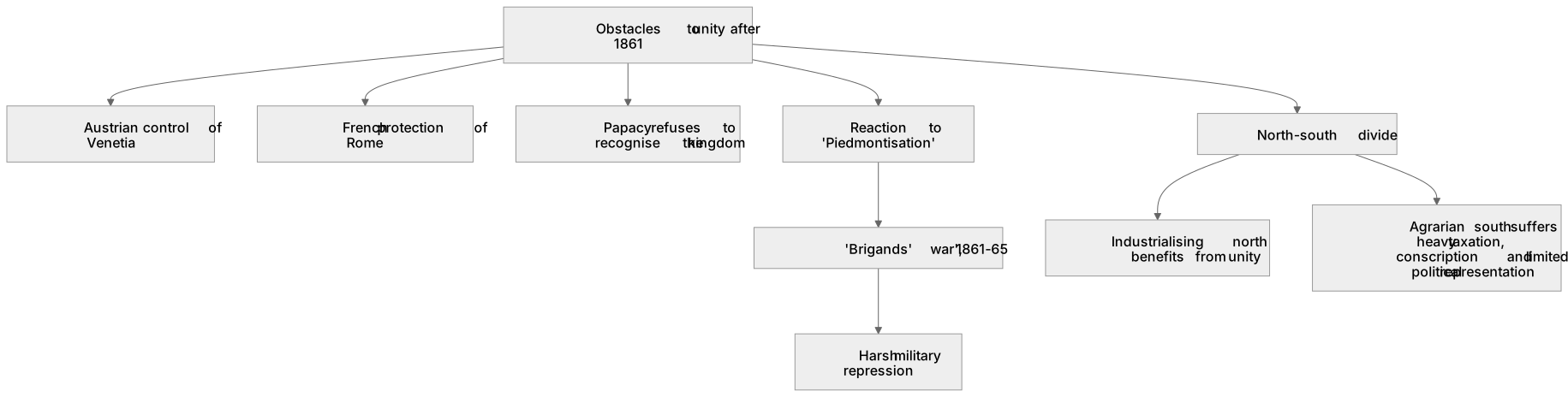
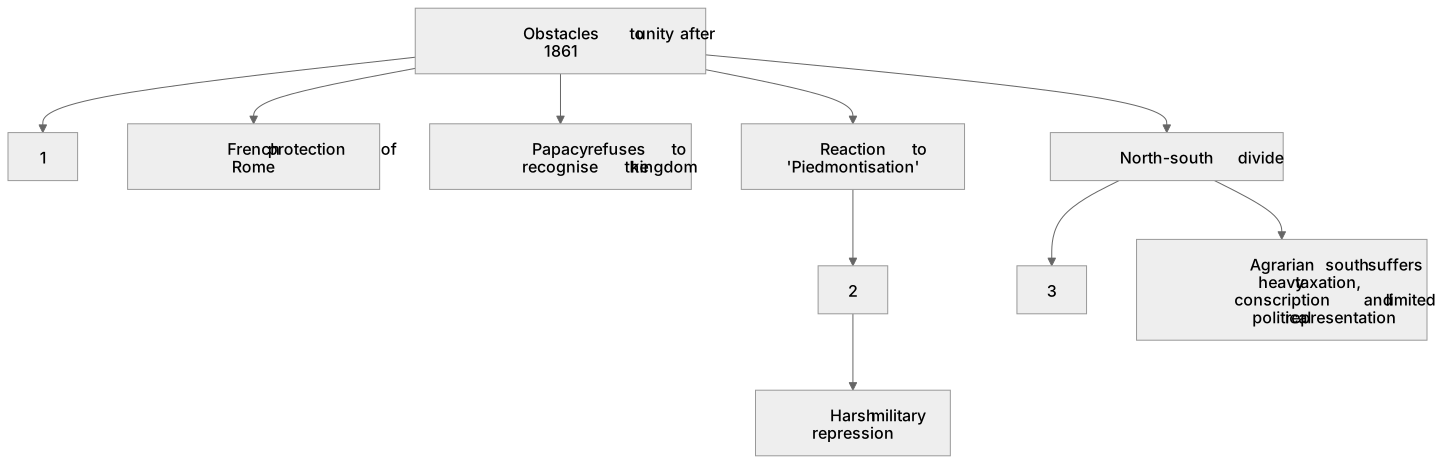
After 1861 the new Kingdom of Italy faced serious obstacles. Austria still held Venetia and France protected Rome, limiting full unity. The papacy refused to recognise the kingdom, and the Pope's spiritual authority encouraged Catholic opposition. Many Italians resented 'Piedmontisation': the extension of Piedmontese laws, taxes and administration to the whole peninsula. This resentment fuelled the 'Brigands' war' in the south (1861–65), a violent insurgency met by harsh military repression. The north-south divide was stark: the industrialising north benefited from unity, while the agrarian south suffered from heavy taxation, conscription and limited political representation. These economic and social tensions undermined national cohesion and posed lasting challenges to the new state.
What earns the marks
- Explains how Austrian control of Venetia and French protection of Rome prevented complete unification and limited Italian foreign policy.
- Analyses the papacy's refusal to accept the Kingdom of Italy and its impact on Catholic loyalty and political legitimacy.
- Describes the reaction to 'Piedmontisation', including the imposition of Piedmontese laws, taxation and centralised administration.
- Explains the causes and nature of the 'Brigands' war' (1861–65) as a revolt against the new order, and the government's military response.
- Assesses the economic and social impact of the north-south divide, such as unequal taxation, conscription, and lack of investment in the south.
Common mistakes and how to put them right
Treating the 'Brigands' war' as purely criminal rather than a complex reaction to political and economic grievances.
Put it right: Recognise it as a mixture of banditry, peasant revolt and resistance to Piedmontisation.
Assuming that unification in 1861 solved all regional differences.
Put it right: Explain that deep north-south divisions persisted and were exacerbated by government policies.
Overlooking the role of the papacy in obstructing unity.
Put it right: Include the Pope's refusal to recognise the kingdom and the resulting tension between church and state.
Exam tips
- Use specific examples, such as the 1863 Legge Pica or the mass execution of brigands, to support your analysis of the 'Brigands' war'.
- Compare the experiences of northern and southern Italy to show the depth of the north-south divide.
- Link each obstacle to the broader question of how successfully Italy was consolidated after 1861.
Try the lesson
The start of the Paper 2, Option 2D.1: The unification of Italy, c1830–70 - 4 Consolidating the Kingdom of Italy, 1861–70: Obstacles to unity after 1861: Austrian and French influence; the papacy; the reaction to ‘Piedmontisation’, including the ‘Brigands’ war’, 1861–65; the economic and social impact of the north-south divide. lesson, made from checked teaching notes for this specification point.
Have a go first
Which foreign power still controlled Venetia and Rome in 1861, making it an obstacle to the complete unification of Italy?
Listen
After 1861 the new Kingdom of Italy faced serious obstacles. Austria still held Venetia and France protected Rome, limiting full unity. The papacy refused to recognise the kingdom, and the Pope's spiritual authority encouraged Catholic opposition. Many Italians resented 'Piedmontisation': the extension of Piedmontese laws, taxes and administration to the whole peninsula. This resentment fuelled the 'Brigands' war' in the south (1861–65), a violent insurgency met by harsh military repression. The north-south divide was stark: the industrialising north benefited from unity, while the agrarian south suffered from heavy taxation, conscription and limited political representation. These economic and social tensions undermined national cohesion and posed lasting challenges to the new state. A strong answer earns marks for these points. Explains how Austrian control of Venetia and French protection of Rome prevented complete unification and limited Italian foreign policy. Analyses the papacy's refusal to accept the Kingdom of Italy and its impact on Catholic loyalty and political legitimacy. Describes the reaction to 'Piedmontisation', including the imposition of Piedmontese laws, taxation and centralised administration. Explains the causes and nature of the 'Brigands' war' (1861–65) as a revolt against the new order, and the government's military response. A common slip: Treating the 'Brigands' war' as purely criminal rather than a complex reaction to political and economic grievances. Instead, recognise it as a mixture of banditry, peasant revolt and resistance to Piedmontisation. Exam tip: Use specific examples, such as the 1863 Legge Pica or the mass execution of brigands, to support your analysis of the 'Brigands' war'.
See it
Key words
Say what each word means before you turn the card.
Piedmontisation
Try answering aloud or in your head before turning the card.
Brigands' war
Try answering aloud or in your head before turning the card.
North-south divide
Try answering aloud or in your head before turning the card.
See every definition
- Piedmontisation
- The extension of Piedmontese laws, taxes and administration to the whole peninsula, which many Italians resented.
- Brigands' war
- A violent insurgency in the south from 1861 to 1865, fuelled by resentment and met by harsh military repression.
- North-south divide
- A stark division in which the industrialising north benefited from unity while the agrarian south suffered from heavy taxation, conscription and limited political representation.
Label the diagram
Some boxes have lost their names. Pick the right name for each number.
1Box 1
2Box 2
3Box 3
There is more to this lesson
The full lesson goes on to check your understanding and help you earn the marks. Create a free account to carry on, with your progress saved.
A week of Premium from your first lesson · Then the free plan continues · No card, no charge
Test your understanding of Paper 2, Option 2D.1: The unification of Italy, c1830–70 - 4 Consolidating the Kingdom of Italy, 1861–70: Obstacles to unity after 1861: Austrian and French influence; the papacy; the reaction to ‘Piedmontisation’, including the ‘Brigands’ war’, 1861–65; the economic and social impact of the north-south divide.
Active recall beats re-reading. Take an instant quiz now to test what you’ve learned and lock it into long-term memory.
A week of Premium from your first lesson · Then the free plan continues · No card, no charge