Pearson Edexcel · A-Level · History
Course version: 9HI0 · Version from Sept 2015
The unification of Italy, c1830–70 - 4 Consolidating the Kingdom of Italy,…
Full specification wording
Paper 2, Option 2D.1: The unification of Italy, c1830–70 - 4 Consolidating the Kingdom of Italy, 1861–70: Solving the ‘Venetian question’, 1861–66: failure of Garibaldi, 1862–64; aims of Victor Emmanuel; diplomacy with Prussia and war with Austria 1866; union with Venetia.
Solving the ‘Venetian question’ dominated Italian foreign policy from 1861 to 1866.
Checked against the Pearson Edexcel 9HI0 specification (opens in a new tab) on .
- Point 2 of 4
- 2 key terms
Study notes
From the checked teaching notes for this specification point.
The idea
Solving the ‘Venetian question’ dominated Italian foreign policy from 1861 to 1866. The failure of Garibaldi between 1862 and 1864 highlighted the limits of volunteer action; his 1862 Sarnico plot to invade Venetia was halted by the government, and his 1864 visit to England failed to secure armed support. Meanwhile, the aims of Victor Emmanuel II focused on completing unification through statecraft. This led to diplomacy with Prussia, culminating in an alliance. In the resulting war with Austria in 1866, Italy performed poorly militarily but benefited from Prussia's decisive victory. The conflict concluded with the union with Venetia, transferred via France. This resolved the Venetian question but underscored Italy's reliance on great-power diplomacy.
What earns the marks
- Explains the failure of Garibaldi (1862–64) to solve the Venetian question, referencing the aborted 1862 Sarnico expedition and his 1864 diplomatic efforts in England.
- Analyses the aims of Victor Emmanuel II, focusing on his desire to acquire Venetia and complete unification through strategic alliances.
- Describes the diplomacy with Prussia that resulted in the 1866 military alliance against Austria.
- Explains the course of the war with Austria in 1866 and how Prussia's victory facilitated the union with Venetia.
- Assesses the significance of the union with Venetia, noting that while it advanced unification, it exposed Italy's military weakness and reliance on foreign powers.
Common mistakes and how to put them right
Confusing Garibaldi's actions regarding Venetia with his attempts on Rome.
Put it right: The 1862 Sarnico plot and 1864 English visit were linked to the Venetian question, whereas Aspromonte (1862) and Mentana (1867) targeted Rome.
Assuming Italy gained Venetia solely through its own military strength.
Put it right: Emphasise the role of diplomacy with Prussia and Austria's defeat by Prussian forces.
Claiming Garibaldi led a failed military expedition to Venetia in 1864.
Put it right: His 1864 efforts were diplomatic (visiting England to raise support), not a military invasion.
Exam tips
- Clearly distinguish between Garibaldi's efforts to solve the Venetian question (1862 Sarnico, 1864 England visit) and his separate campaigns aimed at Rome.
- Link the aims of Victor Emmanuel II to the successful diplomacy with Prussia, showing how state-led action succeeded where Garibaldi's volunteer initiatives failed.
Try the lesson
The start of the Paper 2, Option 2D.1: The unification of Italy, c1830–70 - 4 Consolidating the Kingdom of Italy, 1861–70: Solving the ‘Venetian question’, 1861–66: failure of Garibaldi, 1862–64; aims of Victor Emmanuel; diplomacy with Prussia and war with Austria 1866; union with Venetia. lesson, made from checked teaching notes for this specification point.
Have a go first
Which power controlled Venetia in 1861, making it the focus of the ‘Venetian question’?
Listen
Solving the ‘Venetian question’ dominated Italian foreign policy from 1861 to 1866. The failure of Garibaldi between 1862 and 1864 highlighted the limits of volunteer action; his 1862 Sarnico plot to invade Venetia was halted by the government, and his 1864 visit to England failed to secure armed support. Meanwhile, the aims of Victor Emmanuel II focused on completing unification through statecraft. This led to diplomacy with Prussia, culminating in an alliance. In the resulting war with Austria in 1866, Italy performed poorly militarily but benefited from Prussia's decisive victory. The conflict concluded with the union with Venetia, transferred via France. This resolved the Venetian question but underscored Italy's reliance on great-power diplomacy. A strong answer earns marks for these points. Explains the failure of Garibaldi (1862–64) to solve the Venetian question, referencing the aborted 1862 Sarnico expedition and his 1864 diplomatic efforts in England. Analyses the aims of Victor Emmanuel II, focusing on his desire to acquire Venetia and complete unification through strategic alliances. Describes the diplomacy with Prussia that resulted in the 1866 military alliance against Austria. Explains the course of the war with Austria in 1866 and how Prussia's victory facilitated the union with Venetia. A common slip: Confusing Garibaldi's actions regarding Venetia with his attempts on Rome. Instead, the 1862 Sarnico plot and 1864 English visit were linked to the Venetian question, whereas Aspromonte (1862) and Mentana (1867) targeted Rome. Exam tip: Clearly distinguish between Garibaldi's efforts to solve the Venetian question (1862 Sarnico, 1864 England visit) and his separate campaigns aimed at Rome.
See it
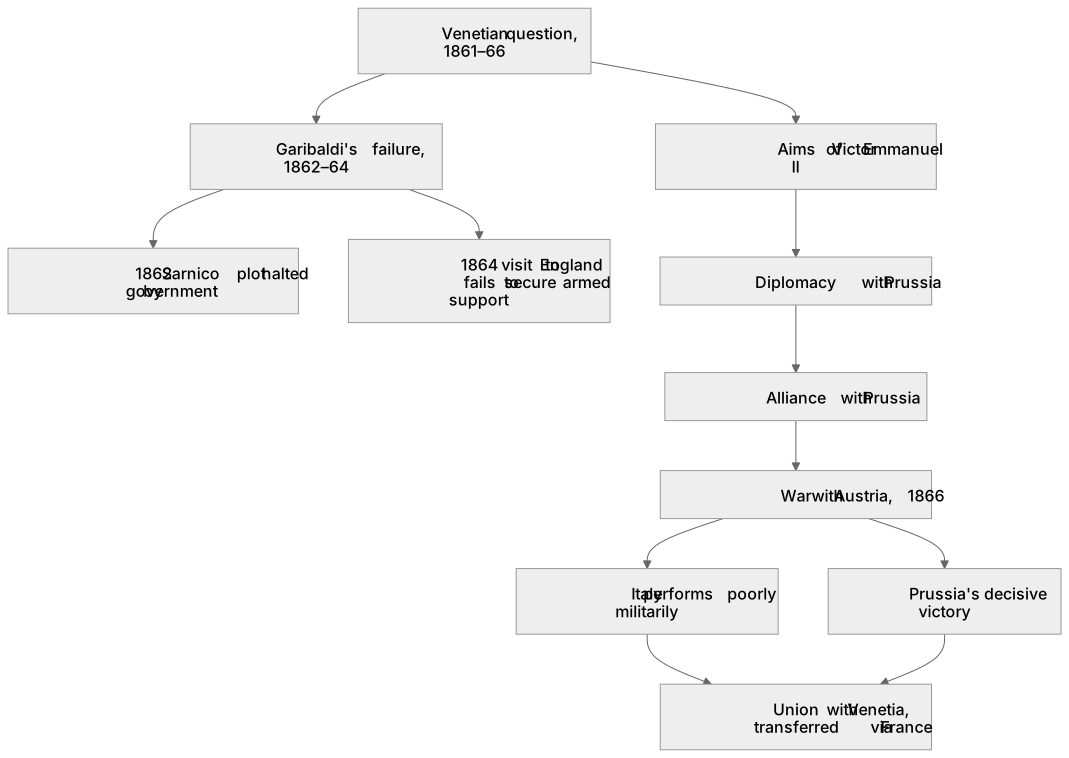
Put the events in order
Put these events in the order they happened, earliest first.
- 1. Sarnico plot to invade Venetia halted by the government
- 2. War with Austria and union with Venetia
- 3. Garibaldi's visit to England failed to secure armed support
Key words
Say what each word means before you turn the card.
National unification and the Venetian question
Try answering aloud or in your head before turning the card.
Great-power diplomacy and alliances
Try answering aloud or in your head before turning the card.
See every definition
- National unification and the Venetian question
- The solving of the Venetian question dominated Italian foreign policy from 1861 to 1866 and was resolved by the union with Venetia.
- Great-power diplomacy and alliances
- Diplomacy with Prussia culminated in an alliance, and the union with Venetia underscored Italy's reliance on great-power diplomacy.
Label the diagram
Some boxes have lost their names. Pick the right name for each number.
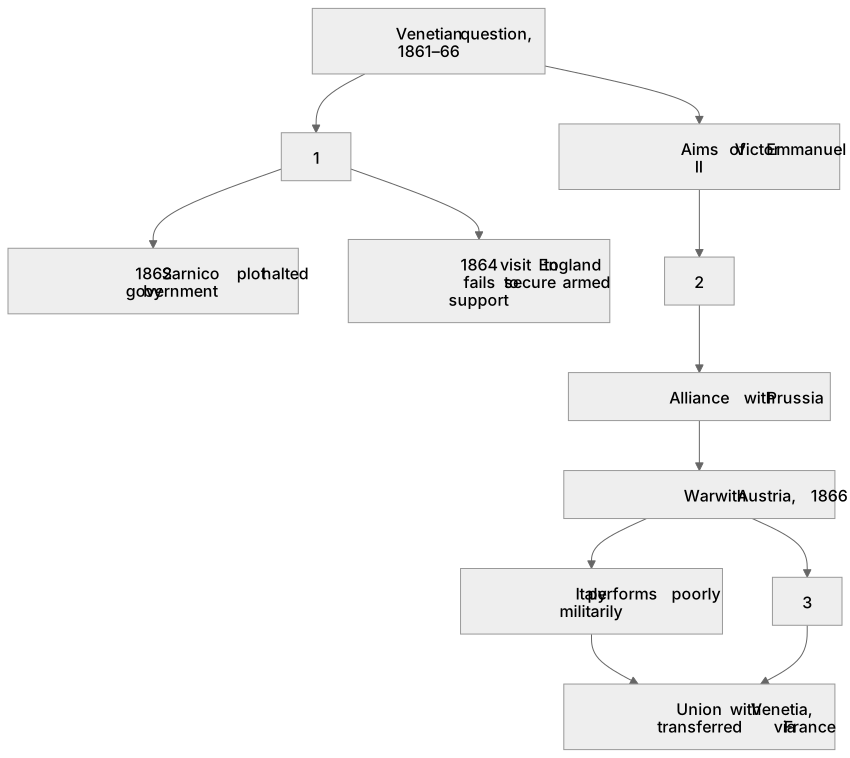
1Box 1
2Box 2
3Box 3
There is more to this lesson
The full lesson goes on to check your understanding and help you earn the marks. Create a free account to carry on, with your progress saved.
A week of Premium from your first lesson · Then the free plan continues · No card, no charge
Test your understanding of Paper 2, Option 2D.1: The unification of Italy, c1830–70 - 4 Consolidating the Kingdom of Italy, 1861–70: Solving the ‘Venetian question’, 1861–66: failure of Garibaldi, 1862–64; aims of Victor Emmanuel; diplomacy with Prussia and war with Austria 1866; union with Venetia.
Active recall beats re-reading. Take an instant quiz now to test what you’ve learned and lock it into long-term memory.
A week of Premium from your first lesson · Then the free plan continues · No card, no charge