Pearson Edexcel · A-Level · History
Course version: 9HI0 · Version from Sept 2015
The unification of Italy, c1830–70 - 4 Consolidating the Kingdom of Italy,…
Full specification wording
Paper 2, Option 2D.1: The unification of Italy, c1830–70 - 4 Consolidating the Kingdom of Italy, 1861–70: Unity in 1870: factors promoting unity, including the constitutional monarchy and national institutions; the divisive effects of social and economic problems, papal opposition, political disunity and continued irredenta.
By 1870, Italy was politically unified under a constitutional monarchy, but unity was fragile.
Checked against the Pearson Edexcel 9HI0 specification (opens in a new tab) on .
- Point 4 of 4
- 4 key terms
Study notes
From the checked teaching notes for this specification point.
The idea
By 1870, Italy was politically unified under a constitutional monarchy, but unity was fragile. The monarchy, parliament, and institutions like the army and education system fostered a sense of nationhood. However, deep divisions remained: social and economic problems, including poverty, illiteracy, and the North-South divide, weakened cohesion. The papacy refused to recognise the state, and political disunity persisted with weak governments and factionalism. Irredentism—the desire to annex Italian-speaking lands such as Trentino and Trieste—continued to challenge the nation-state. Thus, while formal unity was achieved, true national integration was incomplete.
What earns the marks
- Explains how the constitutional monarchy under Victor Emmanuel II provided a unifying symbol and framework for the new state.
- Describes national institutions: the parliament, army, and education system helped promote loyalty and a shared Italian identity.
- Analyses social and economic divisions: poverty, illiteracy, and the North-South economic gap created tensions that undermined unity.
- Explains papal opposition: the pope's refusal to accept the loss of Rome and the resulting Church-State conflict divided Italian society.
- Assesses political disunity: weak coalition governments, factionalism, and limited suffrage meant that political life was unstable and unrepresentative.
- Evaluates continued irredenta: the aspiration to incorporate Italian-speaking territories under foreign rule, such as Trentino and Trieste, remained a source of nationalist agitation.
Common mistakes and how to put them right
Claiming that Italy was fully unified and harmonious by 1870.
Put it right: Significant social, economic, and political divisions remained.
Stating that the pope supported the new Italian state.
Put it right: The papacy opposed it, and the Roman Question remained unresolved.
Error: ignoring irredentism. Correction: many nationalists still sought to annex Italian-speaking lands like Trentino and Trieste.
Assuming all Italians had the vote.
Put it right: Suffrage was limited, and most Italians were excluded from political participation.
Exam tips
- Use specific examples to illustrate divisions: the North-South economic gap, illiteracy rates, and the pope's non expedit.
- When discussing factors promoting unity, refer to the constitution (Statuto Albertino), the monarchy, and institutions like the army.
- Balance your answer by covering both unifying and divisive factors, as the question requires.
- Avoid generalisations; support claims with evidence such as the 1871 capital transfer to Rome or the 1864 Syllabus of Errors.
Try the lesson
The start of the Paper 2, Option 2D.1: The unification of Italy, c1830–70 - 4 Consolidating the Kingdom of Italy, 1861–70: Unity in 1870: factors promoting unity, including the constitutional monarchy and national institutions; the divisive effects of social and economic problems, papal opposition, political disunity and continued irredenta. lesson, made from checked teaching notes for this specification point.
Have a go first
Which of the following was a factor promoting unity in Italy by 1870?
Listen
By 1870, Italy was politically unified under a constitutional monarchy, but unity was fragile. The monarchy, parliament, and institutions like the army and education system fostered a sense of nationhood. However, deep divisions remained: social and economic problems, including poverty, illiteracy, and the North-South divide, weakened cohesion. The papacy refused to recognise the state, and political disunity persisted with weak governments and factionalism. Irredentism—the desire to annex Italian-speaking lands such as Trentino and Trieste—continued to challenge the nation-state. Thus, while formal unity was achieved, true national integration was incomplete. A strong answer earns marks for these points. Explains how the constitutional monarchy under Victor Emmanuel II provided a unifying symbol and framework for the new state. Describes national institutions: the parliament, army, and education system helped promote loyalty and a shared Italian identity. Analyses social and economic divisions: poverty, illiteracy, and the North-South economic gap created tensions that undermined unity. Explains papal opposition: the pope's refusal to accept the loss of Rome and the resulting Church-State conflict divided Italian society. A common slip: claiming that Italy was fully unified and harmonious by 1870. Instead, significant social, economic, and political divisions remained. Exam tip: Use specific examples to illustrate divisions: the North-South economic gap, illiteracy rates, and the pope's non expedit.
See it

Key words
Say what each word means before you turn the card.
constitutional monarchy
Try answering aloud or in your head before turning the card.
national institutions
Try answering aloud or in your head before turning the card.
irredentism
Try answering aloud or in your head before turning the card.
papal opposition
Try answering aloud or in your head before turning the card.
See every definition
- constitutional monarchy
- A system under which Italy was politically unified by 1870, providing a unifying symbol and framework for the new state.
- national institutions
- The parliament, army and education system, which helped promote loyalty and a shared Italian identity.
- irredentism
- The desire to annex Italian-speaking lands such as Trentino and Trieste, which continued to challenge the nation-state.
- papal opposition
- The papacy's refusal to recognise the state, which divided Italian society and left the Roman Question unresolved.
Label the diagram
Some boxes have lost their names. Pick the right name for each number.
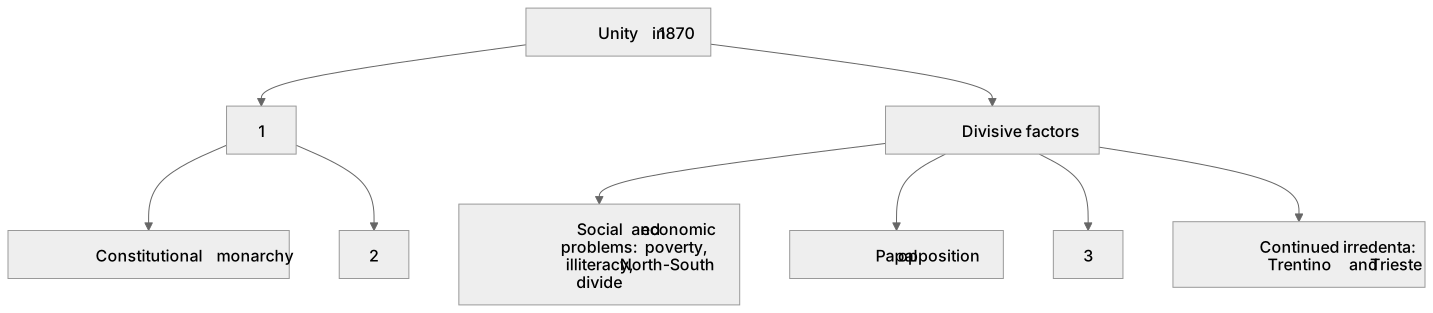
1Box 1
2Box 2
3Box 3
There is more to this lesson
The full lesson goes on to check your understanding and help you earn the marks. Create a free account to carry on, with your progress saved.
A week of Premium from your first lesson · Then the free plan continues · No card, no charge
Test your understanding of Paper 2, Option 2D.1: The unification of Italy, c1830–70 - 4 Consolidating the Kingdom of Italy, 1861–70: Unity in 1870: factors promoting unity, including the constitutional monarchy and national institutions; the divisive effects of social and economic problems, papal opposition, political disunity and continued irredenta.
Active recall beats re-reading. Take an instant quiz now to test what you’ve learned and lock it into long-term memory.
A week of Premium from your first lesson · Then the free plan continues · No card, no charge