Pearson Edexcel · A-Level · History
Course version: 9HI0 · Version from Sept 2015
The unification of Italy, c1830–70 - 4 Consolidating the Kingdom of Italy,…
Full specification wording
Paper 2, Option 2D.1: The unification of Italy, c1830–70 - 4 Consolidating the Kingdom of Italy, 1861–70: Solving the problem of Rome, 1861–70: the papacy and French occupation; the failure of Garibaldi and diplomacy, 1862–67; the impact of the Franco-Prussian war; the Italian takeover of Rome.
After 1861, Rome remained outside the new Kingdom of Italy.
Checked against the Pearson Edexcel 9HI0 specification (opens in a new tab) on .
- Point 3 of 4
- 4 key terms
Study notes
From the checked teaching notes for this specification point.
The idea
After 1861, Rome remained outside the new Kingdom of Italy. The papacy, led by Pius IX, opposed incorporation, and French troops protected Rome, upholding the pope's temporal power. Attempts to resolve the 'Roman Question' failed: Garibaldi's 1862 march was stopped at Aspromonte, and his 1867 attempt ended at Mentana, while diplomatic offers to the papacy were rejected. The Franco-Prussian War of 1870 forced France to withdraw its garrison, and after French defeat at Sedan, Italian forces entered Rome on 20 September 1870. A plebiscite in October overwhelmingly favoured union, and Rome became Italy's capital in 1871. This completed territorial unification but left lasting tension between the Italian state and the papacy.
What earns the marks
- Explains that the papacy under Pius IX refused to surrender Rome or accept the loss of the Papal States, issuing the Syllabus of Errors (1864) and maintaining a hardline stance.
- Describes the French occupation: French troops garrisoned in Rome from 1849 protected the pope and blocked Italian annexation, a key obstacle until 1870.
- Analyses the failure of Garibaldi's attempts: the 1862 march was halted by Italian royal troops at Aspromonte, and the 1867 campaign was defeated by French and papal forces at Mentana.
- Assesses diplomatic failures: negotiations such as the September Convention (1864) failed to secure a lasting solution because France retained a protective role and the papacy refused concessions.
- Explains the impact of the Franco-Prussian War: France's defeat and the withdrawal of its garrison removed the main military obstacle to Italian occupation of Rome.
- Evaluates the Italian takeover: after the fall of Napoleon III's empire, Italian forces entered Rome in September 1870, a plebiscite confirmed union, and Rome became the capital in 1871.
Common mistakes and how to put them right
Stating that Rome was annexed in 1861.
Put it right: Rome was not incorporated until 1870, after the Franco-Prussian War.
Claiming Garibaldi succeeded in taking Rome in 1862 or 1867.
Put it right: Both attempts failed, at Aspromonte and Mentana respectively.
Saying the French occupation ended voluntarily.
Put it right: French troops were withdrawn because of the Franco-Prussian War, not because France chose to leave.
Confusing the September Convention with a final settlement.
Put it right: The 1864 convention did not resolve the Roman Question; French protection continued until 1870.
Exam tips
- When discussing the papacy, refer to Pius IX's Syllabus of Errors and his refusal to recognise the Italian state.
- Use precise dates and places: Aspromonte (1862), Mentana (1867), September 1870 for the occupation, and 1871 for Rome as capital.
- Link the Franco-Prussian War directly to the withdrawal of French troops and the opportunity it created for Italy.
- Avoid vague statements like 'France helped the pope'; specify the French garrison and its role in protecting Rome.
Try the lesson
The start of the Paper 2, Option 2D.1: The unification of Italy, c1830–70 - 4 Consolidating the Kingdom of Italy, 1861–70: Solving the problem of Rome, 1861–70: the papacy and French occupation; the failure of Garibaldi and diplomacy, 1862–67; the impact of the Franco-Prussian war; the Italian takeover of Rome. lesson, made from checked teaching notes for this specification point.
Have a go first
Which state occupied Rome and protected the papacy during the 1860s?
Listen
After 1861, Rome remained outside the new Kingdom of Italy. The papacy, led by Pius IX, opposed incorporation, and French troops protected Rome, upholding the pope's temporal power. Attempts to resolve the 'Roman Question' failed: Garibaldi's 1862 march was stopped at Aspromonte, and his 1867 attempt ended at Mentana, while diplomatic offers to the papacy were rejected. The Franco-Prussian War of 1870 forced France to withdraw its garrison, and after French defeat at Sedan, Italian forces entered Rome on 20 September 1870. A plebiscite in October overwhelmingly favoured union, and Rome became Italy's capital in 1871. This completed territorial unification but left lasting tension between the Italian state and the papacy. A strong answer earns marks for these points. Explains that the papacy under Pius IX refused to surrender Rome or accept the loss of the Papal States, issuing the Syllabus of Errors (1864) and maintaining a hardline stance. Describes the French occupation: French troops garrisoned in Rome from 1849 protected the pope and blocked Italian annexation, a key obstacle until 1870. Analyses the failure of Garibaldi's attempts: the 1862 march was halted by Italian royal troops at Aspromonte, and the 1867 campaign was defeated by French and papal forces at Mentana. Assesses diplomatic failures: negotiations such as the September Convention (1864) failed to secure a lasting solution because France retained a protective role and the papacy refused concessions. A common slip: stating that Rome was annexed in 1861. Instead, Rome was not incorporated until 1870, after the Franco-Prussian War. Exam tip: When discussing the papacy, refer to Pius IX's Syllabus of Errors and his refusal to recognise the Italian state.
See it
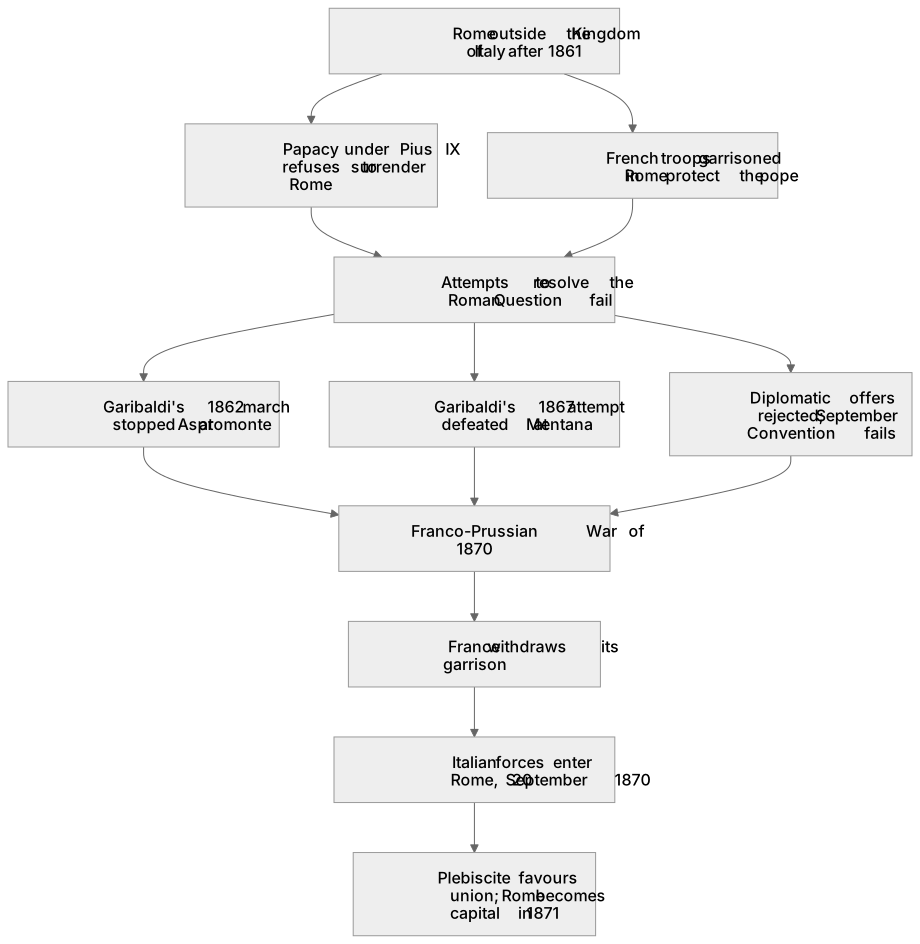
Put the events in order
Put these events in the order they happened, earliest first.
- 1. Syllabus of Errors issued and September Convention negotiated
- 2. Garibaldi's march halted by Italian royal troops at Aspromonte
- 3. Rome became Italy's capital
- 4. Garibaldi's campaign defeated by French and papal forces at Mentana
- 5. Italian forces entered Rome after French defeat at Sedan
Key words
Say what each word means before you turn the card.
Roman Question
Try answering aloud or in your head before turning the card.
Franco-Prussian War
Try answering aloud or in your head before turning the card.
Aspromonte
Try answering aloud or in your head before turning the card.
Mentana
Try answering aloud or in your head before turning the card.
See every definition
- Roman Question
- The problem that Rome remained outside the new Kingdom of Italy after 1861, with the papacy opposing incorporation and French troops protecting Rome.
- Franco-Prussian War
- The conflict of 1870 that forced France to withdraw its garrison from Rome, removing the main military obstacle to Italian occupation.
- Aspromonte
- The place where Garibaldi's 1862 march was stopped by Italian royal troops.
- Mentana
- The place where Garibaldi's 1867 attempt ended, defeated by French and papal forces.
Label the diagram
Some boxes have lost their names. Pick the right name for each number.
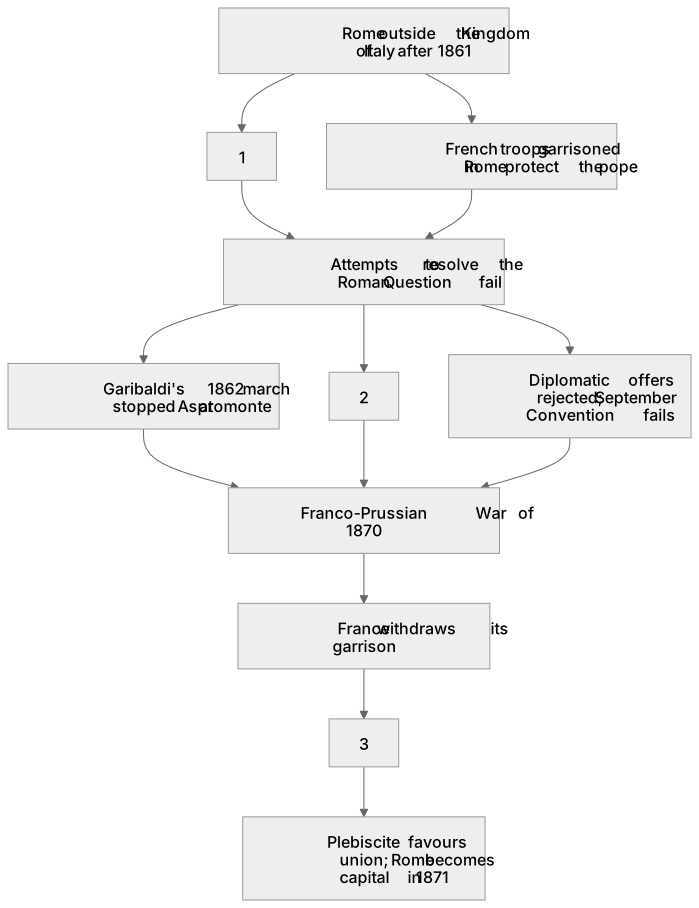
1Box 1
2Box 2
3Box 3
There is more to this lesson
The full lesson goes on to check your understanding and help you earn the marks. Create a free account to carry on, with your progress saved.
A week of Premium from your first lesson · Then the free plan continues · No card, no charge
Test your understanding of Paper 2, Option 2D.1: The unification of Italy, c1830–70 - 4 Consolidating the Kingdom of Italy, 1861–70: Solving the problem of Rome, 1861–70: the papacy and French occupation; the failure of Garibaldi and diplomacy, 1862–67; the impact of the Franco-Prussian war; the Italian takeover of Rome.
Active recall beats re-reading. Take an instant quiz now to test what you’ve learned and lock it into long-term memory.
A week of Premium from your first lesson · Then the free plan continues · No card, no charge