Pearson Edexcel · A-Level · History
Course version: 9HI0 · Version from Sept 2015
The unification of Germany, c1840–71 - 4 Prussia and the Klein-…
Full specification wording
Paper 2, Option 2D.2: The unification of Germany, c1840–71 - 4 Prussia and the Klein- deutschland solution, 1866–71: Prussia’s role in Germany, 1866–67; the Treaty of Prague; the annexation of north German states; the North German Confederation; Prussia’s relationship with south German states; creation of the Zollparlament; Bismarck and the National Liberals.
After the 1866 Austro-Prussian War, Prussia became the dominant German power.
Checked against the Pearson Edexcel 9HI0 specification (opens in a new tab) on .
- Point 1 of 4
- 4 key terms
Study notes
From the checked teaching notes for this specification point.
The idea
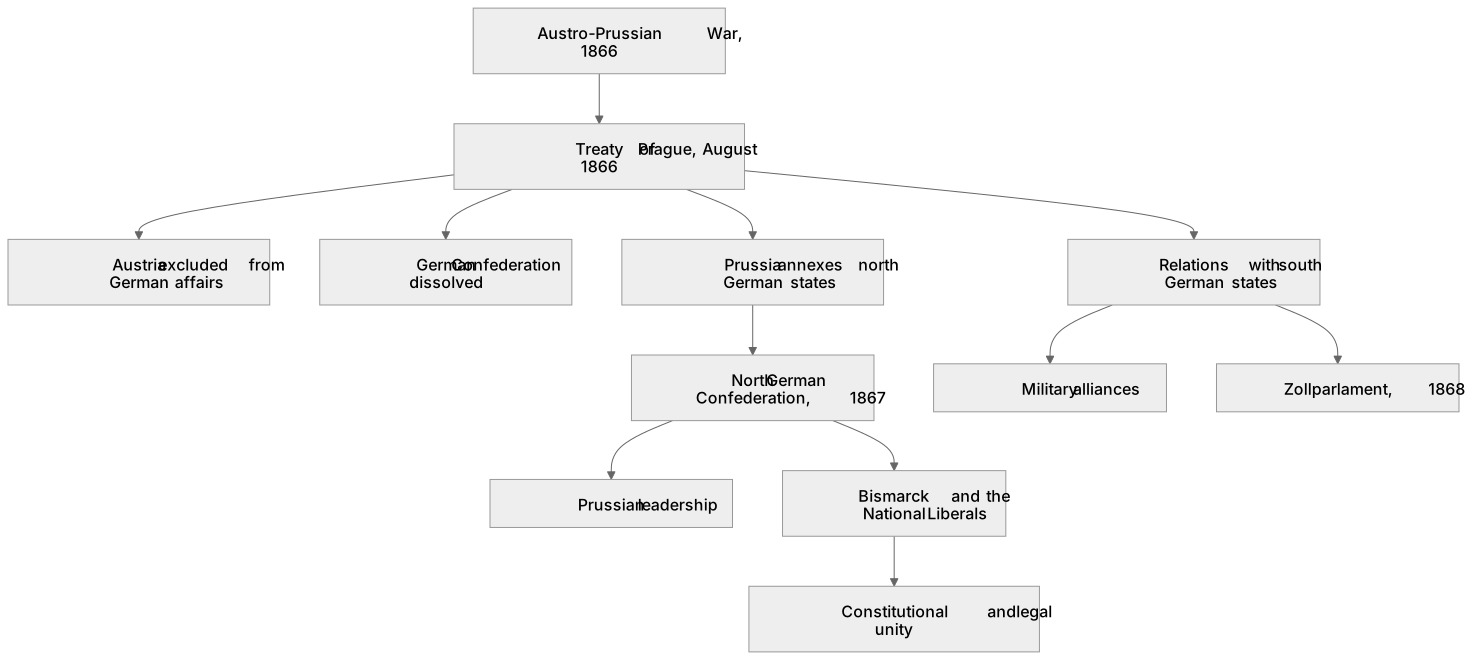
After the 1866 Austro-Prussian War, Prussia became the dominant German power. The Treaty of Prague (August 1866) excluded Austria from German affairs, dissolved the German Confederation, and allowed Prussia to annex several north German states. Prussia then formed the North German Confederation (1867), a federal state under Prussian leadership. Relations with south German states were managed through military alliances and the Zollparlament (1868), which brought them into economic cooperation. Bismarck worked with the National Liberals to secure constitutional and legal unity, using their support to pass key legislation. This period established the Kleindeutschland solution, excluding Austria, and set the stage for further unification.
What earns the marks
- Explains how the Treaty of Prague (1866) excluded Austria from German affairs and dissolved the German Confederation, enabling Prussian dominance.
- Describes the annexation of north German states such as Hanover, Hesse-Kassel, Nassau, and Schleswig-Holstein, and their incorporation into Prussia.
- Outlines the creation of the North German Confederation (1867) under Prussian leadership, with a constitution designed by Bismarck.
- Analyses Prussia’s relationship with south German states, including military alliances and the Zollparlament, and how Bismarck managed these ties.
- Assesses Bismarck’s collaboration with the National Liberals to achieve legal and economic unity, and the significance of this for unification.
Common mistakes and how to put them right
Stating that the Treaty of Prague annexed south German states.
Put it right: The treaty excluded Austria and allowed Prussia to annex only certain north German states; south German states remained independent but allied.
Claiming the North German Confederation included south German states.
Put it right: It was a north German federal state; south German states were linked by treaties and the Zollparlament but not members.
Describing the Zollparlament as a fully sovereign parliament.
Put it right: It was an economic parliament with limited powers, not a government for all Germany.
Exam tips
- Use specific dates and terms (e.g., Treaty of Prague, North German Confederation, Zollparlament) to show precise knowledge.
- Link each development to the broader question of how Prussia achieved dominance and how it affected south German states.
- When discussing Bismarck and the National Liberals, explain their mutual interests and the limits of their cooperation.
Try the lesson
The start of the Paper 2, Option 2D.2: The unification of Germany, c1840–71 - 4 Prussia and the Klein- deutschland solution, 1866–71: Prussia’s role in Germany, 1866–67; the Treaty of Prague; the annexation of north German states; the North German Confederation; Prussia’s relationship with south German states; creation of the Zollparlament; Bismarck and the National Liberals. lesson, made from checked teaching notes for this specification point.
Have a go first
Which of the following states was directly annexed by Prussia following the Austro-Prussian War of 1866?
Listen
After the 1866 Austro-Prussian War, Prussia became the dominant German power. The Treaty of Prague (August 1866) excluded Austria from German affairs, dissolved the German Confederation, and allowed Prussia to annex several north German states. Prussia then formed the North German Confederation (1867), a federal state under Prussian leadership. Relations with south German states were managed through military alliances and the Zollparlament (1868), which brought them into economic cooperation. Bismarck worked with the National Liberals to secure constitutional and legal unity, using their support to pass key legislation. This period established the Kleindeutschland solution, excluding Austria, and set the stage for further unification. A strong answer earns marks for these points. Explains how the Treaty of Prague (1866) excluded Austria from German affairs and dissolved the German Confederation, enabling Prussian dominance. Describes the annexation of north German states such as Hanover, Hesse-Kassel, Nassau, and Schleswig-Holstein, and their incorporation into Prussia. Outlines the creation of the North German Confederation (1867) under Prussian leadership, with a constitution designed by Bismarck. Analyses Prussia’s relationship with south German states, including military alliances and the Zollparlament, and how Bismarck managed these ties. A common slip: stating that the Treaty of Prague annexed south German states. Instead, the treaty excluded Austria and allowed Prussia to annex only certain north German states; south German states remained independent but allied. Exam tip: Use specific dates and terms (e.g., Treaty of Prague, North German Confederation, Zollparlament) to show precise knowledge.
See it
Put the events in order
Put these events in the order they happened, earliest first.
- 1. Treaty of Prague excluded Austria and dissolved the German Confederation
- 2. Establishment of the Zollparlament for economic cooperation with south German states
- 3. Creation of the North German Confederation under Prussian leadership
Key words
Say what each word means before you turn the card.
Treaty of Prague
Try answering aloud or in your head before turning the card.
North German Confederation
Try answering aloud or in your head before turning the card.
Zollparlament
Try answering aloud or in your head before turning the card.
Kleindeutschland solution
Try answering aloud or in your head before turning the card.
See every definition
- Treaty of Prague
- The August 1866 agreement that excluded Austria from German affairs, dissolved the German Confederation, and allowed Prussia to annex several north German states.
- North German Confederation
- A federal state formed in 1867 under Prussian leadership, with a constitution designed by Bismarck.
- Zollparlament
- An economic parliament created in 1868 with limited powers, bringing the south German states into economic cooperation with Prussia.
- Kleindeutschland solution
- The solution established in this period that excluded Austria and set the stage for further unification.
Label the diagram
Some boxes have lost their names. Pick the right name for each number.
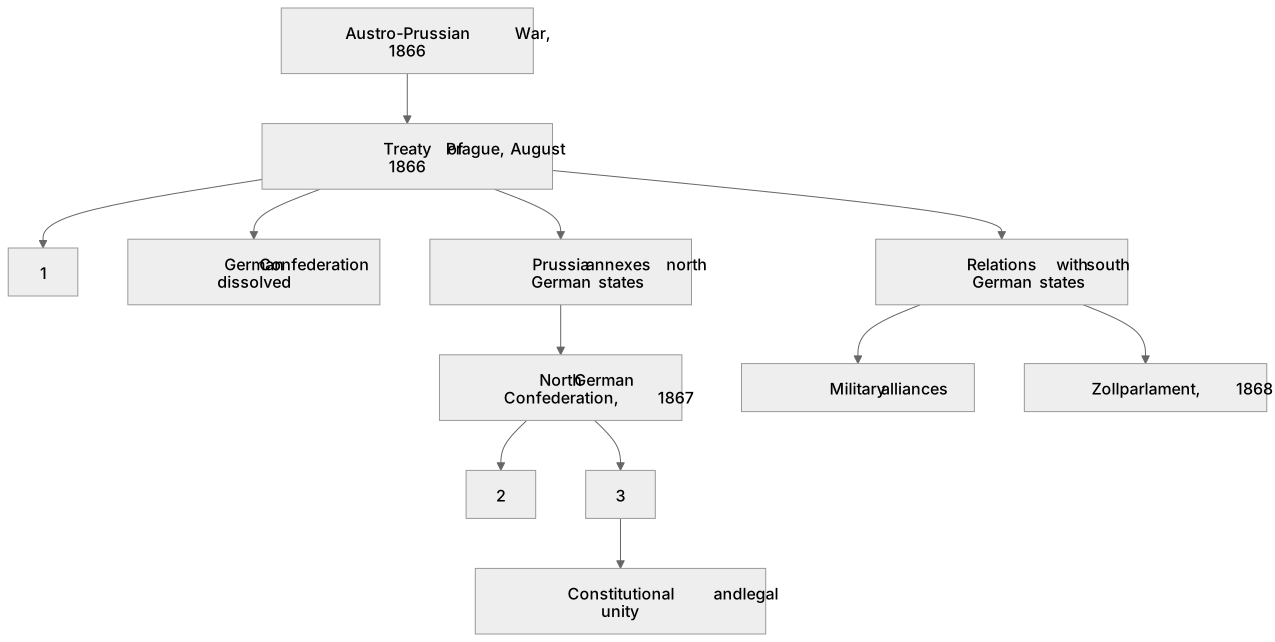
1Box 1
2Box 2
3Box 3
There is more to this lesson
The full lesson goes on to check your understanding and help you earn the marks. Create a free account to carry on, with your progress saved.
A week of Premium from your first lesson · Then the free plan continues · No card, no charge
Test your understanding of Paper 2, Option 2D.2: The unification of Germany, c1840–71 - 4 Prussia and the Klein- deutschland solution, 1866–71: Prussia’s role in Germany, 1866–67; the Treaty of Prague; the annexation of north German states; the North German Confederation; Prussia’s relationship with south German states; creation of the Zollparlament; Bismarck and the National Liberals.
Active recall beats re-reading. Take an instant quiz now to test what you’ve learned and lock it into long-term memory.
A week of Premium from your first lesson · Then the free plan continues · No card, no charge