Pearson Edexcel · A-Level · History
Course version: 9HI0 · Version from Sept 2015
The unification of Germany, c1840–71 - 4 Prussia and the Klein-…
Full specification wording
Paper 2, Option 2D.2: The unification of Germany, c1840–71 - 4 Prussia and the Klein- deutschland solution, 1866–71: Prussia’s relations with France, 1866–70: Napoleon III and Bismarck; significance of the Luxemburg Crisis, the Hohenzollern candidature and the Ems Telegram; outbreak of war; significance of the international situation 1870.
After 1866, Franco-Prussian tensions grew.
Checked against the Pearson Edexcel 9HI0 specification (opens in a new tab) on .
- Point 2 of 4
- 4 key terms
Study notes
From the checked teaching notes for this specification point.
The idea
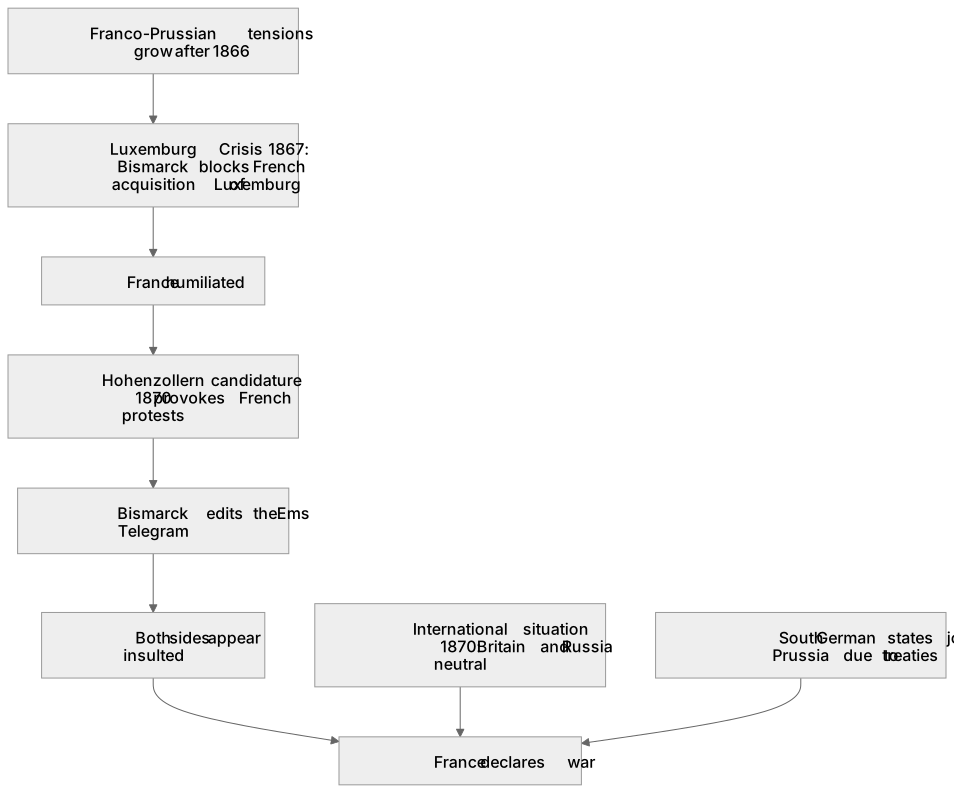
After 1866, Franco-Prussian tensions grew. Napoleon III feared a powerful Prussia and sought compensation for French neutrality. The Luxemburg Crisis (1867) saw Bismarck block French acquisition of Luxemburg, humiliating France. In 1870, the Hohenzollern candidature for the Spanish throne provoked French protests; Bismarck’s editing of the Ems Telegram made it appear that both sides had been insulted, leading France to declare war. The international situation favoured Prussia: Britain and Russia remained neutral, and south German states joined Prussia due to treaties. The war led to the defeat of France and the creation of the German Empire in 1871.
What earns the marks
- Explains the deterioration of Franco-Prussian relations after 1866, including Napoleon III’s fears and Bismarck’s aims.
- Describes the Luxemburg Crisis (1867) and its significance in heightening tensions and humiliating France.
- Analyses the Hohenzollern candidature (1870) and how Bismarck used it to provoke France.
- Explains the Ems Telegram and how Bismarck’s editing made war more likely.
- Assesses the international situation in 1870, including the neutrality of other powers and the role of south German states, leading to the outbreak of war.
Common mistakes and how to put them right
Stating that the Ems Telegram was a declaration of war.
Put it right: It was a diplomatic dispatch edited by Bismarck to provoke France; France declared war.
Claiming that Britain supported France in 1870.
Put it right: Britain remained neutral, as did Russia, which favoured Prussia.
Saying the Luxemburg Crisis led directly to war.
Put it right: It was a diplomatic defeat for France but war came later over the Hohenzollern candidature.
Exam tips
- Use precise dates and names (e.g., Luxemburg Crisis 1867, Ems Telegram 1870) to demonstrate detailed knowledge.
- Explain the significance of each event in escalating tensions, rather than just describing them.
- Link the international situation to the outbreak of war, showing how Prussia isolated France.
Try the lesson
The start of the Paper 2, Option 2D.2: The unification of Germany, c1840–71 - 4 Prussia and the Klein- deutschland solution, 1866–71: Prussia’s relations with France, 1866–70: Napoleon III and Bismarck; significance of the Luxemburg Crisis, the Hohenzollern candidature and the Ems Telegram; outbreak of war; significance of the international situation 1870. lesson, made from checked teaching notes for this specification point.
Have a go first
Which crisis in 1867 arose from Napoleon III's attempt to purchase a neutral duchy from the King of the Netherlands?
Listen
After 1866, Franco-Prussian tensions grew. Napoleon III feared a powerful Prussia and sought compensation for French neutrality. The Luxemburg Crisis (1867) saw Bismarck block French acquisition of Luxemburg, humiliating France. In 1870, the Hohenzollern candidature for the Spanish throne provoked French protests; Bismarck’s editing of the Ems Telegram made it appear that both sides had been insulted, leading France to declare war. The international situation favoured Prussia: Britain and Russia remained neutral, and south German states joined Prussia due to treaties. The war led to the defeat of France and the creation of the German Empire in 1871. A strong answer earns marks for these points. Explains the deterioration of Franco-Prussian relations after 1866, including Napoleon III’s fears and Bismarck’s aims. Describes the Luxemburg Crisis (1867) and its significance in heightening tensions and humiliating France. Analyses the Hohenzollern candidature (1870) and how Bismarck used it to provoke France. Explains the Ems Telegram and how Bismarck’s editing made war more likely. A common slip: stating that the Ems Telegram was a declaration of war. Instead, it was a diplomatic dispatch edited by Bismarck to provoke France; France declared war. Exam tip: Use precise dates and names (e.g., Luxemburg Crisis 1867, Ems Telegram 1870) to demonstrate detailed knowledge.
See it
Put the events in order
Put these events in the order they happened, earliest first.
- 1. Luxemburg Crisis humiliates France as Bismarck blocks its acquisition
- 2. Creation of the German Empire after the defeat of France
- 3. Hohenzollern candidature for the Spanish throne provokes French protests
Key words
Say what each word means before you turn the card.
Franco-Prussian rivalry and diplomacy
Try answering aloud or in your head before turning the card.
Bismarck’s manipulation of events to provoke war
Try answering aloud or in your head before turning the card.
The role of international powers in the conflict
Try answering aloud or in your head before turning the card.
Nationalism and the unification of Germany
Try answering aloud or in your head before turning the card.
See every definition
- Franco-Prussian rivalry and diplomacy
- Tensions grew after 1866 as Napoleon III feared a powerful Prussia and sought compensation for French neutrality, while Bismarck pursued his own aims.
- Bismarck’s manipulation of events to provoke war
- Bismarck used the Hohenzollern candidature and his editing of the Ems Telegram to make it appear both sides had been insulted, leading France to declare war.
- The role of international powers in the conflict
- The international situation favoured Prussia, as Britain and Russia remained neutral and south German states joined Prussia due to treaties.
- Nationalism and the unification of Germany
- The war led to the defeat of France and the creation of the German Empire in 1871.
Label the diagram
Some boxes have lost their names. Pick the right name for each number.
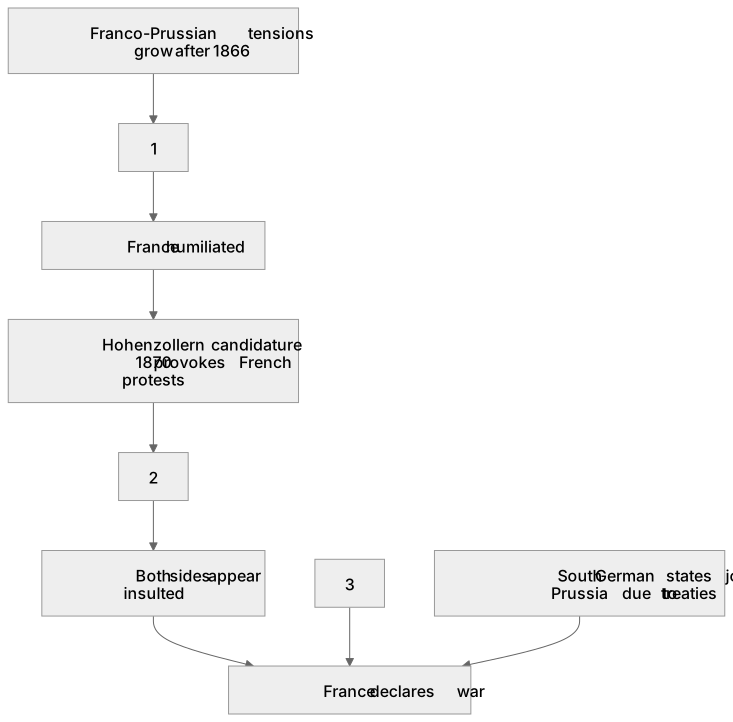
1Box 1
2Box 2
3Box 3
There is more to this lesson
The full lesson goes on to check your understanding and help you earn the marks. Create a free account to carry on, with your progress saved.
A week of Premium from your first lesson · Then the free plan continues · No card, no charge
Test your understanding of Paper 2, Option 2D.2: The unification of Germany, c1840–71 - 4 Prussia and the Klein- deutschland solution, 1866–71: Prussia’s relations with France, 1866–70: Napoleon III and Bismarck; significance of the Luxemburg Crisis, the Hohenzollern candidature and the Ems Telegram; outbreak of war; significance of the international situation 1870.
Active recall beats re-reading. Take an instant quiz now to test what you’ve learned and lock it into long-term memory.
A week of Premium from your first lesson · Then the free plan continues · No card, no charge